Pujara, Rahane score fifties as India reach 188 for 6 at lunch, lead is now 161 runs
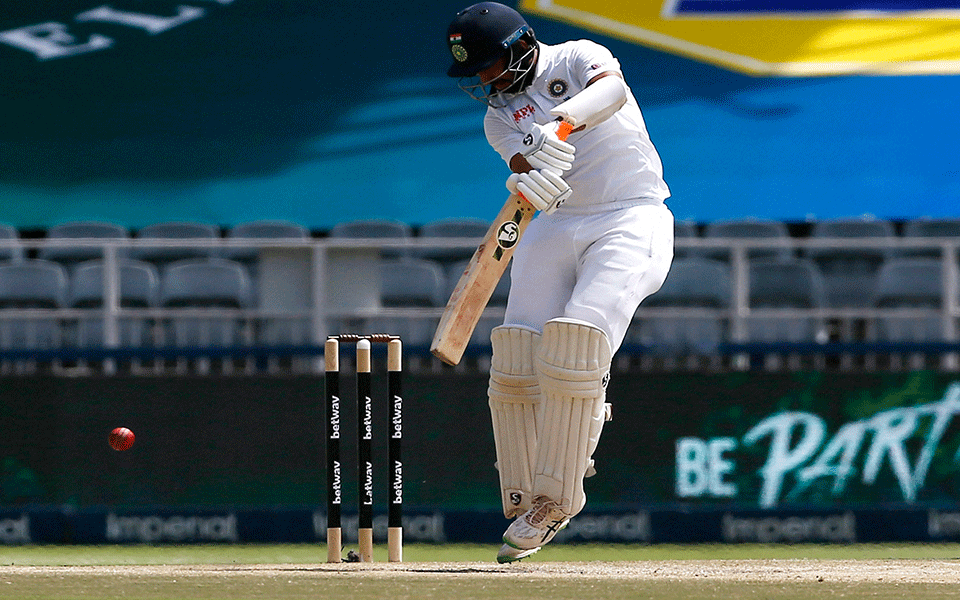
Johannesburg(PTI): Under-fire senior batters Cheteshwar Pujara and Ajinkya Rahane added a lifeline to their respective careers with crucial half-centuries but South Africa came back strongly in the second Test by reducing India to 188 for six at lunch on the third day, here.
Kagiso Rabada (14-3-54-3) breathed fire in the final 45 minutes while Duanne Olivier (11-1-43-1) and Lungi Ngidi (8-2-34-1) also hit the right lengths to get four quick wickets.
India now lead by 161 runs and South Africa would aim to polish off the lower order to set themselves a gettable target since anything in the vicinity of 200 would be difficult to achieve at the Bull Ring.
The match now hangs in balance again after Rishabh Pant's indiscreet shot put India in a spot after Pujara (53 off 86 balls) and Rahane (58 off 78 balls) in a rarely seen counter-attacking mode added 111 runs in just 23.2 overs.
Having understood that time is indeed running out for them, both the batters decided not to try and hang around as they looked for scoring opportunities. The half volleys were driven imperiously and the width was dispatched disdainfully square off the wicket.
When Marco Jansen bowled one short, Rahane uncorked the slash over point for a six. Pujara's 50 came off 62 balls while Rahane's half-century was completed in 67, signalling that they were trying to show 'intent' and put team's interest above everything else.
They hit 18 fours and a six between them.
There was a time when India were 155 for two with a lead of 128 and it seemed that South Africa's propensity to bowl too short or too full was proving to be damaging.
But then Rabada, South Africa's best exponent of fast bowling since Dale Steyn, produced a piece of inspiration that is so synonymous with traditional format.
Rabada found that ideal back of length where there is a crack and it landed there to deviate sharply, taking Rahane's edge into keeper Kyle Verreynne's gloves.
Pujara then got one from Olivier in the off-stump channel to be plumb despite lunging far forward.
However, the man who disappointed one and all was Pant, who first got a snorter from Rabada that hit his helmet viser when he tried to defend awkwardly and then he charged like a raging bull trying to convert a short ball into half volley. The result was an edge to keeper.
The legendary Sunil Gavaskar called it "irresponsible batting and said that no excuse and nonsense of playing natural game" can be provided when people like Rahane and Pujara were "taking blows" for the team.
Let the Truth be known. If you read VB and like VB, please be a VB Supporter and Help us deliver the Truth to one and all.
Tribal man brings dead sister's skeleton to bank to withdraw money from her account
Keonjhar (PTI): A tribal man in Odisha's Keonjhar district on Monday brought the skeleton of his dead sister to a bank to withdraw the money deposited in her name, police said.
The incident occurred at Maliposi branch of Odisha Grameen Bank located at Patana block of Keonjhar district. The man was identified as Jeetu Munda (50) of Dianali village. He was seeking to withdraw Rs 20,000 from the bank account of his elder sister, Kalra Munda (56), who died on January 26, 2026.
"I have run several times to the bank, and the people there told me to bring the account holder to withdraw money deposited in her name. Though I told them that she had died, they did not listen to me and insisted on bringing her to the bank. Therefore, out of frustration, I dug the grave and brought out her skeleton as proof of her death," an illiterate Jeetu Munda told reporters.
Patana Police Station Inspector in charge (IIC) Kiran Prasad Sahu, who reached the bank after getting information, said, "Jeetu is an illiterate tribal man. He does not know what the legal heir or nominee is. The bank officials have failed to make him understand the procedure to withdraw money from the dead person's account."
However, after the incident, the police assured Jeetu Munda that they would facilitate the withdrawal of money from the bank account of his dead sister. Later, the skeleton was again buried at the graveyard in presence of police.
Meanwhile, local Block Development Officer (BDO) Manas Dandpat said that he was not approached by anyone for the legal heir of late Kalra Munda. "Today only, I came to know about it. We will see what can be done to resolve the issue," the BDO said.
Meanwhile, bank sources said that the nominee in Kalra Munda's bank account was also dead. Therefore, Jeetu Munda was the lone claimant over the money deposited in her name.
The local administration has directed the bank officers to make arrangements and ensure that Jeetu Munda, who is the only claimant as per the rules, gets the money as soon as possible.