Dhawan's solidity, middle-order bravery take PBKS to 176 for six over RCB

Bengaluru, Mar 25: The pragmatism of captain Shikhar Dhawan was the bedrock on which Punjab Kings built their 176 for six as Royal Challengers Bangalore bowlers found their bearings on a Chinnaswamy Stadium pitch that offered them springboard bounce here on Monday.
Dhawan (45, 37b), Jitesh Sharma (27, 20b) and Prabhsimran Singh (25, 17b) were the main contributors for the Kings after Royal Challengers opted to bowl first on a track that had a smattering of green.
For RCB, Mohammed Siraj and Glenn Maxwell took wickets apiece.
The Kings made a shaky beginning as Jonny Bairstow got out early as his outings on these shores, which is stretched back to last year's World Cup, has now become more barren than the Indian summer.
In the latest instance, the Englishman's poorly-executed close-to-the-body pull of pacer Siraj was taken by Virat Kohli inside the covers.
But from 17 for one, the visitors found some runs through Dhawan and Prabhsimran who tackled the pitch and the RCB bowlers with aplomb, milking 55 runs off 38 balls.
Dhawan was not precisely smooth during his stay but showed enough pluck to cash in on the loose deliveries, such as a length ball on the off-stump from left-arm spinner Mayank Dagar which he lofted over long-on for a six.
In fact, the RCB bowlers, especially impressive left-arm seamer Yash Dayal (1/23), did well to tie him down with deliveries that darted in to him from just short of good length.
Prabhsimran also occasionally vented his aggressive instincts, and the most telling piece was his flicked six off Cameron Green that sailed 90 meters over mid-wicket for a maximum.
But just as the alliance was blossoming, Prabhsimran tried to pull Maxwell but a feeble top edge was easily grabbed by stumper Anuj Rawat.
Rawat soon doubled the number of his catches when he latched on to a wild heave outside the off-stump by Liam Livingstone off Alzarri Joseph in the last ball of the 12th over.
But the Punjab side suffered a heavier blow as Dhawan got in the very next ball.
The left-hander's attempt to hoist Maxwell out of the ground ended in the hands of Kohli at long-on as the Kings slipped to 98 for four in 12.1 overs.
It wasn't an ideal situation for Kings as they needed a few more runs on the board to give a meaningful challenge to the home side.
They found those from Jitesh, who hammered Dagar for two sixes in a row, and Sam Curran, who added 52 runs for the fifth wicket off 34 balls to push the PBKS past the 150-run mark, that was swelled by a couple of beefy hits by Shashank Singh, who carted Joseph for 20 runs in the final over.
But they would have liked a heavier looking scoreboard in pursuance of their second successive victory.
Let the Truth be known. If you read VB and like VB, please be a VB Supporter and Help us deliver the Truth to one and all.
Bird flu: Karnataka completes 10-day H5N1 surveillance, containment operation
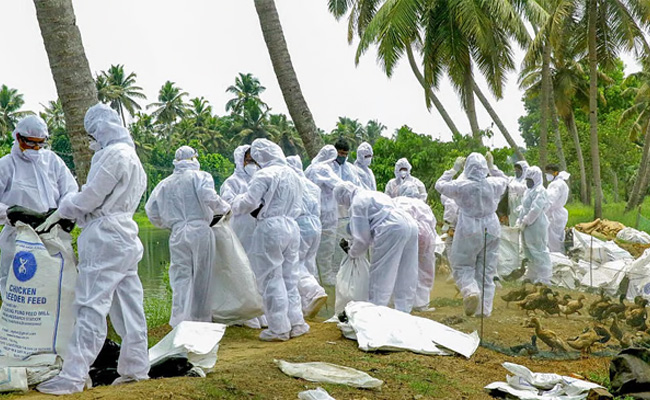
Bengaluru (PTI): The Karnataka government has successfully completed a 10-day intensive surveillance and containment operation following the detection of the H5N1 Avian Influenza outbreak here, officials said on Saturday.
The outbreak was reported in the State Poultry Rearing Training Centre in Mathkuru village, Hesaraghatta, on April 14, they said.
The surveillance was conducted by the Department of Health and Family Welfare of the state government in coordination with the Animal Husbandry and Veterinary Services Department, officials said.
According to an official statement, once the outbreak was confirmed, following laboratory reports from the National Institute of High Security Animal Diseases (NIHSAD-Bhopal), State and District Rapid Response Teams along with Hesaraghatta and Sonnenahalli PHC (Primary Health Centres) teams were immediately deployed.
An infected zone of 0-3 km and a surveillance zone of 3-10 km radius was established. The Department of Animal Husbandry and Veterinary Services, culled all the birds and safely disposed of eggs and of contaminated feed, adhering to national and international biosecurity protocols, it said.
The health department said the surveillance zone from the infective focus in the 10 km radius, a total population of 28,172 across 22 villages was surveyed from day 1 to day 10. Multiple rounds of surveillance were conducted and sanitation activities were completed as per protocol.
During the surveillance period, nasopharyngeal samples collected from all quarantined staff on Day 5, sent to NIV-Bengaluru, were found to be negative for H5N1, it said.
On day 10, nasopharyngeal samples were collected and the results are awaited. No human case of H5N1 infection has been detected in the infected or surveillance zones, the health officials said.
"All healthcare facilities in Bengaluru have been instructed to continue ILI/SARI (Influenza-Like Illness/Severe Acute Respiratory Infection) case surveillance, and ensure adequate stocks of PPE, triple-layer medical masks, oseltamivir, viral transport medium, and throat swab kits," it said.
The Department of Animal Husbandry and Veterinary Services issued a Sanitization Certificate on April 21, officials said.
"No poultry activity will be undertaken for a period of 90 days as a precautionary measure. During the three months of surveillance, the entire area of the farm will be repeatedly disinfected by fumigation (indoors) or sprays (open place) every 15 days," it further stated.
The public has been advised to avoid handling or consuming meat or eggs from sick or dead poultry and report sightings of sick or dead birds promptly to local veterinary or health authorities.
Ensure poultry meat and eggs are thoroughly cooked before consumption, as proper cooking effectively inactivates the virus, they said.
"The public is advised to follow official health advisories and avoid spreading unverified information," the department added.