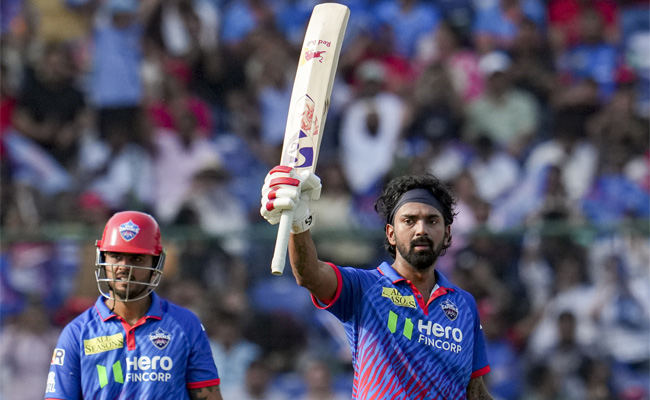
Quinton de Kock, Krunal Pandya power LSG to post 199/8 against PBKS in IPL
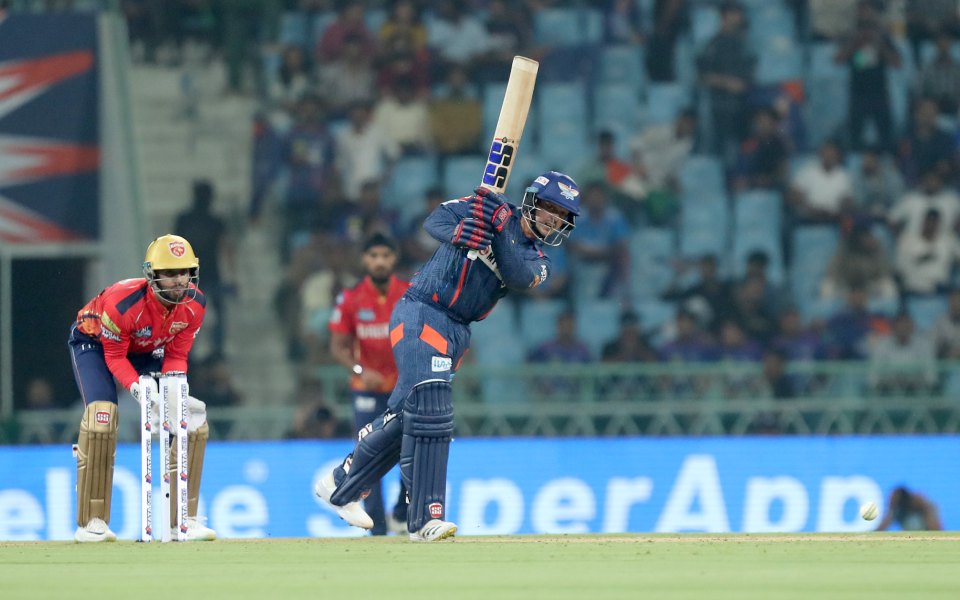
Lucknow, Mar 30: Floater Krunal Pandya's late blitz powered Lucknow Super Giants to a competitive 199/8 in their Indian Premier League match against Punjab Kings here on Saturday.
Asked to bat first, opener Quinton de Kock top-scored for LSG with a 38-ball 54 but it was stand-in skipper Nicholas Pooran's 21-ball 42, which infused life into his team's innings in the middle overs.
On the back of two sixes and four boundaries, Krunal then scored at a strike rate of 200 to finish on a 22-ball 43 and give his side extra cushion.
De Kock got the LSG innings underway with a splendid drive through mid-off for a boundary.
Playing the game as 'impact player' having handed over the leadership responsibility to Nicholas Pooran, KL Rahul didn't look convincing as he tried to flick Kagiso Rabada behind square on the leg-side.
Running in from a long way, a diving Harshal Patel made a valiant attempt to latch on to the ball but Rahul was lucky as the fielder could not pull off what would have been a blinder.
At the other end, De Kock was in his elements as he flayed Rabada over point for a four in the first delivery he faced from the South African speedster.
Next ball de Kock did one better, as he opened the face of the bat to whack Rabada over the backward point boundary for a six.
Rahul drove Arshdeep Singh down the ground for a maximum, and then, smashed another delivery in a similar fashion, but that fetched him a four.
Arshdeep, however, exacted his revenged when the left-arm seamer had the LSG batter caught by Jonny Bairstow at backward point for a nine-ball 15.
Devdutt Padikkal got himself two boundaries before being dismissed by Sam Curran.
Marcus Stoinis (19) hit two sixes before being bowled by Rahul Chahar as he looked to hoick the spinner on the on-side.
That brought Pooran into the middle and the West Indian quickly got into the groove, hitting Chahar for two sixes and a four for a 20-run over, which gave LSG's run rate a much-needed impetus.
Meanwhile, De Kock brought up his half century in 34 balls but a strategic timeout broke LSG's momentum as the left-handed South African batter top-edged a short Arshdeep delivery for wicketkeeper Jitesh Sharma to complete an easy catch.
Pooran kept the scoreboard moving at a good rate until he dragged a Rabada delivery onto the stumps, a big blow for LSG at a crucial juncture.
New man Krunal Pandya did not waste any time to settle down, brilliantly dispatching a short Rabada delivery over midwicket for a maximum.
Curran bowled a tight 17th over to halt LSG's charge, but Krunal got a flurry of boundaries to prop up LSG.
Let the Truth be known. If you read VB and like VB, please be a VB Supporter and Help us deliver the Truth to one and all.
BJP has become party of Bakasur, its hunger insatiable: Sanjay Raut on defection of AAP MPs
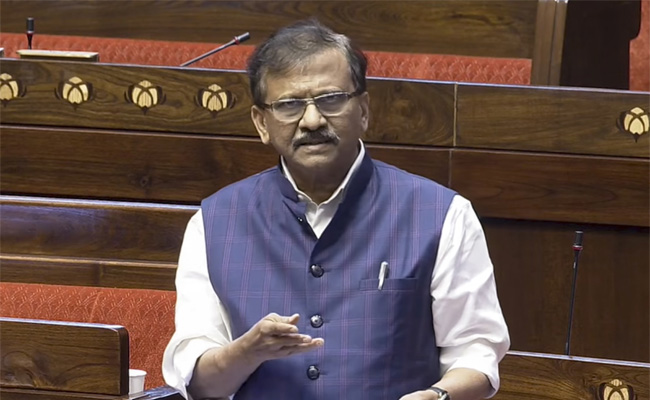
Mumbai (PTI): A day after seven Rajya Sabha MPs of the Aam Aadmi Party (AAP) quit and said they were merging with the BJP, Shiv Sena (UBT) leader Sanjay Raut on Saturday likened the saffron party to the mythological demon Bakasur with insatiable hunger.
Talking to reporters here, Raut said the majority of AAP MPs who switched their loyalties to the Bharatiya Janata Party were "Page 3 leaders", and claimed that they were scared as they were "wealthy and needed protection."
"Let the garbage from other parties go the BJP so that it becomes a dumping ground," Raut said.
The AAP suffered a jolt on Friday as seven out of its 10 Rajya Sabha members, including Raghav Chadha, Ashok Mittal and Sandeep Pathak, quit the party, with Chadha saying all of them had merged with the BJP.
"In Mahabharat, there is a demon called Bakasur whose hunger was insatiable. The BJP has become a party of Bakasur. It can eat anything," Raut said.
Chadha had once termed the BJP a party of goons, while Mittal's businesses faced raids soon after he was made deputy leader of the AAP in the Rajya Sabha (replacing Chadha), said Raut, himself a member of the Upper House of Parliament.
The Enforcement Directorate had last week conducted raids at business entities linked to Mittal in Punjab as part of a FEMA probe.
"Everyone knows about the BJP's politics. It is shamelessness," the Sena (UBT) leader said, adding that US President Donald Trump called India a hellhole and the BJP was showing what hell looks like.
He himself had written to then Vice President and Rajya Sabha chairman Venkaiah Naidu that there was pressure on him to join the BJP but he did not betray his party and preferred to go to jail, Raut said, referring to his arrest in an alleged money laundering case in 2022. He was released on bail in the case months later.
#WATCH | Mumbai | On Raghav Chadha, along with 2/3 AAP Rajya Sabha MPs joining BJP, Shiv Sena (UBT) leader Sanjay Raut says, "... Everyone knows the politics the BJP is playing. Their politics is a single word, we call it shameless. They have no shame. Because these people, like… pic.twitter.com/hJslDdLZDV
— ANI (@ANI) April 25, 2026