Quite excited to play India in a day game: Jonathan Trott
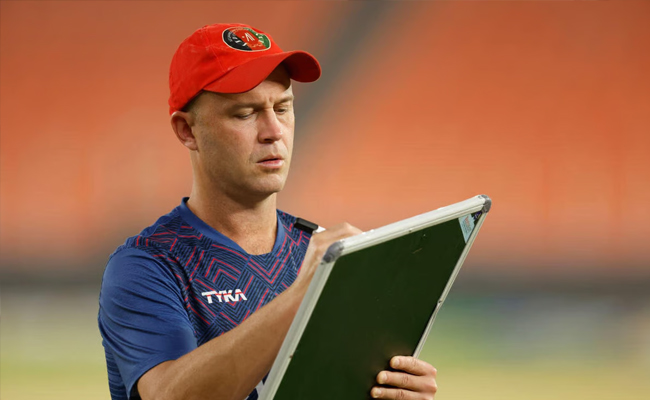
Bridgetown (PTI): Afghanistan head coach Jonathan Trott feels his team is a stronger unit in a day game and expects his sprightly bunch to optimise the conditions against a formidable India in their opening Super 8 fixture here on Thursday.
Afghanistan come into the Super 8s, high on confidence, having won three of their four league games including one against New Zealand. Their sole loss came against West Indies earlier this week.
“Day games actually suit us better. So, quite excited to play India in a day game. Obviously, they are one of the favourites and obviously that has added pressure for India," former England Test batter said.
He doesn't feel that Afghanistan can be dubbed as underdogs anymore.
"........and hopefully, we can come in obviously perceived as underdogs but in my mind very much not underdogs and fully prepared and ready for the battle that confronts us tomorrow which I'm very excited about,” Trott said on Wednesday.
Afghanistan, who were close to a semi-final berth in the ODI World Cup in India last year, are a stronger force in the shortest format. All big teams are wary of them and Trott sees that as a compliment to his unit.
“It's a compliment, but also earned as well. We've had, as you see in he IPL, we've got a lot of players playing a lot of T20 cricket around the world and now it's about putting that together as a side I think in the past we've had some good individual players, but we need all those players playing together as a side.”
Spinners have been Afghanistan’s strength traditionally but in this tournament, left-arm pacer Fazalhaq Farooqi has been their standout bowler and is currently sitting at the top of wicket takers’ charts.
“When you've got the spinners with the experience of T20 cricket, like we have, I think you would obviously say that's one of our strengths, but yet one of our seamers is a leading wicket-taker in the tournament. So, I think we've seen certainly over the last couple of years a more rounded side. So, if it swings and seams, we can take wickets, if it spins hopefully, we can take wickets as well.”
India and Afghanistan had played a thrilling double Super Over in Bengaluru earlier this year. Reminded of that game India narrowly won, Trott added: “What I take away from the match is we should have won it, in that super over. But also, what I take away, it shows how the gap is closing with regards to our side, the ability that our players have to be able to chase as well in T20 cricket.
“That was a fantastic chase in Bangalore and unfortunately, we didn't win. To have a second Super over, I'm not sure that's ever happened before.”
Let the Truth be known. If you read VB and like VB, please be a VB Supporter and Help us deliver the Truth to one and all.
NEET student hangs self in Rajasthan's Sikar

Jaipur (PTI): A student preparing for the NEET examination allegedly committed suicide by hanging himself in a rented room in Rajasthan's Sikar on Friday, police said.
According to the police, the student allegedly hanged himself from a ceiling fan using his sister's scarf while one sister was attending coaching classes and the other was in the bathroom.
He had appeared in the NEET UG exam 2026, which was cancelled due to paper leak, they said.
Udyog Nagar SHO Rajesh Kumar said that the deceased, identified as Pradeep Meghwal, was a resident of Kanika ki Dhani village in Jhunjhunu's Gudha Gaudji area.
He had been living in a rented room in Sikar's Jaldhari Nagar area with his two sisters while preparing for NEET over the last three years.
His elder sister later found him hanging and informed the landlord and police after bringing him down, officials said.
The SHO said the body was kept at SK Hospital mortuary, and a postmortem had not been conducted.
The student's father, Rajesh Kumar Meghwal, told police that Pradeep's NEET examination had gone well and the family was expecting him to score around 650 marks.
Former Rajasthan deputy chief minister Sachin Pilot expressed grief over the incident and linked it to anxiety among students after reports of irregularities and paper leaks in NEET 2026.
Pilot said repeated paper leak incidents and cancellation of examinations were affecting students' mental health and demanded a time-bound investigation and strict action against those responsible.