Rabada takes four as Punjab pacers limit LSG to 153/8
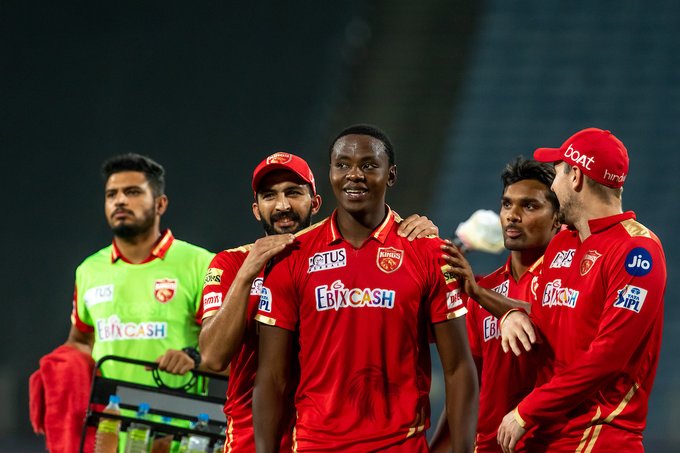
Pune, Apr 29: Kagiso Rabada struck four times as Punjab Kings upped their game in the bowling department to restrict Lucknow Super Giants to 153 for eight in the Indian Premier League here on Friday.
The second wicket stand of 85 runs between opener Quinton de Kock (46 off 37) and Deepak Hooda (34 off 28) was the lone bright spot of LSG's innings.
The pace trio of Rababda (4/38), Arshdeep Singh (0/23) and Sandeep Sharma (1/18) delivered in different ways, while leg spinner Rahul Chahar chipped in with a couple of wickets.
Punjab pacers were impressive in the powerplay after skipper Mayank Agarwal opted to bowl, limiting LSG to 39 with the crucial wicket of in-form K L Rahul (6).
While the ever improving Arshdeep and the seasoned Sandeep got the ball to swing, it was Rabada who got rid of the opposition skipper.
The South African speedster got one to straighten from good length proving it to be too good for Rahul, making it look like a proper Test match dismissal.
With the first four overs only fetching 16 runs, de Kock broke the shackles for LSG by smashing his fellow countryman Rabada for successive sixes, one a straight hit that landed on the boundary rope while the other maximum came via a massive hoick over midwicket.
Hooda, who struggled to rotate strike early on in his innings, got going with a straight six off Rishi Dhawan.
Sandeep was brilliant in his first spell conceding only eight runs in his three overs.
With LSG 67 for 1 in 10 overs, Punjab were very much in control of the game.
The 11th over of Liam Livingstone went for 15 runs and it seemed LSG were finally getting into the groove but the dismissals of set batters de Kock and Hooda increased their troubles.
De Kock was honest enough to walk back into the dressing room after getting a faint edge off Sandeep while Hooda paid the price for not being alert enough to get himself run out after a brilliant direct hit from the deep from Jonny Bairstow.
LSG's innings was going nowhere as they struggled to 109 for five in 15 overs.Cameos from Jason Holder (11 off 8), Dushmantha Chameera (17 off 10) and Mohsin Khan (13 not out off 6) allowed LSG to cross the 150-run mark.
Let the Truth be known. If you read VB and like VB, please be a VB Supporter and Help us deliver the Truth to one and all.
It's govt's responsibility to support youth who dare to dream: Omar Abdullah
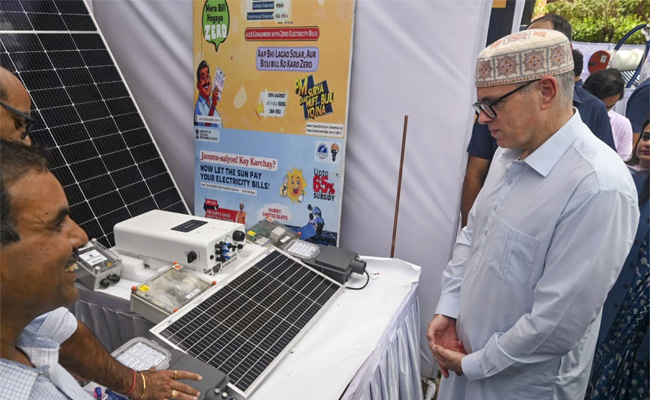
Jammu (PTI): Jammu and Kashmir Chief Minister Omar Abdullah on Monday said the government may not be able to provide jobs to everyone, but it can create an ecosystem for youngsters to become entrepreneurs and innovators.
It is the responsibility of the government to support youth who dare to dream, he said.
After inaugurating the 11th National Conference and Exhibition on Emerging and Innovative Trends in Engineering Technology (NCEEITET) at the Government College of Engineering and Technology (GCET) in Jammu, Abdullah said, “We may not be able to provide jobs to everyone, but we can certainly create an environment where our youngsters become entrepreneurs and innovators.”
The two-day conference is being organised by the GCET in collaboration with the Indian Institute of Technology-Kharagpur and the World University Consortium (WUC).
Addressing the gathering, Abdullah assured that all necessary steps would be taken to strengthen infrastructure and support systems at the GCET, ensuring that it continues to evolve as a premier institution.
The chief minister also inaugurated a new building for the School of Architecture in the college, built at Rs 19.71 crore.
Stressing the need to balance modernity with the region’s cultural and historical identity, Abdullah said, “Not every building needs to be made of glass and steel. Our structures must reflect our heritage and preserve our cultural ethos.”
Highlighting the role of emerging technologies such as artificial intelligence and machine learning, Abdullah said they could significantly improve tourism management, visitor experience and service delivery in Jammu and Kashmir.
However, he cautioned that technological advancement should complement human effort rather than replace jobs, especially in a region where unemployment remains a concern.
The chief minister said that attracting tourists to Jammu and Kashmir was not difficult, but ensuring repeat visits required consistently enriching experiences and better infrastructure across tourism segments, including pilgrimage, border and leisure tourism.
To address the infrastructure gaps in the college, Abdullah announced that funds would be provided this year for the construction of an auditorium.
He also assured support for setting up an incubation centre in GCET.
During the event, Abdullah also released the e-proceedings of the conference, comprising 28 shortlisted research papers.