Rahul, Kuldeep architect India's 8-wkt win in first T20I
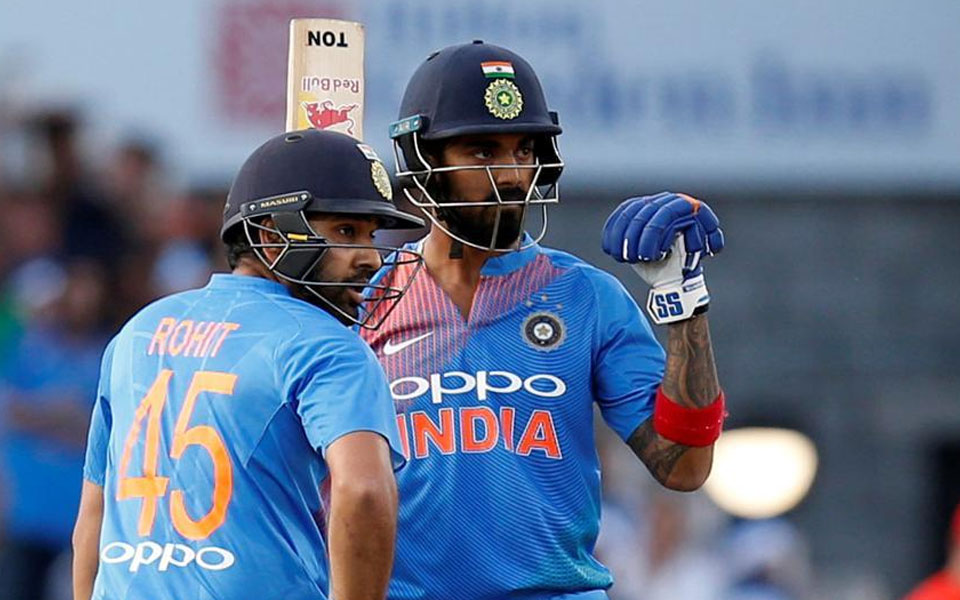
Manchester, July 4 : Riding on a flashy unbeaten century from Lokesh Rahul and chinaman Kuldeep Yadav's maiden T20 International fifer, India outclassed England by eight wickets in the opening match and go 1-0 up in the three-match rubber at the Old Trafford cricket stadium here on Tuesday.
Rahul struck a breezy 54-ball 101, laced with 10 fours and five sixes to anchor India's run chase that saw him forge a masterly 123-run second wicket stand with opener Rohit Sharma (32 off 30).
Chasing 160, India quickly overcame the early loss of opener Shikhar Dhawan (4) as the right-handed duo of Rahul and Rohit helped the visitors race to 50 in the first five overs.
Rahul continued his glorious run with the bat, dominating the partnership with Rohit, who uncharacteristically played the perfect second fiddle to the Karnataka youngster.
Rahul started the onslaught right from the word go before meting out some special treatment to off-spinner Moeen Ali, whom he welcomed with a superb reverse sweep that yielded a boundary and followed up with a massive six over long on.
The right-hander then picked the leg-spinner Adil Rashid for a boundary to third man to get to his half century off just 27 balls, before launching Liam Plunkett for two sixes and as many fours to milk 20 runs from the paceman .
With India comfortably placed at 103/1 midway through the innings, Rohit too stepped up the gas by launching Rashid for a towering six over mid wicket before falling to the same bowler.
Rohit's departure brought in skipper Virat Kohli (20 not out off 22 balls), who was seven shy of becoming the fourth batsman to notch 2000 T20I runs.
Kohli, not only got to the landmark but also ensured Rahul get to his deserving second T20I century with a single before the skipper finished off in style with a thunderous six off Ali to guide India home.
Earlier, England had themselves to blame for wasting a sound 50-run opening start from Jason Roy (30) and Jos Buttler (69) as Kuldeep (5/24) triggered a collapse that saw Alex Hales (8), Eoin Morgan (7), Jonny Bairstow (0) and Joe Root (0) departing in quick succession -- the latter three in a span of four deliveries.
Buttler, however continued tormenting the Indians with a 46-ball knock laced with eight fours and a couple of sixes before becoming Kuldeep's fifth victim, thanks to a brilliant catch by Kohli after Rahul dropped him one ball earlier.
Towards the end, lower order bat David Willey's unbeaten 29 off 15 balls helped England to some sort of respectability.
Brief Scores: England 159/8 (Jos Buttler 69, Jason Roy 30; Kuldeep Yadav 5/24) lose to India 163/2 (Lokesh Rahul 101 not out, Rohit Sharma 32, Virat Kohli 20 not out) by 8 wickets.
Let the Truth be known. If you read VB and like VB, please be a VB Supporter and Help us deliver the Truth to one and all.
World “being ravaged by handful of tyrants,” says Pope Leo days after spat with Trump
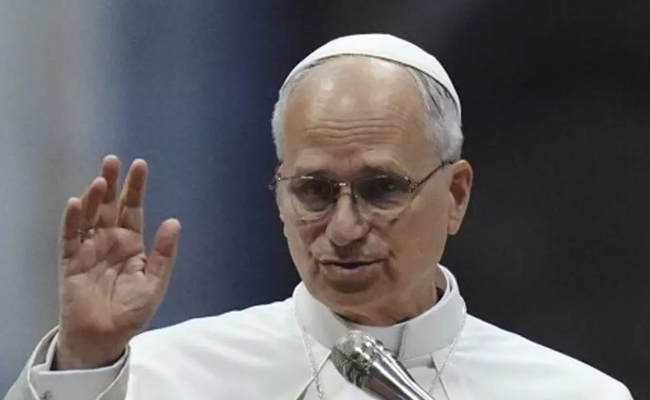
Vatican City: Pope Leo XIV has criticised global leaders stating that the world is “being ravaged by a handful of tyrants” during his visit to Cameroon, BBC reported.
His remarks came amid an ongoing spat with Donald Trump following a recent exchange of criticism.
During his visit to a region in the central African country affected by insurgency, the Pope spoke against leaders who, according to him, misuse religion for personal or political purposes.
He also criticised the large spending on wars, saying leaders “turn a blind eye to the fact that billions of dollars are spent on killing and devastation, yet the resources needed for healing, education and restoration are nowhere to be found”.
He further said, “the masters of war pretend not to know that it takes only a moment to destroy, yet often a lifetime is not enough to rebuild.”
Speaking in the north-western city of Bamenda, which has been affected by violence for nearly a decade, the Pope described the situation as “an endless cycle of destabilisation and death” in a “bloodstained” region.
Addressing people gathered at a cathedral, he said, “those who rob your land of its resources generally invest much of the profit in weapons, thus perpetuating an endless cycle of destabilisation and death.”
He also spoke about the need for peace, stating, “peace is not something we must invent: it is something we must embrace by accepting our neighbour as a brother and as our sister.”
The comments come days after a public disagreement between the Pope and Donald Trump. The Pope had earlier expressed concern over Trump’s warning that “a whole civilisation will die” if Iran did not accept US demands related to the war and the Strait of Hormuz.
Trump responded by criticising the Pope on social media, writing, “Leo should get his act together as Pope.”
In another post, he described the Pope as “weak on Crime and terrible for Foreign Policy,” while also sharing content portraying himself in a religious context. The now deleted post included Trump depicting himself as a Jesus-like figure. The post trigerred backlash.
He later continued his criticism and did not apologise.
Responding to questions about Trump’s remarks during his visit, the Pope said he had “no fear” of the US administration and would continue to speak against war. He also said earlier that he did not want to engage in a direct debate with Trump but would continue promoting peace.
The differences between the Pope and the US administration have also been visible in their positions on the conflict involving Iran, Israel and the United States.
During a Palm Sunday Mass at St Peter's Square, the Pope described the conflict as “atrocious” and said, “this is our God: Jesus, king of peace, who rejects war, whom no one can use to justify war.”
He added, “he does not listen to the prayers of those who wage war, but rejects them.” He also quoted a passage from the Bible, saying, “even though you make many prayers, I will not listen: your hands are full of blood.”
The Pope’s Africa tour includes visits to multiple cities across four countries and is his second major international trip since becoming Pope last year.