Rain forces abandonment of 2nd Women's T20I between India and South Africa
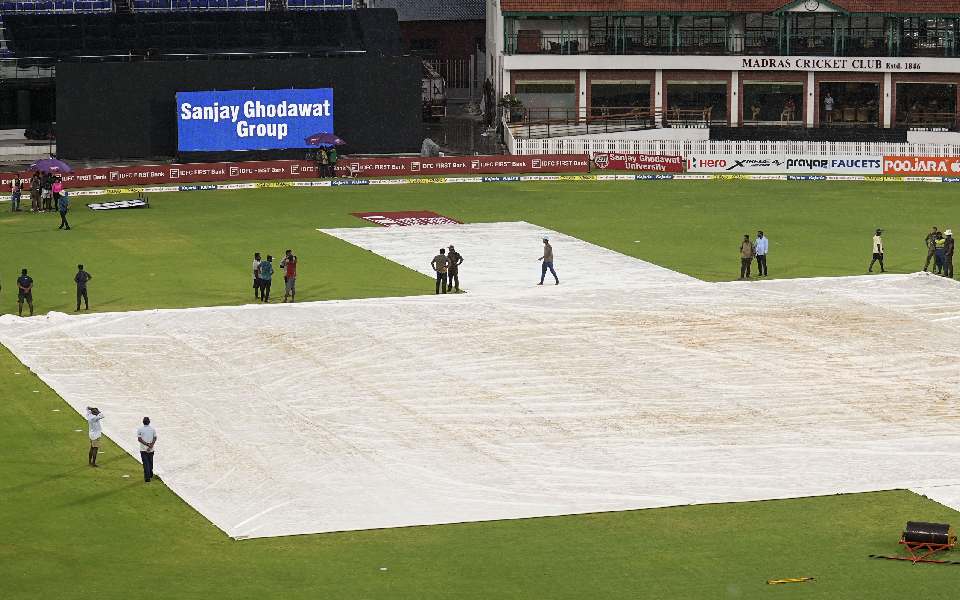
Chennai, Jul 7: Persistent rain forced the abandonment of the second women's T20 International between India and South Africa after the visitors made 177 for six in their innings here on Sunday.
It helped South Africa maintain their 1-0 lead in the three-match series, and now, India will have to win the third and final T20I here on Tuesday (July 9) to avoid a rare home series defeat.
The start of the match was delayed by 15 minutes because of rain and it was a constant spoilsport on three occasions during South Africa's innings without stopping the proceedings.
But the heavens opened up during the innings break, sufficient to force the teams to stay put in their respective dressing rooms.
The overs began to lose by 9.16 pm, and the nagging drizzle meant that even the cut-off time -- 10.13 pm -- for a five-over-a-side contest could not be met, eventually forcing the umpires to take the tough call.
Earlier, Tazmin Brits made a measured fifty as the Proteas overcame some mid-innings jitters to post a challenging 177 for six after being asked to bat first.
Brits (52 off 39 balls) received solid support from Anneke Bosch (40 off 32 balls) as the Proteas racked up their second-highest T20I total against India.
Openers Laura Wolvaardt (22 off 12 balls) and Brits were involved in a 42-run opening stand before pacer Pooja Vastrakar got rid of the former in the fifth over.
In the company of Marizanne Kapp (20 off 14 balls), Brits continued her brisk scoring ways as they put up 66 runs during the powerplay.
While Brits brought up her 11th T20I half-century, she failed to push her stand with Bosch going beyond 38, falling to Deepti in the 14th over, with the score reading 113 for three.
The Indian bowlers, especially the spinners, were barely giving the South Africans any room to bat freely, forcing them to use the sweep shots quite often.
Vastrakar bowled the final over and got rid of Nadine de Klerk (14 off 9 balls), but Jemimah Rodrigues dropped the chance to dismiss Annerie Dercksen (12 not out) for which she made the Indians pay, striking three fours in a row off the last three balls of SA innings.
Vastrakar and Deepti claimed two wickets each for the hosts.
Let the Truth be known. If you read VB and like VB, please be a VB Supporter and Help us deliver the Truth to one and all.
Chhattisgarh govt enforces austerity measures, restricts foreign travel and cuts convoy vehicles

Raipur (PTI): The Chhattisgarh government on Saturday rolled out a set of austerity measures, including restricted use of convoy vehicles for the chief minister, ministers and heads of state-run bodies, besides curbs on foreign travel at government expense.
The state has decided to implement the cost-saving steps with immediate effect to ensure efficient management of financial resources and discipline in public spending, said a directive issued by Finance Secretary Rohit Yadav.
The move follows Prime Minister Narendra Modi’s appeal for austerity amid the ongoing conflict in West Asia.
The order said that only essential vehicles should be used in the convoys of the CM, ministers and office-bearers of corporations, boards and commissions, while ensuring restrained use of other government resources.
It also directed departments to take steps for a phased conversion of all official vehicles into electric vehicles in order to promote the use of EVs.
As part of fuel-saving measures, expenditure on petrol and diesel for government vehicles should be kept to a minimum, the directive said.
Vehicle pooling arrangements should also be implemented for officials of departments travelling to the same destination, it added.
The order further stated that foreign travel of government employees at state expenses will be completely prohibited except under extremely unavoidable circumstances. In such cases, prior approval of the CM will be mandatory.
To reduce administrative expenditure, departments have been instructed to hold physical meetings preferably only once a month and encourage virtual and online meetings. Regular departmental review meetings should compulsorily be conducted through video conferencing, it said.
The government also stressed the need for energy conservation in its offices, directing that all electrical equipment, including lights, fans, air-conditioners and computers, must be switched off after office hours.
The directive will remain effective till September 30 this year.
Amid the war involving the US, Israel and Iran, Modi has suggested reducing petrol and diesel consumption, using metro rail services in cities, carpooling, increased use of EVs, utilising railway services for parcel movement and working from home to conserve foreign exchange.