Parag's magnificent 84 sets up RR's 12-run win over DC

Jaipur, Mar 28: Young Riyan Parag showed why he is considered a precocious talent as he struck a stunning 84 not out off 45 balls to set up a 12-run win for Rajasthan Royals against Delhi Capitals in their IPL match here on Thursday.
Sent in to bat, RR were reduced to 36 for 3 in the eighth over but the 22-year-old Parag single-handedly took the home side to 185 for 5 with a magnificent unbeaten knock studded with seven fours and six sixes.
Parag, who was promoted to number 4 by the team management this season and made 43 in the previous match, took 25 runs off veteran South African pacer Anrich Nortje with scores of 4, 4, 6, 4, 6, 1 in the final over to hit his highest T20 score.
Chasing 186 for a win, DC could only manage 173 for 5 in 20 overs though South African youngster Tristan Stubbs (44 not out off 23 balls) kept them in the hunt till the final over from which they needed 17 runs.
Avesh Khan conceded just four runs to help RR win their second consecutive match.
South African pacer Nandre Burger and Yuzvendra Chahal took two wickets apiece to also contribute in the RR win.
"Definitely disappointed. The best thing to do from here is to learn from it. The bowlers did well through the 15-16 overs. But the batters did well at the death, hopefully we do better in the next game," DC skipper Rishabh Pant said.
DC were reduced to 34 for 2 in the fourth over with Burger taking two wickets in three balls in a fine display of fast bowling.
Burger, who was brought in as Impact Sub for Shimron Hetmyer, dismissed opener Mitchell Marsh (23 off 12 balls) and Ricky Bhui (0) in the fourth over.
DC captain Rishabh Pant came out to bat at the fall of Bhui's wicket and along with senior batter David Warner built the innings without taking too much risk. Delhi were 89 for 2 at the halfway stage.
Warner was the more aggressive one as he got the boundaries to keep DC in the hunt. The senior Australian batter fell one run short of his fifty courtesy a brilliant diving catch by Sandeep Sharma off the bowling of Avesh in the 12th over.
Warner and Pant were involved in a crucial 67-run partnership for the third wicket.
Playing in his 100th IPL match and 14 months after a horrible car crash, Pant tried to build the innings with occasional boundaries. But he got out for a 26-ball 28 as Chahal induced a faint lower edge for Sanju Samson to do the rest behind the stumps in the 14th over.
The asking rate shot up to more than 13 runs an over and DC needed 66 from the last five overs.
Stubbs kept DC in the game with two consecutive sixes off Ravichandran Ashwin in the 17th over, but in the end the Delhi side were short by 12 runs.
They needed 34 runs from the final two overs which they could not get. It was DC's second consecutive loss.
Earlier, Parag shared 54 and 52 runs respectively with Ravichandran Ashwin (29) and Dhruv Jurel (20) after RR made a shaky start.
Royals captain Samson struck three consecutive boundaries in the fourth over bowled by pacer Mukesh Kumar before nicking a Khaleel Ahmed delivery two overs later to Pant to get out for 15.
RR were 30 for 2 by then as Mukesh had given DC their first breakthrough with the wicket of Yashasvi Jaiswal (5).
The Royals were in more trouble after wrist spinner Kuldeep Yadav literally forced his captain Pant to take a review, which later proved to be successful, to dismiss Englishman Jos Buttler for an LBW decision.
Ashwin came out to bat at number five and he lofted a Kuldeep delivery for a six to help RR reach 58 for 3 at halfway stage. He gave Nortje even a harsher treatment with two sixes in the next over that yielded 15 runs.
Ashwin, however, holed out to Tristan Stubbs near the boundary ropes for a 19-ball 29.
Parag then made his presence felt, striking two boundaries and a six off Ahmed to take RR past 100 in the 15th over.
Let the Truth be known. If you read VB and like VB, please be a VB Supporter and Help us deliver the Truth to one and all.
Bird flu: Karnataka completes 10-day H5N1 surveillance, containment operation
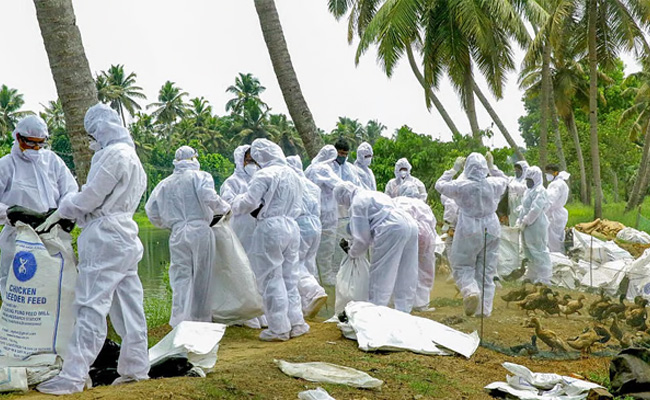
Bengaluru (PTI): The Karnataka government has successfully completed a 10-day intensive surveillance and containment operation following the detection of the H5N1 Avian Influenza outbreak here, officials said on Saturday.
The outbreak was reported in the State Poultry Rearing Training Centre in Mathkuru village, Hesaraghatta, on April 14, they said.
The surveillance was conducted by the Department of Health and Family Welfare of the state government in coordination with the Animal Husbandry and Veterinary Services Department, officials said.
According to an official statement, once the outbreak was confirmed, following laboratory reports from the National Institute of High Security Animal Diseases (NIHSAD-Bhopal), State and District Rapid Response Teams along with Hesaraghatta and Sonnenahalli PHC (Primary Health Centres) teams were immediately deployed.
An infected zone of 0-3 km and a surveillance zone of 3-10 km radius was established. The Department of Animal Husbandry and Veterinary Services, culled all the birds and safely disposed of eggs and of contaminated feed, adhering to national and international biosecurity protocols, it said.
The health department said the surveillance zone from the infective focus in the 10 km radius, a total population of 28,172 across 22 villages was surveyed from day 1 to day 10. Multiple rounds of surveillance were conducted and sanitation activities were completed as per protocol.
During the surveillance period, nasopharyngeal samples collected from all quarantined staff on Day 5, sent to NIV-Bengaluru, were found to be negative for H5N1, it said.
On day 10, nasopharyngeal samples were collected and the results are awaited. No human case of H5N1 infection has been detected in the infected or surveillance zones, the health officials said.
"All healthcare facilities in Bengaluru have been instructed to continue ILI/SARI (Influenza-Like Illness/Severe Acute Respiratory Infection) case surveillance, and ensure adequate stocks of PPE, triple-layer medical masks, oseltamivir, viral transport medium, and throat swab kits," it said.
The Department of Animal Husbandry and Veterinary Services issued a Sanitization Certificate on April 21, officials said.
"No poultry activity will be undertaken for a period of 90 days as a precautionary measure. During the three months of surveillance, the entire area of the farm will be repeatedly disinfected by fumigation (indoors) or sprays (open place) every 15 days," it further stated.
The public has been advised to avoid handling or consuming meat or eggs from sick or dead poultry and report sightings of sick or dead birds promptly to local veterinary or health authorities.
Ensure poultry meat and eggs are thoroughly cooked before consumption, as proper cooking effectively inactivates the virus, they said.
"The public is advised to follow official health advisories and avoid spreading unverified information," the department added.