Rayudu, Pandya power India to 252 after top-order collapse
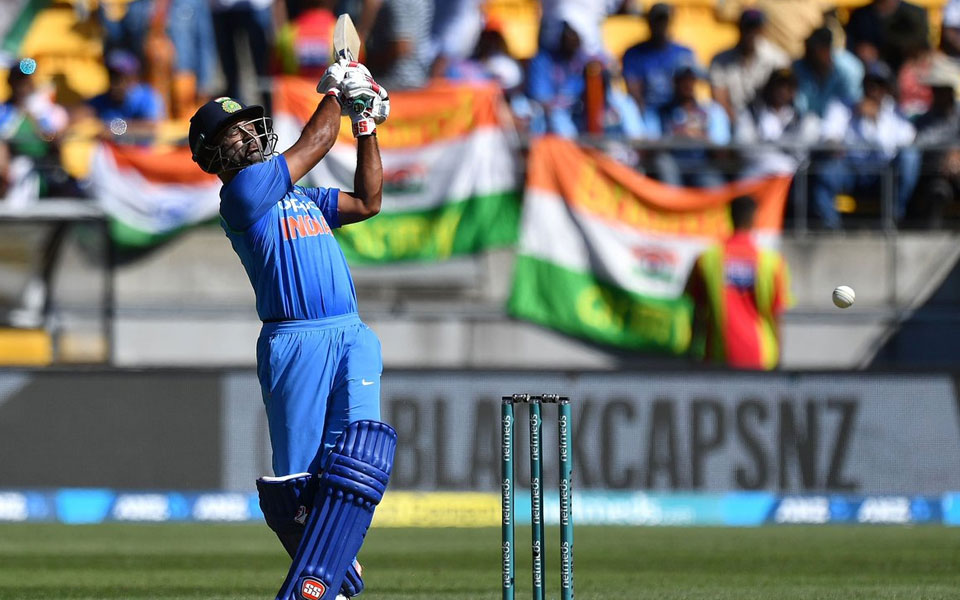
Wellington, Feb 3 : The Indian top-order struggled again in testing conditions before Ambati Rayudu and Hardik Pandya powered the visitors to a fighting 252 in the fifth and final ODI against New Zealand here on Sunday.
India's middle-order, which has been under scrutiny, delivered under pressure after the visitors were left gasping at 18 for four.
Rayudu (90 off 113) and Vijay Shankar (45 off 64) shared a 98-run stand for the fifth wicket to lead India's recovery before a spectacular cameo from Hardik Pandya (45 off 22) pushed India past 250.
Pacer Matt Henry was the standout bowler for the hosts, taking four wickets for 35 runs while Trent Boult picked up three for 39.
After a 'humiliating' loss in the fourth ODI in which India were shot out for 92, captain Rohit Sharma won the toss and took the challenge of batting first on a surface aiding the fast bowlers.
India made three changes in the playing eleven.
A fit again Mahendra Singh Dhoni was back in the team in place of Dinesh Karthik while Mohammad Shami and Shankar replaced Khaleel Ahmed and Kuldeep Yadav. The chinaman bowler was rested from the game.
The ball swung at the Westpac Stadium, like it did at Hamilton, and troubled the Indian batsmen including the experienced opening pair of Rohit and Shikhar Dhawan.
Boult, who took five wickets on Thursday, and Henry swung the ball at express pace and shared two wickets each to leave India reeling at 18 for four in seven overs. At that stage, another sub-100 total from India looked very much a possibility.
It was a combination of top-class fast bowling and questionable shot selection that led to the top-order failure. Rohit (2) was outdone by a beauty from Henry, the one that moved away from the middle stump line to dislodge the off-stump.
Dhoni (1), playing after the missing the last two games due to injury, was bowled by Boult, a peach of a delivery that swung back sharp and late to take the Indian wicketkeeper's off-stump. On the other hand, Shikhar Dhawan slashed one hard to be caught at third man while the young Shubman Gill, getting his second game of the series, scooped a simple catch to the cover fielder.
Just when India looked down in the dumps, Rayudu and and Shankar showed admirable fight to weather the storm and lead India's recovery. Initially in the partnership, Shankar looked more comfortable while Rayudu focused on blocking. The Tamil Nadu all-rounder was sent ahead of Kedar Jadhav at number six, indicating the team management's faith in his abilities.
It was unfortunate for Shankar to miss out on well-deserved fifty as he got run out after a mix-up with Rayudu.
Rayudu at the other end began to play his strokes and hammered Colin de Grandhomme for two consecutive boundaries to bring up his 10th ODI fifty. A little later, he smashed Colin Munro for successive sixes before he perished after trying to hit another one out of the park. Rayudu's crucial knock comprised eight fours and four sixes.
Pandya took the centrestage after Rayudu's fall and once again showed what he brings to the table late the innings.
Pandya's brute power was on full display when he whacked leggie Todd Astle for three sixes in as many balls. The all-rounder did not even spare the in-form Boult, pulling him over midwicket for another maximum. His cameo included two fours and five sixes.
Let the Truth be known. If you read VB and like VB, please be a VB Supporter and Help us deliver the Truth to one and all.
Riyan Parag likely to be fined 25 percent of match fees for vaping inside dressing room
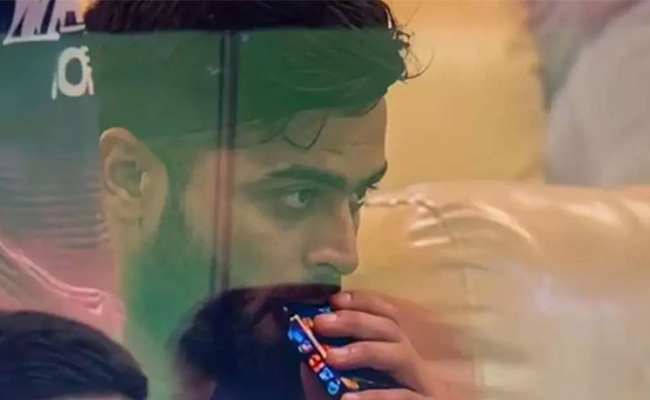
New Delhi (PTI): Rajasthan Royals captain Riyan Parag is set to be fined 25 per cent of his match fee for bringing the game into "disrepute" after being caught vaping on camera during the IPL game against Punjab Kings in Mullanpur.
Parag's actions during the Royals' chase on Tuesday night drew condemnation on social media.
PTI has learned that on field umpires Tanmay Srivastava and Nitin Menon had not reported the matter to match referee Amit Sharma right after the game. They only did that after seeing visual proof and Sharma found Parag guilty for a code of conduct breach as per the IPL guidelines.
The Level 1 offences carries 25 per cent deduction from match fees and one demerit point.
"He is set to be fined a portion of his match fees and a demerit point for a Level 1 offence," said an IPL source.
The Indian government had banned e-cigarettes back in 2019, prohibiting their production, sale and distribution. As per the law, the offender faces imprisonment up to one year and/or a Rs one lakh fine for a first time offence.
"Article 2.21 of IPL Code of Conduct is intended to cover all types of conduct that bring the game into disrepute and which is not specifically and adequately covered by the specific offences set out elsewhere in this Code of Conduct, including Article 2.20," the IPL Code of Conduct states.
"By way of example, Article 2.21 may (depending upon the seriousness and context of the breach) prohibit, without limitation, the following: (a) public acts of misconduct; (b) unruly public behaviour; and (c) inappropriate comments which are detrimental to the interests of the game.
"When assessing the seriousness of the offence, the context of the particular situation, and whether it was deliberate, reckless, negligent, avoidable and/or accidental, shall be considered.
"Further, the person lodging the Report shall determine where on the range of severity the conduct lays (with the range of severity starting at conduct of a minor nature (and hence a Level 1 Offence) up to conduct of an extremely serious nature (and hence a Level 4 Offence)."
Since it is a Level 1 offence there was no need for a hearing.
Parag, who has not had the best of times with the bat this IPL, was seen inhaling an e-cigarette, also known as vaping, in the dressing room during the live broadcast of their game against Punjab Kings. Royals won the game to end Kings' unbeaten run in the tournament.
This is not the first controversy to hit the Royals this season. Earlier this month, team manager Romi Bhinder was fined Rs one lakh for breaching PMOA protocol after being found using his phone in the dugout.
IPL and BCCI officials involved in the conduct of the IPL termed it as a careless act in the age of social media and prying TV cameras.
Royals next host Delhi Capitals at home on Friday night.