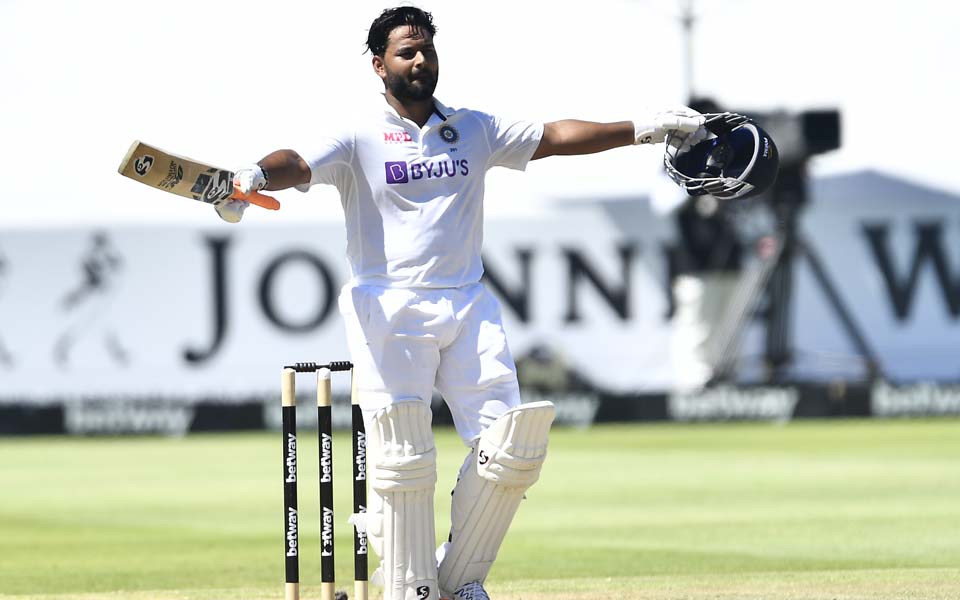
Cape Town, Jan 13: Rishabh Pant scored one of his finest hundreds in most adverse of circumstance but another shoddy batting show left India with only 211 runs to defend on the third day of the third and final cricket Test against South Africa, here Thursday.
Pant's (100 not out off 139 balls) fourth Test hundred constituted for more than 50 percent of India's second innings total of 198 with Virat Kohli's 29 off 143 balls being the second highest individual score.
The umpires called for tea break at the fall of final Indian wicket in the extended second session.
This was the first Test match in 145-year-history where all 20 batters of one team were caught.
The day belonged to Pant as he scored a hundred which is as good as one would ever see and what stood out was his shot selection, which was immaculate.
He didn't do anything that was 'un-Pant' like as there was a rasping square cut off a rising one from Kagiso Rabada (3/53). There was the audacious down the track cover drive off Duanne Olivier and that six over long-on off Keshav Maharaj came just an over before lunch.
These are all shots that one associates with the dashing keeper-batter but what was exemplary was his use of discretion as to what kind of deliveries he would attack.
In between defending the good balls, he drove Maharaj out of the attack with a one-handed slog sweep and a six over long-off. When Olivier dug one short at his pace, it was pulled for six as he hit six fours and four sixes in all.
Skipper Virat Kohli's presence during a 94-run stand definitely helped that he had that guiding light in the middle as he went about his job.
Once Pant had unsettled the line and length of the Proteas pace unit, Dean Elgar opened the field allowing them to rotate the strike but once Kohli perished outside the off-stump, it was only Pant who had to take the burden.
The other highlight was his batting with the tail, taking a single off either the fourth or fifth delivery shielding the Number 9, 10 and 11 as much as possible.
If Pant's learning from his mistake was one good aspect, same can't be said about Cheteshwar Pujara (9) and Ajinkya Rahane (1) as they have now put their careers in jeopardy.
Pujara was again cramped for room on the leg side and the tickle off the gloves was brilliantly taken by Keegan Petersen at leg slip, diving to his right and snapping it up inches ahead of the ground.
In case of Rahane, Rabada bowled a terrific one which kicked from length and took his gloves and Dean Elgar at first slip caught it after keeper Kyle Verreynne had managed to tip it up with his gloves.
Seven Indian batters failed to get into double figures.
Let the Truth be known. If you read VB and like VB, please be a VB Supporter and Help us deliver the Truth to one and all.
New Delhi: A bill to set up a 13-member body to regulate institutions of higher education was introduced in the Lok Sabha on Monday.
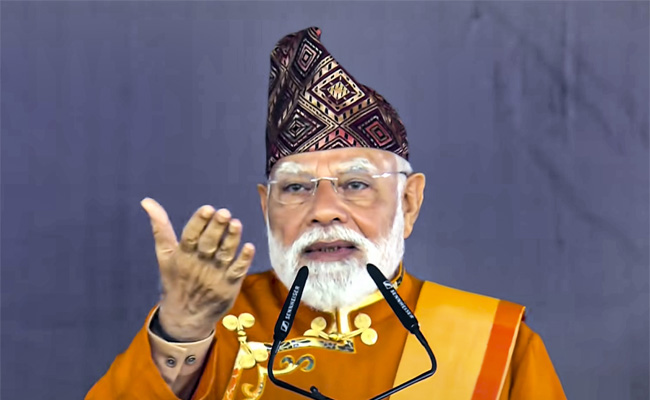
Union Education Minister Dharmendra Pradhan introduced the Viksit Bharat Shiksha Adhishthan Bill, which seeks to establish an overarching higher education commission along with three councils for regulation, accreditation, and ensuring academic standards for universities and higher education institutions in India.
Meanwhile, the move drew strong opposition, with members warning that it could weaken institutional autonomy and result in excessive centralisation of higher education in India.
The Viksit Bharat Shiksha Adhishthan Bill, 2025, earlier known as the Higher Education Council of India (HECI) Bill, has been introduced in line with the National Education Policy (NEP) 2020.
The proposed legislation seeks to merge three existing regulatory bodies, the University Grants Commission (UGC), the All India Council for Technical Education (AICTE), and the National Council for Teacher Education (NCTE), into a single unified body called the Viksit Bharat Shiksha Adhishthan.
At present, the UGC regulates non-technical higher education institutions, the AICTE oversees technical education, and the NCTE governs teacher education in India.
Under the proposed framework, the new commission will function through three separate councils responsible for regulation, accreditation, and the maintenance of academic standards across universities and higher education institutions in the country.
According to the Bill, the present challenges faced by higher educational institutions due to the multiplicity of regulators having non-harmonised regulatory approval protocols will be done away with.
The higher education commission, which will be headed by a chairperson appointed by the President of India, will cover all central universities and colleges under it, institutes of national importance functioning under the administrative purview of the Ministry of Education, including IITs, NITs, IISc, IISERs, IIMs, and IIITs.
At present, IITs and IIMs are not regulated by the University Grants Commission (UGC).
Government to refer bill to JPC; Oppn slams it
The government has expressed its willingness to refer it to a joint committee after several members of the Lok Sabha expressed strong opposition to the Bill, stating that they were not given time to study its provisions.
Responding to the opposition, Parliamentary Affairs Minister Kiren Rijiju said the government intends to refer the Bill to a Joint Parliamentary Committee (JPC) for detailed examination.
Congress Lok Sabha MP Manish Tewari warned that the Bill could result in “excessive centralisation” of higher education. He argued that the proposed law violates the constitutional division of legislative powers between the Union and the states.
According to him, the Bill goes beyond setting academic standards and intrudes into areas such as administration, affiliation, and the establishment and closure of university campuses. These matters, he said, fall under Entry 25 of the Concurrent List and Entry 32 of the State List, which cover the incorporation and regulation of state universities.
Tewari further stated that the Bill suffers from “excessive delegation of legislative power” to the proposed commission. He pointed out that crucial aspects such as accreditation frameworks, degree-granting powers, penalties, institutional autonomy, and even the supersession of institutions are left to be decided through rules, regulations, and executive directions. He argued that this amounts to a violation of established constitutional principles governing delegated legislation.
Under the Bill, the regulatory council will have the power to impose heavy penalties on higher education institutions for violating provisions of the Act or related rules. Penalties range from ₹10 lakh to ₹75 lakh for repeated violations, while establishing an institution without approval from the commission or the state government could attract a fine of up to ₹2 crore.
Concerns were also raised by members from southern states over the Hindi nomenclature of the Bill. N.K. Premachandran, an MP from the Revolutionary Socialist Party representing Kollam in Kerala, said even the name of the Bill was difficult to pronounce.
He pointed out that under Article 348 of the Constitution, the text of any Bill introduced in Parliament must be in English unless Parliament decides otherwise.
DMK MP T.M. Selvaganapathy also criticised the government for naming laws and schemes only in Hindi. He said the Constitution clearly mandates that the nomenclature of a Bill should be in English so that citizens across the country can understand its intent.
Congress MP S. Jothimani from Tamil Nadu’s Karur constituency described the Bill as another attempt to impose Hindi and termed it “an attack on federalism.”