Rohit should captain in T20 World Cup, Virat also should be there: Sourav Ganguly
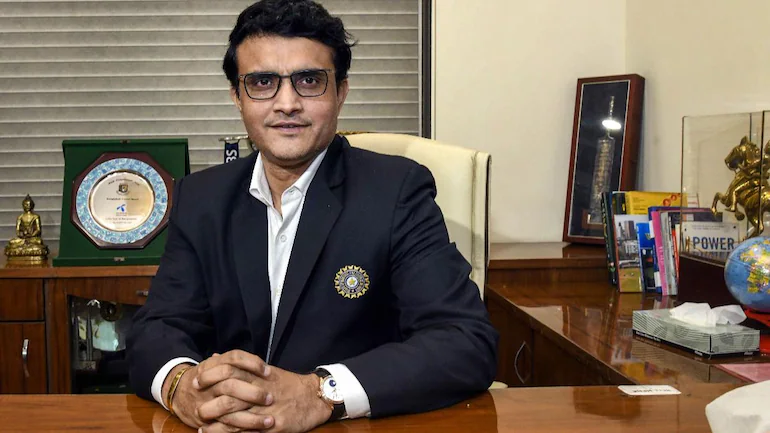
Kolkata: Former captain Sourav Ganguly on Sunday backed stalwarts Rohit Sharma and Virat Kohli to feature in India's squad for the T20I World Cup in June.
The duo, who have not featured in any T20I for about 14 months, have made themselves available for the sport's shortest format, and it remains to be seen if they are picked for the three-match T20I series against Afghanistan, beginning January 11 in Mohali.
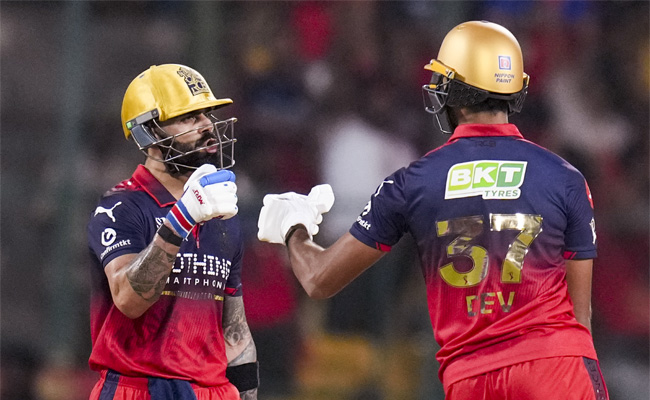
''Of course Rohit should captain the team in the T20I World Cup. Virat Kohli also should be there. Virat Kohli is an outstanding player, nothing will happen (even if they are coming back to T20 fold after a long gap),'' Ganguly added.
India's semifinal defeat to England in the T20I World Cup on November 10 was the duo's last appearance in the shortest format. Ganguly is impressed with Yashasvi Jaiswal's outing in the two-Test series in South Africa and said the young opener will get enough opportunities in future.
The 22-year-old left-handed batter managed only 50 runs in four innings on the challenging South African tracks of Centurion and Cape Town as the series ended in a 1-1 draw.
''He has played well in the second Test, it's just the start of his career. He will get enough opportunities,'' Ganguly said during a promotional event here.
After their innings and 32-run defeat at Centurion, India made a strong comeback to defeat South Africa by seven wickets at Cape Town in what was the shortest ever Test.
''People say a lot of things after losing one match, India are a strong side. But look at the way they have played. They won the ODI series, drew both the Test and T20I series.''
Let the Truth be known. If you read VB and like VB, please be a VB Supporter and Help us deliver the Truth to one and all.
T'gana RTC strike: Talks between govt, employees successful

Hyderabad (PTI): Talks between employees of Telangana State Road Transport Corporation (RTC) who were on strike and the state government concluded successfully on Friday as the government agreed to the key demands of the workmen.
Following a day-long marathon of talks between the leaders of the employees' Joint Action Committee (JAC) and the cabinet sub-committee, the government announced after midnight that it acceded to the demands, including a merger of RTC with the government, 11 per cent pay revision and elections to the employees' unions.
A committee comprising officials and employee leaders would be appointed over the merger of RTC with the government, it said.
The RTC management has also agreed to address the remaining issues as well, an official release said.
The employees would call off their strike and the RTC buses would hit the roads shortly, it said.
The employees had been on an indefinite strike since April 22 over a series of demands, including the merger of RTC with the government.
Earlier in the day, a driver of the RTC, who attempted suicide on April 23 during the strike, died at a hospital here in the early hours of Friday.
Shankar Goud, a 55-year-old driver, set himself ablaze by pouring petrol at Narsampet in Warangal district when the employees were staging a protest on Thursday in support of their demands.
Goud suffered serious burns, was initially admitted to a state-run hospital in Warangal, and later shifted to a super-speciality hospital in Hyderabad for advanced treatment.
"He succumbed (to injuries) at about 1.30 am on Friday," a senior official said.
The driver’s body was taken to his relative’s village, Muttojipet in Warangal district, for funeral rites.
Tension prevailed in Muttojipet as his family members and RTC employees attempted to take the body to the Narsampet bus station, where he worked, to enable his colleagues to pay their last respects. However, police did not permit this, citing law-and-order concerns.
This led to a deadlock before the funeral could proceed.
Union Minister Bandi Sanjay Kumar criticised the Telangana government for not allowing the body to be taken to the Narsampet bus station.
Kumar, Minister of State (Home), visited Muttojipet village in Warangal district, where the funeral was held, and paid homage to Goud.
“They (family members) want to take the body to the bus depot for five minutes. Is the RTC bus depot in Pakistan or Bangladesh? They are emotionally attached to taking the body there. The government is hurting sentiments and creating fear among RTC employees,” Kumar told reporters.
He also expressed anger at the police for not allowing the body to be taken to the bus station and staged a protest, according to a release from his office.
RTC employees and BJP workers attempted to take the mortal remains in an ambulance to Narsampet, but were stopped by the police.
Later, after discussions with the police, the family members and RTC employees agreed to conduct the funeral in the village.
Sanjay Kumar, stating he would abide by the family’s decision, left the village after the funeral was conducted there.
Transport Minister Ponnam Prabhakar said an ex gratia of Rs 10 lakh, a house, and a government job would be provided to the kin of Goud.
Chief Minister A Revanth Reddy expressed shock over the employee’s death and conveyed deep condolences to the grieving family, according to the release.
The RTC employees’ JAC had earlier announced an agitation programme from April 24 to 29, including silent marches and submission of memorandums to MLAs and other leaders.