1st T20I: Rookie keeper Seifert smashes 84 as New Zealand score 219/6 vs India

Wellington, Feb 6: Unheralded wicketkeeper-batsman Tim Seifert took the Indian bowling attack to cleaners with a scintillating 84 off 43 balls as New Zealand scored a commanding 219 for 6 in the first T20 International here Wednesday.
Seifert, whose previous best score in T20 Internationals happens to be 14, was promoted to open alongside Colin Munro (34 off 20 balls) and they added 86 runs in only 8.2 overs in a whirlwind start.
Seifert's knock had seven fours and half a dozen of sixes, setting the tone for a big total.
Seifert showed the intent straightaway as he gave Bhuvneshwar Kumar the charge as he picked the knuckle ball early, dispatching it over mid-wicket for a six. The next shot was a four as he stood and hammered past the bowler.
With Munro hitting Khaleel Ahmed (1/48 in 4 overs) for two successive sixes, New Zealand were off to a blazing start scoring 44 off the first four overs.
Seifert was lucky to survive when Mahendra Singh Dhoni dropped a sharp chance as the batsman had edged one off Krunal Pandya (1/37 in 4 overs).
But he promptly put the next delivery into the stands moving across towards off and sweeping it over backward square leg.
There wasn't signs of overt footwork but he shuffled enough inside the crease to make room for the big shots and in the process disturb the line and length of the bowlers.
When Hardik Pandya (2/51 in 4 overs) drifted on the leg stump, he was flicked behind the square and when he pitched wide outside off-stump, he lofted him cover point region.
In Hardik's next over, he again hit the bowler for a boundary and a flicked six. In between, his elder brother Krunal was switch hit for a boundary.
The elder Pandya finally got a breakthrough as Munro was caught in the deep off Vijay Shankar.
But Seifert never let the momentum drop as he hit two more sixes off Krunal, who just kept on pushing the ball through a flatter trajectory.
The normally dependable Yuzvendra Chahal (1/35 in 4 overs) also was slog swept over mid-wicket for the sixth maximum apart from being hit over extra cover for a boundary.
Just when it looked that a century was there for the taking, Khaleel bowled one in the block hole coming wide off the crease to clean Seifert up.
Once Seifert was gone, skipper Kane Williamson (34 off 22 balls) took charge and Scott Kuggeliejn (20 no off 7 balls) finished with a flourish. PTI KHS.
Let the Truth be known. If you read VB and like VB, please be a VB Supporter and Help us deliver the Truth to one and all.
Women BJP MLAs protest against opposition in UP assembly premises
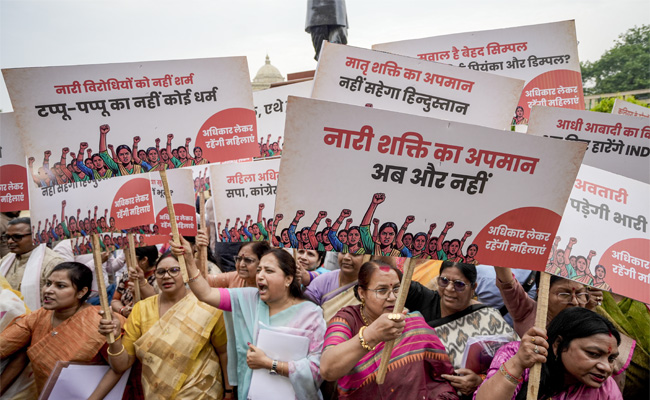
Lucknow (PTI): Women BJP MLAs held a protest in the Vidhan Bhawan complex before the one-day special session of Uttar Pradesh assembly, slamming the opposition for defeating the passage of a bill, which would have led to implementation of the Women's Reservation Law, in the Lok Sabha.
This followed another demonstration by Samajwadi Party MLAs, who alleged that the BJP was misleading public in the name of women's reservation.
The women BJP legislators assembled in front of Chaudhary Charan Singh's statue in the assembly premises, holding banners inscribed with the slogan "Insult to Matrushakti (women's power), India will not tolerate it". The protesting members entered the main hall of Vidhan Bhawan carrying the banners.
Participating in the protest, the state Minister for Women Welfare and Child Development, Baby Rani Maurya, told reporters that all opposition parties, including the Samajwadi Party and the Congress, had opposed the women's reservation, a stance for which they would have to pay a heavy political price.
"On this issue, all of us women stand united. We will ensure that we secure our reservation," she said.
BJP MLA Ketki Singh remarked that their protest represents the collective outrage of millions of women across the state.
Singh asserted that the opposition has betrayed women by creating hurdles in the path of women's reservation. The current demonstration is merely the beginning, and very soon, women from every street, intersection and household will join the protest movement, she said.
Minister Vijaylakshmi Gautam said, "We strongly condemn the despicable act committed by the Samajwadi Party and the Congress in an attempt to hold back 'half the population' (women). Their action was directed against the very bill that Prime Minister Narendra Modi had introduced to empower and strengthen Nari Shakti (women's power), and which he strived to pass expeditiously."
Uttar Pradesh assembly is holding a one-day special session on Thursday. During the session, the government is set to move a censure motion against the opposition parties over their failure to pass the Constitution Amendment Bill, which would have led to implementation of the Women's Reservation Act, in the Lok Sabha.