Russell, Rana help KKR survive Klaasen fury for thrilling four-run win over SRH

Kolkata, Mar 23: Harshit Rana's resilience in the final over and Andre Russel's muscling fifty helped Kolkata Knight Riders survive Heinrich Klaasen's six-hitting spree and score a thrilling four-run victory over Sunrisers Hyderabad in their IPL match here on Saturday.
Klaassen almost turned the match on its head with a 29-ball 63 in which he moussed eight sixes without a single four.
But SRH bravely chased KKR's imposing 208/7, which was built around Russell's (64, 25b) and Phil Salt's 54 (40b), but could only make 204 for seven.
The South African took IPL's costliest buy Mitchell Starc to cleaners smashing him for three sixes, while Bengal cricketer Shahbaz Ahmed ended the Aussie left-arm quick's over with another six.
That 26-run over meant Starc, who joined the Knight Riders for a record Rs 24.75 crore, finished with woeful figures of 4-0-53-0.
Needing 13 off the last over, KKR gambled with rookie pacer Rana as he was hammered for seven runs off the first two balls.
But first he dismissed Shahabaz and then Klaassen off his penultimate delivery, which came through a superb backward diving catch by Suyash Sharma, to give the local side a fantastic win.
The Hyderabad outfit needed five runs off the last ball but skipper Pat Cummins failed to connect the ball, as Rana finished with fine figures (3/33).
Chasing the imposing target on a beautiful batting deck at Eden Gardens, Hyderabad found themselves at 145/5, needing 61 runs from 19 balls before Klaasen came in.
Earlier, openers Mayank Agarwal and Abhishek Sharma, who both scored identical 32, gave SRH a perfect start.
The duo made 60 runs in 33 balls before Agarwal was dismissed by Rana.
Before Rana got into the act, KKR's trump card Narine dished out his sorcery. The West Indian bowled from seventh to 13th over, and gave away just 19 runs in four overs.
He took only one wicket but stifled SRH's progress in the middle-overs.
However, KKR's fielding was an eyesore. Varun Chakravarthy's fitness was always a concern and it came to fore when he dropped a dolly to deprive Narine the wicket of Rahul Tripathi.
The former KKR batter got another reprieve in the next over and this time impact player Suyash failed to hold on to a return catch.
It would have been a boundary, but umpire Yeshwant Barde got in the way of the ball, leaving him grounded.
Earlier, Salt got third IPL fifty in just 38 balls before being dismissed by Mayank Markande (2/39).
The Englishman made 54 off 40 after Narine (2), Venkatesh Iyer (7), Shreyas Iyer (0) and Nitish Rana (9) fell cheaply with pacer T Natarajan (3/32) making early dents.
But KKR had the Dre Russ' power in their ranks.
Russell teed off against Markande when he launched the SRH leg-spinner deep into the stands -- three sixes in five balls.
Markande for a moment thought that he had the last laugh when Aiden Markram took a blinder at long-on but replays showed he grounded the forward diving catch, giving Russell a breather on 20.
The warning signs were on for SRH and the Jamaican went ballistic in Bhuvneshwar Kumar's penultimate over hitting him for two fours and two sixes, taking 26 runs.
Rinku Singh, at the other end, made a 15-ball 23 as the duo put together 81 runs from 33 balls as Kolkata scored 85 runs in the last five overs.
However, credit should also go to Salt and Ramandeep Singh.
Salt remained firm despite early wickets and got handy support from debutant Ramandeep who quickly ran off the blocks in an entertaining 54-run partnership.
Ramandeep slammed Cummins for a boundary and then pulled a short one for a six.
He also hit Markande and Marco Jansen and Shahbaz Ahmed for three more sixes in his 17-ball 35 before being dismissed by Cummins.
The partnership set the tone for the final assault by Russell and Rinku.
Let the Truth be known. If you read VB and like VB, please be a VB Supporter and Help us deliver the Truth to one and all.
BJP has become party of Bakasur, its hunger insatiable: Sanjay Raut on defection of AAP MPs
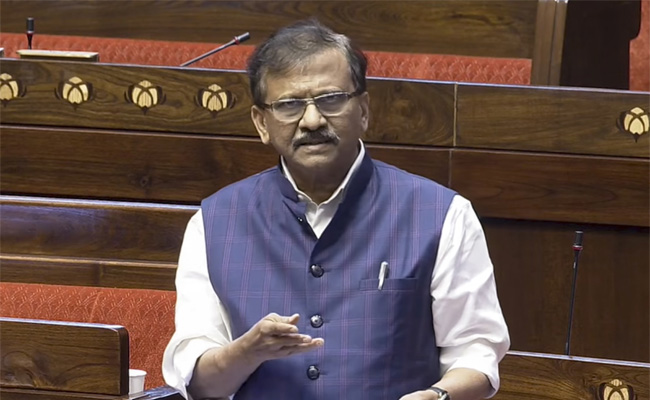
Mumbai (PTI): A day after seven Rajya Sabha MPs of the Aam Aadmi Party (AAP) quit and said they were merging with the BJP, Shiv Sena (UBT) leader Sanjay Raut on Saturday likened the saffron party to the mythological demon Bakasur with insatiable hunger.
Talking to reporters here, Raut said the majority of AAP MPs who switched their loyalties to the Bharatiya Janata Party were "Page 3 leaders", and claimed that they were scared as they were "wealthy and needed protection."
"Let the garbage from other parties go the BJP so that it becomes a dumping ground," Raut said.
The AAP suffered a jolt on Friday as seven out of its 10 Rajya Sabha members, including Raghav Chadha, Ashok Mittal and Sandeep Pathak, quit the party, with Chadha saying all of them had merged with the BJP.
"In Mahabharat, there is a demon called Bakasur whose hunger was insatiable. The BJP has become a party of Bakasur. It can eat anything," Raut said.
Chadha had once termed the BJP a party of goons, while Mittal's businesses faced raids soon after he was made deputy leader of the AAP in the Rajya Sabha (replacing Chadha), said Raut, himself a member of the Upper House of Parliament.
The Enforcement Directorate had last week conducted raids at business entities linked to Mittal in Punjab as part of a FEMA probe.
"Everyone knows about the BJP's politics. It is shamelessness," the Sena (UBT) leader said, adding that US President Donald Trump called India a hellhole and the BJP was showing what hell looks like.
He himself had written to then Vice President and Rajya Sabha chairman Venkaiah Naidu that there was pressure on him to join the BJP but he did not betray his party and preferred to go to jail, Raut said, referring to his arrest in an alleged money laundering case in 2022. He was released on bail in the case months later.
#WATCH | Mumbai | On Raghav Chadha, along with 2/3 AAP Rajya Sabha MPs joining BJP, Shiv Sena (UBT) leader Sanjay Raut says, "... Everyone knows the politics the BJP is playing. Their politics is a single word, we call it shameless. They have no shame. Because these people, like… pic.twitter.com/hJslDdLZDV
— ANI (@ANI) April 25, 2026