Samson's unbeaten 86 in vain as India lose to SA by 9 runs in 1st ODI
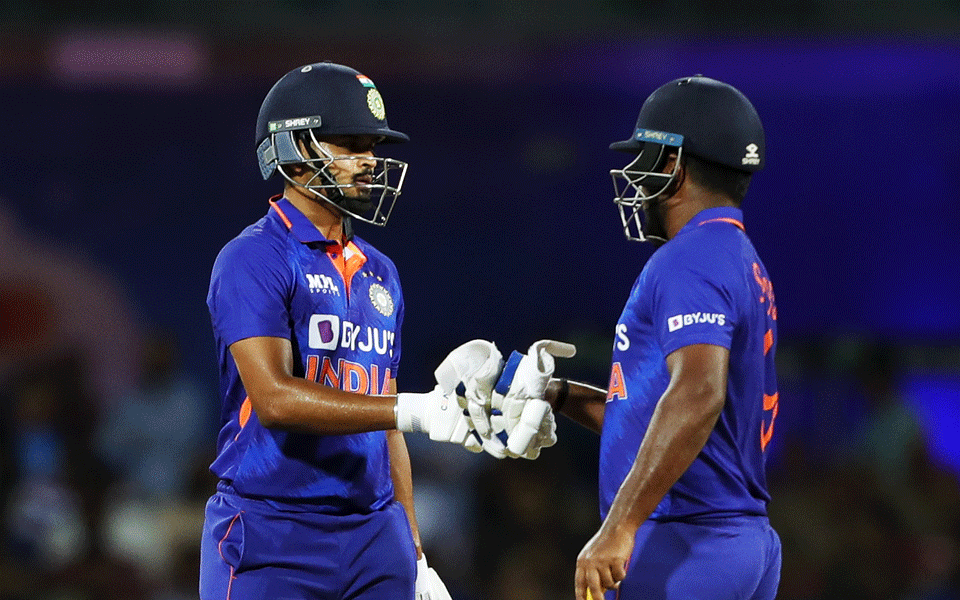
Lucknow (PTI): Below-par death bowling coupled with ordinary fielding and batting, except for Sanju Samson and Shreyas Iyer, hurt a second-string Indian team as it slumped to a nine-run defeat against South Africa in the rain-truncated first ODI of the three-match series here on Thursday.
Opting to bowl in the rain-hit 40-over-a-side game, India started on the right note reducing South Africa to 110 for 4 in 22.4 overs before David Miller and Heinrich Klaasen hit strokeful half-centuries to guide South Africa to 249 for 4.
Down at 110 for four, Miller (75 not out off 63 balls) and Klaasen (74 not out off 65 balls) added 139 runs for the unbroken fifth wicket to take the visitors to close to 250-run mark.
Shardul Thakur was the pick of the bowlers for India with figures of 2/35 from eight overs. The Indian bowlers struggled in the death overs, conceding 54 runs in the last five overs.
If that was not enough, the Indian fielders dropped as many as four catches in the outfield to help South Africa's cause.
Chasing a stiff target of 250, Samson (86 not out off 63 balls) and Iyer (50 off 37 balls) struck fifties, while Shardul Thakur (33 off 31 balls) used the long handle to good effect towards the end but it was not enough in the end.
India endured a disastrous start to their chase, losing both Shubman Gill (3) and skipper Shikhar Dhawan (4) cheaply to be reduced to 8 for 2 inside six overs.
While Kagiso Rabada cleaned up Gill in the third over, Dhawan inside-edged one on to his stumps from a Wayne Parnell delivery in the sixth over.
Ishan Kishan and debutant Ruturaj Gaikwad then tried to stabilise the innings with a 48-run partnership for the third wicket before the latter was stumped by Quinton de Kock off the bowling of Tabraiz Shamsi as India slumped to 48 for 3 in 16.4 overs.
In the reserves for the T20 World Cup squad, Iyer helped his cause with a 37-ball 50 and together with Sanju Samson shared 67 runs for the fifth wicket to keep India in the hunt.
Iyer decorated his innings with eight hits to the fence before handing a simple catch to Rabada at mid-on off Lungi Ngidi's bowling.
But Samson and Thakur kept India in the hunt with an attacking 93-run partnership of just 64 balls for the sixth wicket.
With India needing 45 off the last three overs, Ngidi struck twin blows, dismissing Thakur and Kuldeep Yadav in successive balls to hand South Africa the upper hand.
Needing 30 off the last over, Samson tried his best, smashing one six and three fours but to no avail.
Earlier sent into bat, South Africa made a relatively slow start, reaching 41 for no loss after 10 overs. India skipper Shikhar Dhawan's decision to bowl was justified by new ball bowlers Mohammed Siraj and Avesh Khan.
Siraj, in particular, was brilliant as he swung the ball both ways to trouble the Proteas batters initially but without any luck.
Dhawan introduced Shardul Thakur in the ninth over and in two balls the pacer gave his team the first chance, inducing an edge from Janneman Malan but Shubman Gill dropped a sitter at the first slip.
But Shardul got his man four overs later as Malan flicked one straight to Shreyas Iyer at short midwicket.
Leg-spinner Ravi Bishnoi was taken to task by South Africa skipper Temba Bavuma (8) as he conceded 31 runs from his first three overs.
Bavuma, who was struggling for runs in the preceding T20I series, reverse-swept and drove Bishnoi for two boundaries in the 14th over.
But Bavuma's short and attacking innings was cut short by Thakur, who went through his defence as the batter registered another single digit score in the tour.
Kuldeep Yadav gave India another breakthrough soon, cleaning up Aiden Markram for a duck with a sharp leg-spin.
Quinton de Kock went about his business in quiet fashion and held one end together before perishing in the 23rd over.
De Kock scored 48 off 54 balls with the help of five boundaries before he was trapped in front of the wicket by Bishnoi as South Africa slumped to 110 for 4 in the 23rd over.
Two overs later, Miller effortlessly struck the visitors' first six of the innings, straight over long-on boundary off the bowling of Bishnoi.
Miller and Klaasen then took the attack to the opposition. Miller played sensibly and dispatched the loose balls to the boundary to record his 18th half-century off 50 balls with the help of four boundaries and one hit over the fence.
Klaasen soon followed suit and registered his fourth ODI fifty in 52 balls. Death over bowling continued to haunt India as Miller and Klaasen brought up their century partnership in just 84 balls.
To add to that, India dropped as many as four catches, displaying poor outfield fielding standards.
Let the Truth be known. If you read VB and like VB, please be a VB Supporter and Help us deliver the Truth to one and all.
KKR defeat LSG via Super Over
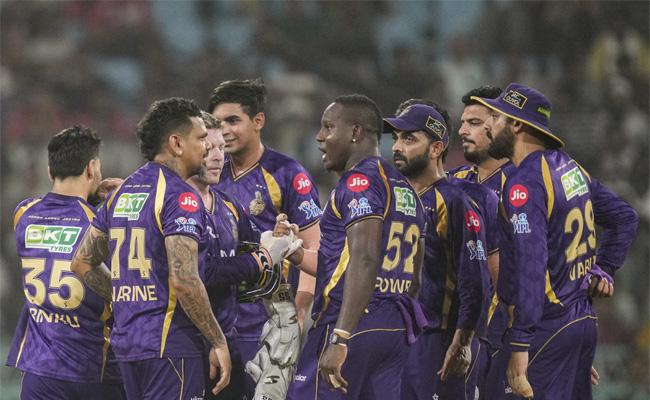
Lucknow (PTI): Kolkata Knight Riders edged Lucknow Super Giants via Super Overs in a battle between two bottom-placed teams in the IPL, here on Sunday.
Chasing a modest 156, LSG suffered a batting collapse and managed to tie the contest and take it to Super Over with No. 9 Mohammed Shami striking a last-ball six against a wayward Kartik Tyagi, who leaked 16 runs in the final over.
But Sunil Narine bowled a stunning Super Over conceding just one run and taking two wickets to give KKR an easy target.
Rinku Singh then finished the chase with a boundary off first ball from Prince Yadav.
Earlier the KKR were in deep trouble with 93/7 in 15 overs but Rinku smashed a sensational 83 not out from 51 balls including four sixes in a row in the final over to lift them to 155/7.
Cameron Green (34) was the only other batter to reach double-digit scores as KKR suffered a familiar batting meltdown with Mohsin taking his maiden fifer.
In reply, LSG continued their dismal show with the bat to succumb to their fifth loss in a row.
Brief Scores:
Kolkata Knight Riders 155/7; 20 overs (Rinku Singh 83 not out, Cameron Green 34; Mohsin Khan 5/23). Lucknow Super Giants 155/8; 20 overs (Rishabh Pant 42). KKR won via Super Over.