Sarfaraz Khan is not being ignored for just cricketing reason, there's more: BCCI official claims
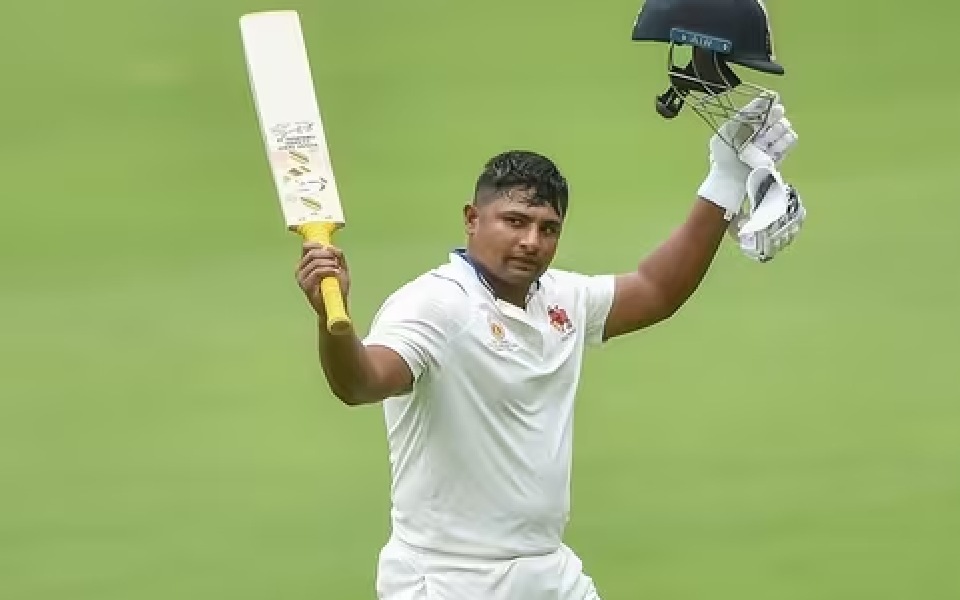
New Delhi, Jun 25: Sarfaraz Khan's non-inclusion in the Indian team for the West Indies tour was criticised by none other than Sunil Gavaskar, but BCCI sources claimed that his below-par "fitness level" as well as alleged "off-field conduct" has influenced the decision.
The Mumbai batter scored 2566 runs in the last three Ranji seasons. He scored 928 runs in the 2019/20 season, 982 in the 2021-22 and 656 in the 2022-23 season.
The 25-year-old has a very impressive career average of 79.65 after 37 red ball games, so it was very surprising that the two-time former India U-19 World Cup player had to make way for someone like Ruturaj Gaikwad, whose career average is 42-plus.
"The angry reactions are understandable but I can tell you with some degree of certainty that the reason behind Sarfaraz getting ignored time and again is not just cricketing one. There are multiple reasons for which he hasn't been considered," a BCCI official privy to selection developments told PTI on conditions of anonymity.
"Are the selectors fools to not consider a player who has scored 900 plus runs in successive seasons? One of the reason is his fitness which isn't exactly of international standard.
"He has to work hard, maybe shed weight and comeback leaner and fitter as it's not just batting fitness that is sole criteria for selection," the source added.
However, a source close to Sarfaraz said that he has recently scored 16.5 in YoYo test during his stint at NCA.
According to the BCCI official, fitness is not the only reason for his non-selection.
"His conduct on and off the field hasn't exactly been top notch. Certain things said, certain gestures made and some incidents have been taken note of. A bit more disciplined approach would only do him a world of good. Hopefully, Sarfaraz along with his father and coach Naushad Khan will work on those aspects," the senior official added.
Reportedly, Sarfaraz's celebrations after his hundred against Delhi earlier this year during a Ranji game, didn't go down well.
Before that, during the 2022 Ranji Trophy final, his conduct during a break had irked MP coach and Mumbai stalwart Chandrakant Pandit.
However, a source close to Sarfaraz said, "Chandu sir treats him like a son and he has hugged my son. He has known him as a kid and loves him like anything. So these are baseless allegations."
Asked if IPL performance and perceived weakness against short ball has also contributed to his non-selection, the source replied, "That's a perception built by media. Do you think there could be any cricketing reason?
"When Mayank Agarwal broke into Indian Test team, he scored 1000 first class runs in one month. Did MSK Prasad's committee check his IPL credentials? Ditto for Hanuma Vihari, who came through domestic and A team ranks. If their IPL and white ball record wasn't checked then, why would SS Das's committee reinvent the wheel now? Simple. The reason is not a cricketing one," he added.
As of now, it will be difficult for Sarfaraz to make it to the team.
"Just think about it. Why was Sarfaraz not even among the reserves for the World Test Championship? Suryakumar Yadav, Yashasvi Jasiwal were the two reserves after Ruturaj pulled out due to his marriage."
Right now, according to the pecking order, Ajinkya Rahane is at No 5 and Gaikwad is the reserve middle-order batter who can also be used as a floater.
So once Rahane fails, most likely Gaikwad will get a chance. Also it is difficult to rule out Suryakumar Yadav, who is playing Duleep Trophy for West Zone. And if Shreyas Iyer gets fit, then the road to an international call-up could get much tougher for Sarfaraz.
Let the Truth be known. If you read VB and like VB, please be a VB Supporter and Help us deliver the Truth to one and all.
Choose faith or future: BJP alleges 'second-class treatment' of Hindus in K'natka CET row
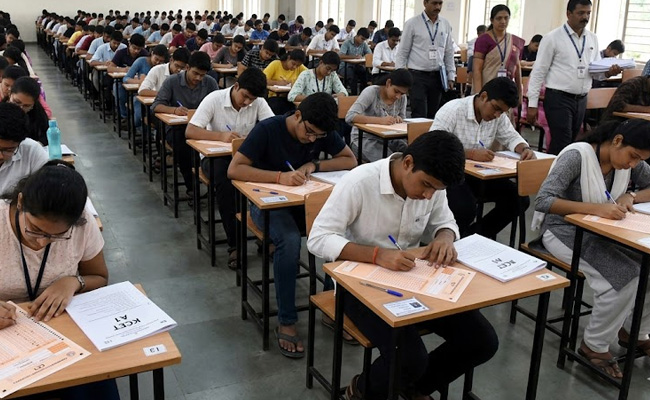
New Delhi (PTI): The BJP on Saturday accused the Karnataka Congress government of being "anti-Hindu" and following double standards after students appearing for the Common Entrance Test (CET) were allegedly asked to remove their 'janeu'.
A political row erupted after five Brahmin students were allegedly forced to remove the thread, considered sacred and worn across the torsos, at a city college in during the CET on Friday.
Students alleged that the invigilators at Madivala asked them to remove their janeu/yajnopaveetha if they wanted to write the exam.
In a video post on X, BJP national spokesperson Shehzad Poonawalla lambasted the act.
"Is it a crime to be a Hindu in Karnataka? In Karnataka, students were stopped from entering the examination hall for wearing a janeu and were given a brutal option -- choose your faith or your future. This happened last year as well," Poonawalla alleged.
ALSO READ: ECI to release exact voter turnout in TN
He accused the Karnataka government of practising double standards and engaging in appeasement politics.
"In Karnataka, we have seen the politics of appeasement. Muslim reservation, a Muslim-only budget, and quotas and contractual work for Muslims. But Hindus have to remove their sacred thread if they want to take an exam, which even the courts have, by the way, allowed," he alleged.
He accused the Congress government of adopting a similar approach in other states where it is in power, while allowing hijab and burka in classrooms.
"It has happened in various Congress-ruled states. We have seen that the Congress party advocates the right to hijab and burkha within the classroom. They say this should be allowed. Even the courts have overruled it.
"But in the case of janeu, they want it to be removed. This is not the first time this has happened. In Telangana and other states, the tilak and mangalsutra were removed. But hijab is fine. This is the kind of second-class treatment being given to Hindus," he added.
Poonawalla said the Congress should rename itself from INC to "MMC -- Muslim League Maowadi Congress" or the "Islamic National Caliphate Party".
As the controversy took a political turn, the college suspended the invigilator pending inquiry. The government also ordered a probe.
The police registered a case and detained three staff members of Krupanidhi College who were in charge of examination checking for questioning, officials said.
A similar incident took place last year in Karnataka, following which the government directed that the candidates would not be asked to remove the janeu while appearing for the CET.