Shafali scores fastest women's Test double ton as India score 525/4 at stumps on day 1 against SA
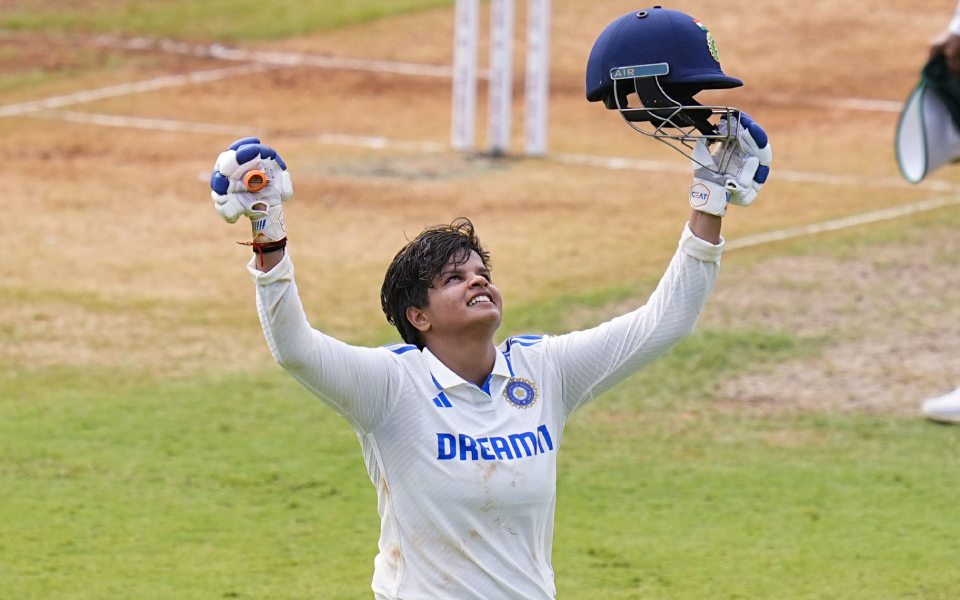
Chennai, Jun 28: Opener Shafali Verma's record-breaking double century and her formidable 292-run partnership with Smriti Mandhana set the platform for India's massive 525 for 4 on the opening day of their one-off women's Test against South Africa here on Friday.
On a day when records fell like ninepins, India also broke the 89-year-old mark for most runs scored on a single day by 94 runs. England women had racked up 431/2 against New Zealand at Lancaster Park, Christchurch in 1935.
Shafali, 20, reached her double-century off just 194 balls, eclipsing the record of Annabel Sutherland of Australia who achieved the feat off 248 deliveries in a Test against South Africa in February.
Shafali was dismissed soon after, being run out at 205 (197 balls). The young opener's previous best in Tests was 96.
Shafali, playing only in her fifth Test, smashed 23 boundaries and eight maximums during her historic knock.
Shafali also became only the second Indian after former skipper Mithali Raj to hit a double century in Test cricket after almost 22 long years. Mithali's 214 had come off 407 balls and the former India skipper achieved it during the drawn second Test against England at Taunton in August, 2002.
Shafali's partner for most part of her innings on Friday, vice-captain Mandhana, too bettered her Test score of 127 with a knock of 149 off 161 balls.
Jemimah Rodrigues contributed 55 runs. At stumps skipper Harmanpreet Kaur (42 not out) and Richa Ghosh (43 not out) were at the crease.
Brief scores:
India 1st innings 525 for 4 in 98 overs (Shafali Verma 205, Smriti Mandhana 149, Jemimah Rodrigues 55, Harmanpreet Kaur 42 not out, Richa Ghosh 43 not out; Delmi Tucker 2/141).
Let the Truth be known. If you read VB and like VB, please be a VB Supporter and Help us deliver the Truth to one and all.
NEET student hangs self in Rajasthan's Sikar

Jaipur (PTI): A student preparing for the NEET examination allegedly committed suicide by hanging himself in a rented room in Rajasthan's Sikar on Friday, police said.
According to the police, the student allegedly hanged himself from a ceiling fan using his sister's scarf while one sister was attending coaching classes and the other was in the bathroom.
He had appeared in the NEET UG exam 2026, which was cancelled due to paper leak, they said.
Udyog Nagar SHO Rajesh Kumar said that the deceased, identified as Pradeep Meghwal, was a resident of Kanika ki Dhani village in Jhunjhunu's Gudha Gaudji area.
He had been living in a rented room in Sikar's Jaldhari Nagar area with his two sisters while preparing for NEET over the last three years.
His elder sister later found him hanging and informed the landlord and police after bringing him down, officials said.
The SHO said the body was kept at SK Hospital mortuary, and a postmortem had not been conducted.
The student's father, Rajesh Kumar Meghwal, told police that Pradeep's NEET examination had gone well and the family was expecting him to score around 650 marks.
Former Rajasthan deputy chief minister Sachin Pilot expressed grief over the incident and linked it to anxiety among students after reports of irregularities and paper leaks in NEET 2026.
Pilot said repeated paper leak incidents and cancellation of examinations were affecting students' mental health and demanded a time-bound investigation and strict action against those responsible.