Melbourne (PTI): The Indian team could not have risked playing star pacer Jasprit Bumrah in the T20 World Cup with a dodgy back while his replacement Mohammad Shami is on his way to full recovery from COVID-19, said captain Rohit Sharma on Saturday.
Speaking at the captains' media interaction ahead of the T20 World Cup, Rohit gave an update on Shami, who has been drafted into the squad despite having not played a competitive game since July.
"Shami had COVID two-three weeks ago. He was called to the NCA then, he worked hard for the last 10 days and he is in Brisbane. He will practice with us tomorrow," Rohit said.
"Whatever we have heard on his recovery is positive. He did three four bowling sessions with full intensity. We have made a lot of effort to do player management over the last 12 months but injuries happen. If you see, whoever has come into the squad, he has got matches under his belt."
Bumrah was ruled out of the tournament with a back injury, leaving a big hole in the bowling department. While the batting has come a long way in the last one year, bowling remains the team's weak link.
"Bumrah is a quality bowler. We spoke to a lot of specialists about his (back) injury but the response was not very positive. World Cup is important but his career is more important, he is only 27-28.
"We could not have risked playing him here, that is what the specialists also said. We will miss him," said Rohit.
Injuries are unfortunate but inevitable and that is one of the main reasons why India focused on creating a bigger pool of players over the last 12 months, said the skipper.
Be it in batting or bowling, India gave a lot of opportunities to youngsters after their early exit from the World Cup 12 months ago, besides drastically changing their playing style.
"Injuries are part and parcel of the sport. If you play so many matches , injuries will happen. Our focus in the last one year has been on increasing our bench strength. You must have seen we played new guys whenever there was an opportunity," he said.
Rohit said the team has to make the best use of available resources rather than thinking about the injured.
"There is no point being disappointed about it. What needs to be done is the important thing. It was a conscious effort to come here (Australia) early, we played two practice games and two more to go.
"We will be fully prepared before the first game (against Pakistan on October 23). There is no last minute decisions to be made. All the concerned players have been informed in advance," he said referring to the India's playing eleven for the big game.
He also has high expectations from Suryakumar Yadav in this tournament. Suryakumar has been India's number one T20 batter over the last 12 months.
"He is in good form, hope he continues in that fashion in the middle order. He is a very confident and fearless player and uses his skill sets really well," Rohit said.
'We understand importance of Indo-Pak contest'
=============================
The most awaited World Cup clash is the India-Pakistan fixture at the MCG on October 23.
While players from both teams share a cordial relationship with each other and of late have looked rather relaxed before the big game, the fans on either side of the border contribute massively in building hype around the fixture.
Both Rohit and his Pakistani counterpart Babar Azam too looked extremely relaxed at the captains' media interaction here. It was not a surprise that out of the 16 captains, most questions were reserved for Rohit and Babar.
They were also asked about what they usually end up talking about when they meet during tournaments.
"We don't even talk about cricket," revealed Babar.
"Rohit bhai is elder than me. I try to learn about the game from him. He has achieved a lot and I try to pick whatever I can from him," said the humble Pakistan skipper.
With his response, Rohit lightened up the mood in the hall.
"Babar is absolutely right. We understand the importance of the game but there is no point talking about it and creating that pressure within yourself. Whenever we meet, we ask about each other's families. I have met all his teammates.
"Even our former players told us what all they talk. It is usually about 'how their families are, how their life is, what new car they have bought or going to buy'. It is mainly that," said Rohit drawing a smile from Babar.
Let the Truth be known. If you read VB and like VB, please be a VB Supporter and Help us deliver the Truth to one and all.
KKR defeat LSG via Super Over
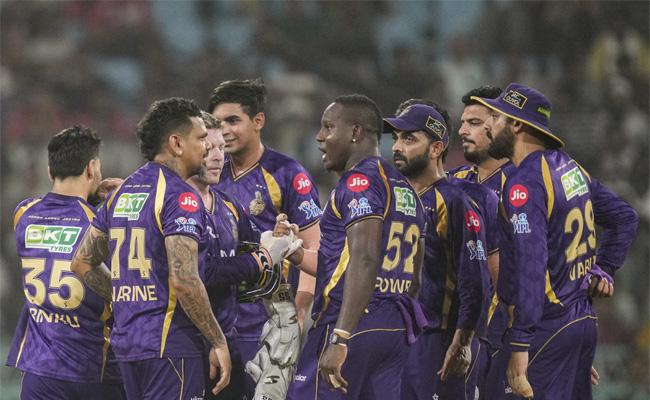
Lucknow (PTI): Kolkata Knight Riders edged Lucknow Super Giants via Super Overs in a battle between two bottom-placed teams in the IPL, here on Sunday.
Chasing a modest 156, LSG suffered a batting collapse and managed to tie the contest and take it to Super Over with No. 9 Mohammed Shami striking a last-ball six against a wayward Kartik Tyagi, who leaked 16 runs in the final over.
But Sunil Narine bowled a stunning Super Over conceding just one run and taking two wickets to give KKR an easy target.
Rinku Singh then finished the chase with a boundary off first ball from Prince Yadav.
Earlier the KKR were in deep trouble with 93/7 in 15 overs but Rinku smashed a sensational 83 not out from 51 balls including four sixes in a row in the final over to lift them to 155/7.
Cameron Green (34) was the only other batter to reach double-digit scores as KKR suffered a familiar batting meltdown with Mohsin taking his maiden fifer.
In reply, LSG continued their dismal show with the bat to succumb to their fifth loss in a row.
Brief Scores:
Kolkata Knight Riders 155/7; 20 overs (Rinku Singh 83 not out, Cameron Green 34; Mohsin Khan 5/23). Lucknow Super Giants 155/8; 20 overs (Rishabh Pant 42). KKR won via Super Over.