Shikhar Dhawan announces retirement, says 'I am at peace'
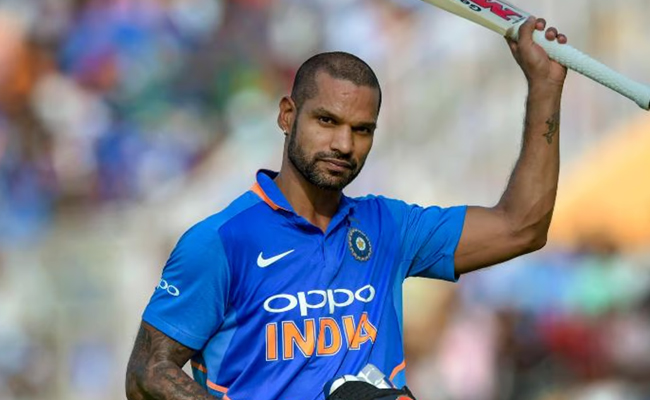
New Delhi (PTI): Veteran India opener Shikhar Dhawan announced his retirement from all forms of cricket two years after he last donned the national jersey, saying that he leaves the scene a content man after representing the country in all three formats.
The 38-year-old made his international debut in 2010 in an ODI against Australia in Visakhapatnam and his last India game was also a 50-over match, against Bangladesh in 2022.
"As I close this chapter of my cricketing journey, I carry with me countless memories and gratitude. Thank you for the love and support! Jai Hind!," Dhawan said in a post on 'X'.
"It's important to turn the page to move forward in life and that's why I am announcing my retirement from international and domestic cricket. As I bid goodbye to my cricket journey, I have peace in my heart that I played for so long," he said.
A product of Sonnet Club and a fighter from West Delhi, Dhawan appeared in 34 Tests, 167 ODIs and 68 T20Is for India but had fallen out of favour in the last couple of years due to patchy form and emergence of younger opening talents like Yashasvi Jaiswal and Shubman Gill.
His best came in the 50-over format in which he amassed 6793 runs at an average of 44.11, including 17 hundreds and 39 fifties. He averaged 40.61 for his 2315 Test runs, which featured seven centuries.
"I am standing at a point in my life where when I look back, I see only memories, and when I look ahead, I see a new world. I had just one goal in life, to play for India, and I made it happen," he said.
"I am very thankful to DDCA (Delhi and Districts Cricket Association), the BCCI and my fans. And that's why I tell myself, don't be sad that you won't play for India again but be happy that you played for your country. And that's the biggest thing for me, that I played," he said in his concluding remarks in the social media post.
The Delhi-born batter didn't enjoy a memorable beginning to his international career, getting dismissed for a two-ball duck.
However, after initial struggles, Dhawan returned to the Indian team in 2013 and cemented his place across all three formats with some fine performances including being named the Player-of-the-Tournament in India's triumphant campaign in the Champions Trophy in England.
One of the highlights of his illustrious career was the brilliant 185 he scored against Australia on Test debut in Mohali, having raced to his century in just 85 balls with a flurry of boundaries.
Dhawan, however, could have been even out before he had faced a ball in his Test debut. The first delivery of the India innings slipped out of Mitchell Starc's hand and fell on the stumps with the debutant out of his ground at the non-striker's end.
The Australians did not appeal, and the flamboyant Dhawan took full advantage of that by setting the record for the fastest century by a Test debutant.
At his peak, the Delhi swashbuckler was a sight to behold with his range of strokes and ability to hit powerfully.
Dhawan did not forget to thank the people who helped in becoming the player that he was, forming en excellent partnership with Rohit Sharma at the top of the Indian batting order.
"I always had one goal in mind that was to play for India and I achieved it thanks to a lot of people. First of all my family, my childhood coach Tarak Sinha and Madan Sharma, under their guidance, I learnt cricket.
"Then my entire team with whom I played for years, got another family, fame and everyone's love and support."
"I just say this to myself that don't be sad that you won't play for your country again but always be happy that you played for your country. And it's the biggest achievement for me that I played," Dhawan added in the video.
He is a bonafide IPL legend, appearing in 222 matches, that yielded 6769 runs, including two hundreds and 51 half centuries.
His 768 fours in the tournament are the highest by any batter and he also holds the distinction of being the first to hit consecutive hundreds in the event.
He was a part of the title-winning Sunrisers Hyderabad team in the 2016 season. He has also played for Delhi, Mumbai and Punjab. Of these, he captained Delhi and Punjab at various stages of his career.
He had appeared for Punjab this season but played in only five matches owing to fitness issues.
Let the Truth be known. If you read VB and like VB, please be a VB Supporter and Help us deliver the Truth to one and all.
Women’s Reservation Bill: K'taka CM accuses PM Modi of adopting 'double standard'
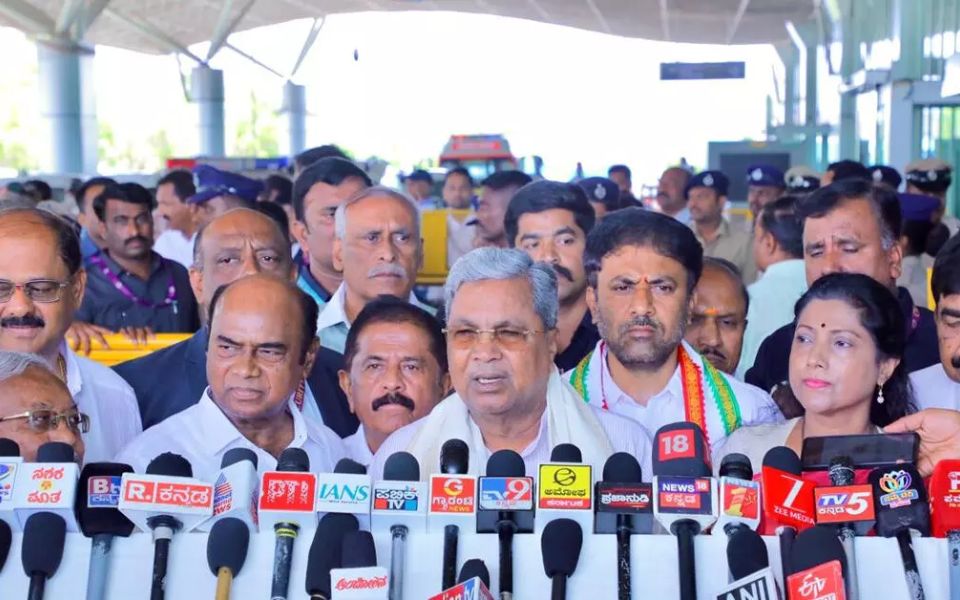
Mysuru (Karnataka) (PTI): Karnataka Chief Minister Siddaramaiah on Monday accused Prime Minister Narendra Modi of adopting a “double standard” on women’s reservation, alleging that the Centre had delayed implementation despite having the opportunity to act earlier.
Addressing reporters here, Siddaramaiah said the BJP and Modi had earlier opposed welfare guarantees and were now replicating them, while also questioning the timing and intent behind the women’s reservation move.
“That’s what I call double standards. Narendra Modi is not for social justice. If he was, this would have been done long ago. How many years has he been in power? It’s been 12 years. Why hasn’t it been done so far?” he asked.
The Chief Minister reiterated that the Congress had consistently supported women’s reservation and accused the Centre of "politicising" the issue.
“We spoke about women’s reservation. The Prime Minister asked me what our stand was. I said we are in favour of women’s reservation,” he said, referring to recent discussions with the PM.
He maintained that delimitation should only be carried out after a fresh Census to ensure equitable representation among states.
“In my view, delimitation should be done after a new census. That is why we opposed it. We have not opposed women’s reservation. We have always supported it,” he said.
Highlighting Congress’ past role, he said, “Who brought the 73rd and 74th amendments? Rajiv Gandhi and the Congress party. Those amendments ensured 50 per cent reservation for women in local bodies. Why would we oppose it?”
Siddaramaiah further questioned the union government’s delay in implementation. “Narendra Modi indulged in politics and got it passed in 2023. Why didn’t he implement it immediately? Then why did he wait so long? He could have implemented it immediately. If he is committed to women’s reservation, he should have implemented it,” he said.
On the linkage between delimitation and reservation, he asked, “Why did the Centre link it with delimitation? Why did it go for a constitutional amendment?” adding that such a move could disadvantage southern states that have successfully controlled population growth.
“Southern states have controlled population well, but northern states haven’t. Naturally, it benefits them and disadvantages us,” he said.
Responding to BJP’s criticism that women would “teach Congress a lesson,” Siddaramaiah said, “They are doing politics. If Modi had brought this earlier, who would have opposed women’s reservation?”
On electoral prospects elsewhere, he said he had no direct information on Tamil Nadu but was optimistic about ruling DMK's victory.
"According to the information I have, DMK and its alliance are likely to win,” while asserting that Kerala would also be won by the opposition.
In a major setback to the BJP-led Central government, a Constitution Amendment Bill to implement 33 per cent reservation for women in legislatures in 2029 and increase the number of Lok Sabha seats to 816 was defeated on Friday, with the ruling dispensation asserting that the struggle to give the rights to women will continue.
While 298 members voted in support of the bill in Lok Sabha, 230 MPs voted against it. Out of 528 members who voted, the bill required 352 votes for a two-third majority.
According to the Constitution (131st Amendment) Bill, Lok Sabha seats were to be increased to 816 from the current 543 to "operationalise" the women's reservation law before the 2029 parliamentary polls, following a delimitation exercise based on the 2011 Census.
Seats were also to be increased in state and Union territory assemblies to accommodate 33 per cent reservation for women.