1st T20I: Shivam Dube's half-century powers India to beat Afghanistan by six wickets
Mohali, Jan 11: India's fringe players, led by Shivam Dube, made the opportunity count to set up a six-wicket win over Afghanistan in the first T20 of the three-match series here on Thursday.
A lively 68-run partnership off 43 balls between the seasoned Mohammad Nabi (42 off 27) and youthful Azmatullah Omarzai (29 off 22) lifted Afghanistan to 158 for five after India dominated the powerplay.
The total posted was not enough in good batting conditions as India got home comfortably in 17.3 overs.
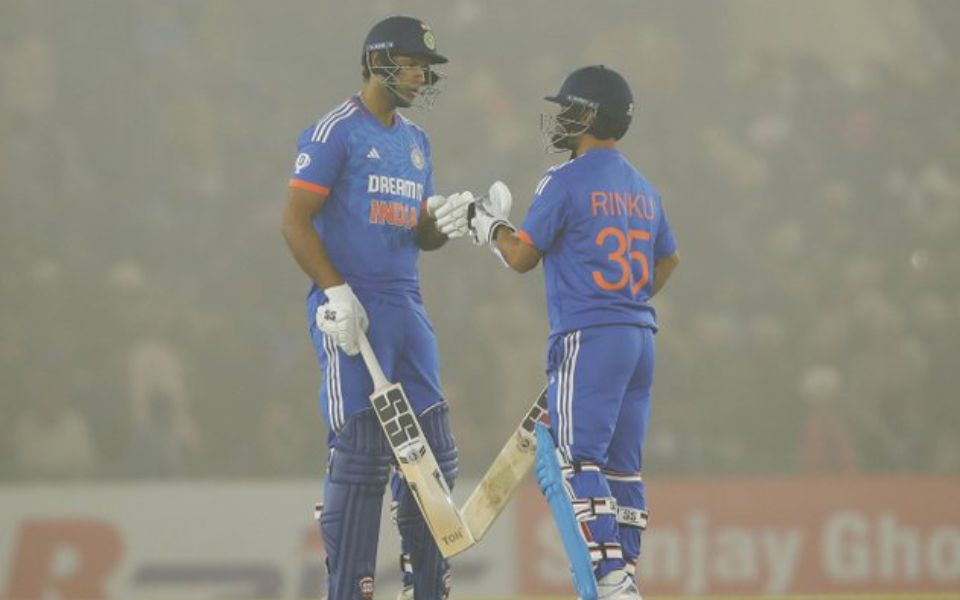
Dube (60 not out), playing his first T20 since the Asian Games, and Tilak Varma (26 off 22) shared a 44-run stand off 29 balls to give Indian innings momentum after losing the openers inside four overs.
Rohit Sharma (0), returning to T20s after 14 months, and Shubman Gill (23) got involved in an avoidable mix-up that limited the Indian skipper's stay to just two balls. The usually calm and cool Rohit did not hide his anger on this occasion as Gill did not pay heed to his call for a quick single.
Gill was not able to stay for long but Varma and Dube were able to take the innings forward and India did not look back from there on.
Dube, who is seen as a back up to injury prone Hardik Pandya, used his long levers efficiently and his disdainful drives on the off side stood out. He ended the game in style with a straight six and four in the fine leg region.
Jitesh Sharma (31 off 20) also gave a good account of himself before Rinku Singh (16 not out off 9) joined Dube in the middle and took the team home.
Earlier, a stroke-filled partnership between Nabi and Omarzai was just what Afghanistan needed after India reduced the visitors to 57 for three in 10 overs amid chilly conditions at the PCA Stadium.
Openers Rahamanullah Gurbaz (23 off 28) and skipper Ibrahim Zadran (25 off 22) could only find four boundaries in the powerplay.
The start of the game was delayed by a few minutes as a flickering blue light around the sightscreen distracted Gurbaz.
Pacer Arshdeep Singh opened the innings with a maiden before the spinners got into the game as early as the fourth over.
Axar Patel, who ended up as the stand out bowler for India with figures of 4-0-23-2, had Gurbaz stumped with a fast and straight delivery after the opener slog swept him for a six.
Zadran was the next to depart as he smashed an innocuous ball from Dube straight to India skipper Rohit Sharma at cover. It was only the second ball of his opening spell.
Rahmat Shah, making his T20 debut after playing 106 ODIs for Afghanistan, chopped on to stumps a flatter one from Axar.
Afghanistan badly needed a move on and that came via the experience of Nabi and Omarzai, who had impressed with his all-round abilities in the ODI World Cup in India.
While the top-order struggled to rotate strike, Omarzai and Nabi showed their teammates how to build a T20 innings.
Both targeted Ravi Bishnoi and Mukesh Kumar in the middle overs.
Nabi's back-to-back sixes off Mukesh stood out in his quickfire knock. He first made room to smash him over extra cover and waited still for the second ball to dispatch it over mid-wicket.
Najibullah Zadran (19 not out off 11) and Karim Janat (9 not out off 5) took the total past 150.
India dropped three catches in the biting cold of Mohali. Opener Yashasvi Jaiswal was unavailable for selection due to a sore right groin.
Let the Truth be known. If you read VB and like VB, please be a VB Supporter and Help us deliver the Truth to one and all.
T'gana RTC strike: Talks between govt, employees successful

Hyderabad (PTI): Talks between employees of Telangana State Road Transport Corporation (RTC) who were on strike and the state government concluded successfully on Friday as the government agreed to the key demands of the workmen.
Following a day-long marathon of talks between the leaders of the employees' Joint Action Committee (JAC) and the cabinet sub-committee, the government announced after midnight that it acceded to the demands, including a merger of RTC with the government, 11 per cent pay revision and elections to the employees' unions.
A committee comprising officials and employee leaders would be appointed over the merger of RTC with the government, it said.
The RTC management has also agreed to address the remaining issues as well, an official release said.
The employees would call off their strike and the RTC buses would hit the roads shortly, it said.
The employees had been on an indefinite strike since April 22 over a series of demands, including the merger of RTC with the government.
Earlier in the day, a driver of the RTC, who attempted suicide on April 23 during the strike, died at a hospital here in the early hours of Friday.
Shankar Goud, a 55-year-old driver, set himself ablaze by pouring petrol at Narsampet in Warangal district when the employees were staging a protest on Thursday in support of their demands.
Goud suffered serious burns, was initially admitted to a state-run hospital in Warangal, and later shifted to a super-speciality hospital in Hyderabad for advanced treatment.
"He succumbed (to injuries) at about 1.30 am on Friday," a senior official said.
The driver’s body was taken to his relative’s village, Muttojipet in Warangal district, for funeral rites.
Tension prevailed in Muttojipet as his family members and RTC employees attempted to take the body to the Narsampet bus station, where he worked, to enable his colleagues to pay their last respects. However, police did not permit this, citing law-and-order concerns.
This led to a deadlock before the funeral could proceed.
Union Minister Bandi Sanjay Kumar criticised the Telangana government for not allowing the body to be taken to the Narsampet bus station.
Kumar, Minister of State (Home), visited Muttojipet village in Warangal district, where the funeral was held, and paid homage to Goud.
“They (family members) want to take the body to the bus depot for five minutes. Is the RTC bus depot in Pakistan or Bangladesh? They are emotionally attached to taking the body there. The government is hurting sentiments and creating fear among RTC employees,” Kumar told reporters.
He also expressed anger at the police for not allowing the body to be taken to the bus station and staged a protest, according to a release from his office.
RTC employees and BJP workers attempted to take the mortal remains in an ambulance to Narsampet, but were stopped by the police.
Later, after discussions with the police, the family members and RTC employees agreed to conduct the funeral in the village.
Sanjay Kumar, stating he would abide by the family’s decision, left the village after the funeral was conducted there.
Transport Minister Ponnam Prabhakar said an ex gratia of Rs 10 lakh, a house, and a government job would be provided to the kin of Goud.
Chief Minister A Revanth Reddy expressed shock over the employee’s death and conveyed deep condolences to the grieving family, according to the release.
The RTC employees’ JAC had earlier announced an agitation programme from April 24 to 29, including silent marches and submission of memorandums to MLAs and other leaders.