Silence of crowd when Virat got out was most satisfying: Cummins
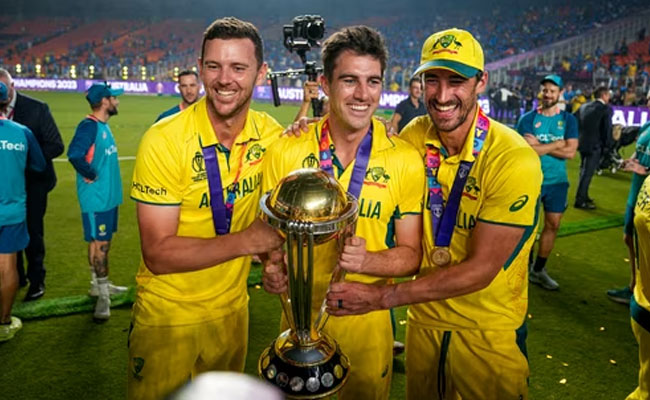
Ahmedabad (PTI): The deafening silence of over 90,000 supporters at the Narendra Modi Stadium, as Pat Cummins snuffed out the peerless Virat Kohli in the World Cup final, was perhaps the "sweetest moment" the Australian skipper has ever experienced on a cricket field.
After becoming the fifth Australian captain to secure his country's sixth ODI World Cup here on Sunday, Cummins admitted that he has "fallen in love with 50-over format all over again".
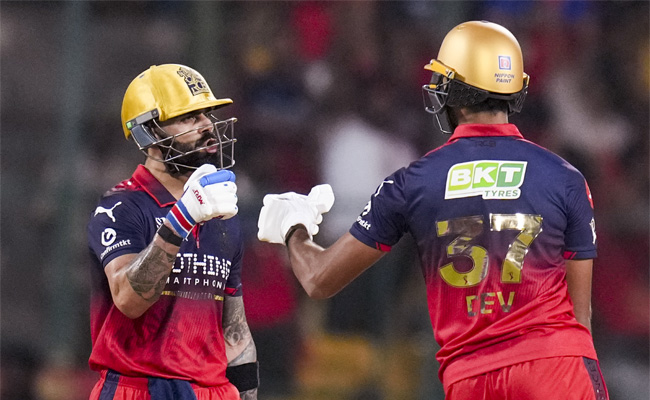
He got Kohli, who was well-set on 54, with a delivery that had an extra bounce and the premier India batter played on trying to jab it towards the covers.
"Yeah, I think so," Cummins nodded in affirmative when asked if the silence was his sweetest experience on a cricket field.
In fact, going against their custom, the Aussies had a second huddle to just acknowledge how big the moment in the game it was.
"We did take a second in the huddle just to acknowledge the silence that was going around the crowd. It just felt like it was one of those days where it was all made for him to score another hundred like he normally does and that was satisfying," Cummins said.
He believes that ODI World Cup is here to stay as it hs got its own legacy and also players have their stories to tell and perhaps, it is the bilateral series that become a problem.
"I must say, maybe because we won, I did fall in love with ODI again this World Cup. I think the scenario where every game really matters, it does mean a bit different to just a bilateral," he acknowledged.
"I mean, the World Cup's got such rich history, I'm sure it's going to be around for a long time. Yeah, there's so many wonderful games, so many wonderful stories within this last couple of months. So, I think there's definitely a place."
He lost his mother in March, during a tour of India, which he had to curtail.
He returned, leading the country to the World Test Championship title, secured the coveted Ashes, and now clinched what he termed the "pinnacle of this sport".
Australia's 'Captain Marvel' has accomplished it all.
"Yeah, I mean at this moment just incredibly proud really of the year we've had. I have obviously had a really big year," he said.
He spoke about the sacrifices made by everyone in the team and their families.
"I know my family at home is watching, just got a message from dad saying he's had a lot of 4am wake ups, not going to bed until 4am, so he's as pumped as anything. So yeah, you sacrifice a lot to play for Australia."
But this was also about going through all of that in search of this day.
"Everyone in the team has and we've spent a lot of this year away but we do it for these moments and my wife and two girls are probably asleep, but they're all pumped, they do the journey with us.
"So, everyone's got their own story, but there's a lot of proud people out there in our team," Cummins said.
From his hotel room, he saw Indian supporters, all clad in blue, walk towards the stadium. He felt a sense of nervous energy, pacing up and down in his hotel room.
"I always like to say I'm pretty relaxed but I was a little bit nervous this morning," he admitted.
"Just pacing around, waiting for it to start, seeing the sea of blue in the hotel getting closer to the ground.
"Observing the sea of blue, cars parked with selfie cameras out, you knew you were walking into something pretty special," Cummins described his experience before the game.
"And then to walk out for the toss and just see 130,000 blue Indian shirts, it's an experience you'll never forget. Awesome day and the good thing was they weren't too noisy for most of it," he said.
The official attendance for the match was 92,543.
Head gamble pays off
Amid all the emotions, the skipper spoke about Travis Head, the man, who always messes with India, be it the WTC final or ODI World Cup final. The Indian team has no answer for him.
"Travis Head was phenomenal. A lot of credit should also go to Andrew McDonald and George Bailey, the selectors, to take a punt," he was all praise for the backroom staff, who had their own conviction in why they needed the southpaw in the mix.
In fact, there was a chance that the decision could have boomeranged.
"He had a broken finger, a broken hand for the half of the tournament, but to keep him in the squad was a huge risk.
"And the medical team were fantastic, obviously, to get him into a place where he could perform. So that was a big risk."
"I think we could have been made to look really silly if that didn't pay off, but you got to take those risks to win a tournament," he added.
The skipper couldn't be happier for a player who is ready to put everything on the line for the team.
"Trav, the player we've seen in Tests, epitomises everything I want in a cricket team. He takes the game on, plays with a smile, puts pressure back on the opposition, and is just great fun to be around. I couldn't be happier for Trav," the skipper wouldn't stop gushing in his mate's praise.
Let the Truth be known. If you read VB and like VB, please be a VB Supporter and Help us deliver the Truth to one and all.
T'gana RTC strike: Talks between govt, employees successful

Hyderabad (PTI): Talks between employees of Telangana State Road Transport Corporation (RTC) who were on strike and the state government concluded successfully on Friday as the government agreed to the key demands of the workmen.
Following a day-long marathon of talks between the leaders of the employees' Joint Action Committee (JAC) and the cabinet sub-committee, the government announced after midnight that it acceded to the demands, including a merger of RTC with the government, 11 per cent pay revision and elections to the employees' unions.
A committee comprising officials and employee leaders would be appointed over the merger of RTC with the government, it said.
The RTC management has also agreed to address the remaining issues as well, an official release said.
The employees would call off their strike and the RTC buses would hit the roads shortly, it said.
The employees had been on an indefinite strike since April 22 over a series of demands, including the merger of RTC with the government.
Earlier in the day, a driver of the RTC, who attempted suicide on April 23 during the strike, died at a hospital here in the early hours of Friday.
Shankar Goud, a 55-year-old driver, set himself ablaze by pouring petrol at Narsampet in Warangal district when the employees were staging a protest on Thursday in support of their demands.
Goud suffered serious burns, was initially admitted to a state-run hospital in Warangal, and later shifted to a super-speciality hospital in Hyderabad for advanced treatment.
"He succumbed (to injuries) at about 1.30 am on Friday," a senior official said.
The driver’s body was taken to his relative’s village, Muttojipet in Warangal district, for funeral rites.
Tension prevailed in Muttojipet as his family members and RTC employees attempted to take the body to the Narsampet bus station, where he worked, to enable his colleagues to pay their last respects. However, police did not permit this, citing law-and-order concerns.
This led to a deadlock before the funeral could proceed.
Union Minister Bandi Sanjay Kumar criticised the Telangana government for not allowing the body to be taken to the Narsampet bus station.
Kumar, Minister of State (Home), visited Muttojipet village in Warangal district, where the funeral was held, and paid homage to Goud.
“They (family members) want to take the body to the bus depot for five minutes. Is the RTC bus depot in Pakistan or Bangladesh? They are emotionally attached to taking the body there. The government is hurting sentiments and creating fear among RTC employees,” Kumar told reporters.
He also expressed anger at the police for not allowing the body to be taken to the bus station and staged a protest, according to a release from his office.
RTC employees and BJP workers attempted to take the mortal remains in an ambulance to Narsampet, but were stopped by the police.
Later, after discussions with the police, the family members and RTC employees agreed to conduct the funeral in the village.
Sanjay Kumar, stating he would abide by the family’s decision, left the village after the funeral was conducted there.
Transport Minister Ponnam Prabhakar said an ex gratia of Rs 10 lakh, a house, and a government job would be provided to the kin of Goud.
Chief Minister A Revanth Reddy expressed shock over the employee’s death and conveyed deep condolences to the grieving family, according to the release.
The RTC employees’ JAC had earlier announced an agitation programme from April 24 to 29, including silent marches and submission of memorandums to MLAs and other leaders.