Simran Shaikh costliest player in WPL mini auction; Sneh Rana goes unsold
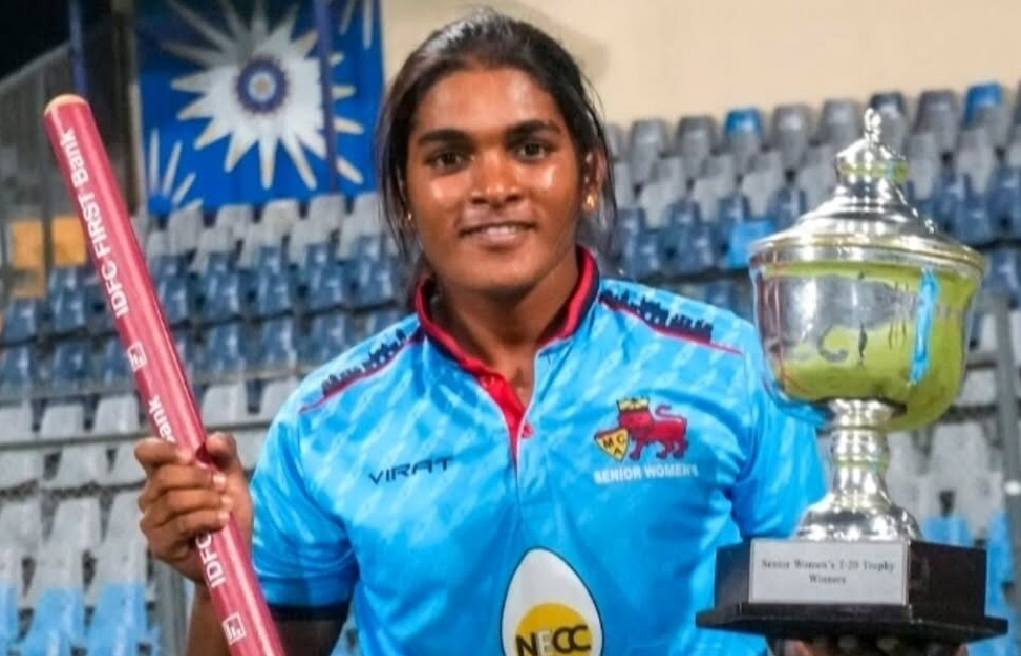
Bengaluru, Dec 15: Mumbai cricketer Simran Shaikh became the costliest player of the Women's Premier League mini-auction 2025, being bought by Gujarat Giants for Rs 1.90 crore even as veteran India player Sneh Rana went unsold here on Sunday.
On a day when five teams competed to fill 19 slots from a pool of 120 players to finalise their squads for next year's WPL, the other top money earners were West Indies stalwart Deandra Dottin (Rs 1.70 crore - Gujarat Giants), 16-year-old U19 wicketkeeper-batter G Kamalini (Mumbai Indians - Rs 1.60 crore), Prema Rawat (Royal Challengers Bengaluru - Rs 1.20 crore) and N Charani (Delhi Capitals - Rs 55 lakh).
Delhi Capitals and Gujarat Giants were involved in a bidding war for Simran before the latter raised the bar to net her.
Simran, 22, a middle-order batter, played a few matches for UP Warriorz during the 2023 WPL season. She has made 176 runs in 11 matches for Mumbai at 22 with a strike rate of 100.57 during the Senior Women's T20 Trophy in October-November this year.
All-rounder Dottin, who is currently in India with the West Indies team for the white-ball series, was the costliest among overseas players and was bought by the Giants for the second time in the auction.
Dottin, 33, a veteran of 132 WT20Is, was one of the three players with base price of Rs 50 lakh and saw UP Warriorz too make a wholehearted bid for her before Gujarat Giants upped the amount.
Dottin was signed by Gujarat Giants for Rs 60 lakh ahead of WPL 2023, but could not play the tournament as the franchise failed to obtain a medical certificate before the season. Dottin had refuted the claims made by the franchise.
Gujarat Giants coach Michael Klinger, speaking to the broadcaster, said that both Dottin and Simran were on their radar for quite some time.
"We were targeting Dottin and Simran. They bring in power and batting at a high strike rate. That often creates a winning culture, so I'm really excited for our first two picks," said Klinger.
Tamil Nadu's G Kamalini, 16, who struck a fine 44 in India's victory over Pakistan in the U19 Women's T20 Asia Cup in Kuala Lumpur on Sunday, also secured her career's biggest pay cheque of Rs 1.60 crore from Mumbai Indians during the auction.
Defending champions RCB added talented leg-spin all-rounder Prema alongwith pace-bowling all-rounders Joshitha VJ, Raghvi Bist, and Jagravi Pawar, for Rs 10 lakh.
"Strengthening our spin arsenal was a key priority. Prema brings great control as a wrist spinner. Additionally, the pace-bowling all-rounders provide the flexibility," said head coach Luke Williams.
Uttarakhand's Nandini Kashyap, who has been named in the Indian squad for the three-match T20I series against West Indies starting Sunday in Navi Mumbai, was roped in by Delhi Capitals.
Delhi Capitals also bought Ireland's Sarah Bryce, Niki Prasad -- India's U19 captain -- and N Charani during the auction.
Another Uttarakhand player, Raghvi Bisht, who is in the India squad for the West Indies T20I series, has been roped in by RCB along with Joshitha JV and Mumbai's Jagravi Pawar.
Mumbai Indians, winners of the inaugural WPL, added South African veteran Nadine de Klerk, Akshita Maheshwari and Sanskriti Gupta for the upcoming edition of the WPL.
Gujarat Giants, who have finished at the bottom of the WPL points table in the two previous editions, also added England's Danielle Gibson and Prakashika Naik.
Australia's Alana King joined her skipper Alyssa Healy at UP Warriorz, who also roped in Arushi Goel and Kranti Goud.
No capped India player was bought during the auction, which included senior player Sneh Rana, who has captained Gujarat Giants in the first edition of the tournament.
Let the Truth be known. If you read VB and like VB, please be a VB Supporter and Help us deliver the Truth to one and all.
Power tariffs under BESCOM to rise from May 1
Bengaluru (PTI): Power bills for consumers under the Bangalore Electricity Supply Company Limited (BESCOM) will go up from May 1, following an order issued by the Karnataka Electricity Regulatory Commission (KERC) on Friday.
The hike comes after KERC allowed the BESCOM to recover a revenue deficit of Rs 2,068 crore incurred in 2024-25, from the consumers.
As a result, for every unit of electricity consumed in 2024-25, the customers will be charged an additional 56 paise, it said.
"BESCOM shall calculate, for each of the active consumers of FY2024-25 the amount to be recovered based on their actual energy consumption during FY2024-25. Such amount shall be recovered during FY 2026-27 in equal monthly instalments, to be called as 'FY25 True up Charges', commencing from the first meter reading date falling on or after 1 May 2026 and concluding with the reading date ending on 30 April 2027," the order said.
"It is further ordered that BESCOM shall maintain a separate head of account, allocated for the purpose, to record the adjustment of the said amount to ensure full recovery of the deficit," it added.
Similarly Chamundeshwari Electricity Supply Corporation Limited (CESC) has also recorded a revenue deficit of Rs 121.71 crore and can collect an additional 15 paisa per unit for consumption in 2024-25, official sources said.