Sooryavanshi headlines U-19 World Cup Team of the Tournament
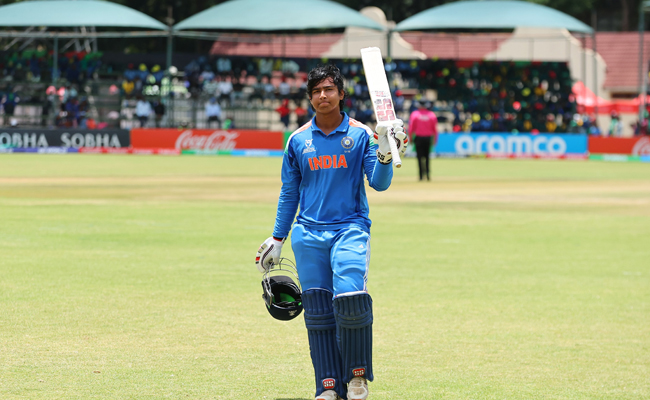
Dubai (PTI): Batting sensation Vaibhav Sooryavanshi was among the three Indians named in the Team of the Tournament for the ICC Under-19 World Cup on Sunday.
The 14-year-old Sooryavanshi, who scored a majestic 175 from 80 balls in the final against England and was subsequently crowned Player of the Tournament, is joined by compatriots Kanishk Chouhan and Henil Patel in the 12-member team. India won the title for a record extending sixth time.
Chouhan made consistently valuable contributions with bat and ball, while Patel’s 11 wickets included a superb spell of five for 16 against the USA.
Runners-up England are also represented by three players, with Thomas Rew named as the captain and wicketkeeper.
Rew scored 330 runs at an average of exactly 66, including a match-winning century in the semi-final against Australia.
Manny Lumsden, who was the tournament’s top wicket-taker with 16, and Ben Mayes, the competition’s leading run-scorer with 444, including 191 against Scotland, join Rew in the team.
Mayes was one run away from equalling the all-time record for the highest individual score at an U19 Men’s World Cup, which had been set four days earlier by Sri Lanka’s Viran Chamuditha – who is also selected.
Chamuditha’s trailblazing 192 came against Japan and included 26 fours and a six.
Afghanistan duo Faisal Khan Shinozada and Nooristani Omarzai are both chosen after playing key roles in their country’s run to the semi-finals.
Faisal finished the tournament with back-to-back centuries against Ireland and India, while Nooristani took 14 wickets, with a best of five for nine against Tanzania.
Australia captain Oliver Peake also scored two centuries, reaching three figures against West Indies and in a losing cause against England in the last four, while Pakistan’s Ali Raza and West Indies’ Vitel Lawes complete the selection.
Raza took 13 wickets at 13.92 apiece, going at just over four an over, while Jamaican left-arm spinner Lawes took 10 scalps in his five matches.
The selection panel was made up of Ian Bishop (Convenor), Lydia Greenway, Andy Flower, Telford Vice.
ICC U19 men’s World Cup Team of the Tournament: Vaibhav Sooryavanshi (India), Viran Chamuditha (Sri Lanka), Faisal Khan Shinozada (Afghanistan), Thomas Rew [wk, capt] (England), Oliver Peake (Australia), Ben Mayes (England), Kanishk Chouhan (India), Nooristani Omarzai (Afghanistan), Vitel Lawes (West Indies), Ali Raza (Pakistan), Manny Lumsden (England), Henil Patel (India).
Let the Truth be known. If you read VB and like VB, please be a VB Supporter and Help us deliver the Truth to one and all.
Delhi: Father, son held for killing 19-year-old woman in suspected honour killing

New Delhi (PTI): The Delhi Police has arrested a man and his son for allegedly murdering his 19-year-old daughter in west Delhi's Hari Nagar area, an official said on Friday.
The case first came to light on April 1 after a PCR call was received around 2 pm, alleging that a woman had been killed by her family members and her body was being taken for last rites, he said.
The accused, identified as Mohammad Maneer (55), a vegetable vendor, and his son Meraj Ali (19), were arrested in connection with the case, the officer said.
The victim had been in a relationship with a man from her native place for the past two years, which was opposed by her father, Maneer and brother Meraj, he said.
"When the girl did not end the relationship despite objections, the family killed her," the officer said.
On April 1, the police said that when their team reached the spot, they found that the woman's body was being taken for burial.
Acting on the input, the burial process was stopped over suspicion of honour killing.
"Police intercepted the family members and took possession of the body," he said.
Police said that the man who had made the PCR told them that the woman was in love with his cousin.
During the inquiry, police also interacted with the PCR caller, who said his cousin, a friend of the deceased, had informed him about the situation and suspected foul play, prompting him to alert the police control room.
The body of the woman was subsequently shifted to the mortuary of Deen Dayal Upadhyay Hospital for preservation and postmortem.
Police said that both the crime team and the forensic science laboratory (FSL) team were called to inspect the scene and collect evidence.
Police said that, as per the postmortem report, the cause of death was identified as smothering, indicating that the woman was suffocated.
A preliminary inquiry also revealed that the family had initiated preparations for the last rites soon after the woman's death, raising suspicion about the circumstances.
Initial investigation pointed to the family's opposition to the woman's relationship.
"The family members of the woman saw her with the man, and she was taken back home. We got to know that she was beaten up and even locked inside the house for some days," a source said.
Further investigation into the matter is underway, police added.