T20 WC: De Kock, bowlers power SA to 7-run win over England
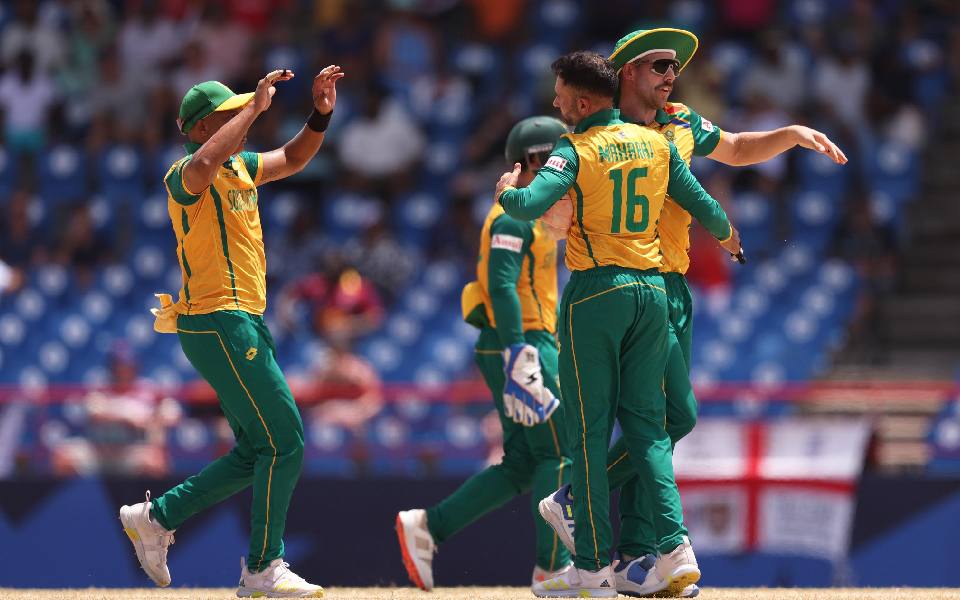
Gros Islet (St Lucia), Jun 21: A fluent fifty by Quinton de Kock and a gritty effort by bowlers powered South Africa to a tight seven-run win over England in their Group 2 Super Eights match of the T20 World Cup here on Friday.
Harry Brook made 53 off 37 balls (7x4) but there was not much contribution from other batters as defending champions ended up at 156/6, chasing 164.
Kagiso Rabada and Keshav Maharaj took two wickets apiece for SA.
Earlier, De Kock made a forceful half-century but South Africa were limited to 163 for six.
De Kock made 65 (38b, 4x4, 4x6), while David Miller (43, 28b, 4x4, 2x6) gave the South African innings the late impetus.
For England, pacer Jofra Archer was the leading wicket-taker (3/40).
Brief scores:
South Africa: 163 for 6 in 20 overs (Quinton de Kock 65, David Miller 43; Adil Rashid 1/23, Jofra Archer 3/40).
England: 156/6 in 20 overs (Harry Brook 53, Liam Livingstone 33; Keshav Maharaj 2/25, Kagiso Rabada 2/32).
Let the Truth be known. If you read VB and like VB, please be a VB Supporter and Help us deliver the Truth to one and all.
NEET student hangs self in Rajasthan's Sikar

Jaipur (PTI): A student preparing for the NEET examination allegedly committed suicide by hanging himself in a rented room in Rajasthan's Sikar on Friday, police said.
According to the police, the student allegedly hanged himself from a ceiling fan using his sister's scarf while one sister was attending coaching classes and the other was in the bathroom.
He had appeared in the NEET UG exam 2026, which was cancelled due to paper leak, they said.
Udyog Nagar SHO Rajesh Kumar said that the deceased, identified as Pradeep Meghwal, was a resident of Kanika ki Dhani village in Jhunjhunu's Gudha Gaudji area.
He had been living in a rented room in Sikar's Jaldhari Nagar area with his two sisters while preparing for NEET over the last three years.
His elder sister later found him hanging and informed the landlord and police after bringing him down, officials said.
The SHO said the body was kept at SK Hospital mortuary, and a postmortem had not been conducted.
The student's father, Rajesh Kumar Meghwal, told police that Pradeep's NEET examination had gone well and the family was expecting him to score around 650 marks.
Former Rajasthan deputy chief minister Sachin Pilot expressed grief over the incident and linked it to anxiety among students after reports of irregularities and paper leaks in NEET 2026.
Pilot said repeated paper leak incidents and cancellation of examinations were affecting students' mental health and demanded a time-bound investigation and strict action against those responsible.