Successful day for Indians at Badminton Worlds
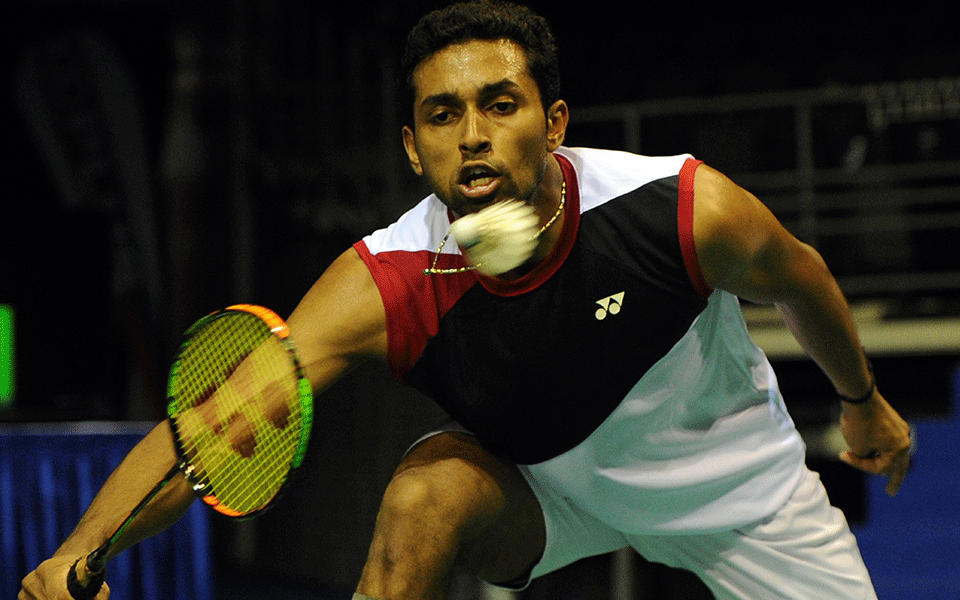
Nanjing (China), July 30: Indian shuttlers enjoyed a comfortable outing on the opening day of the Badminton World Championship on Monday with H.S.Prannoy and Sameer Verma sailing into the second round of the men's singles while the doubles shuttlers also marched to the next round with ease.
Prannoy, seeded 11th in the tournament, hardly broke into a sweat in cruising past unseeded New Zealander Abhinav Manota in straight games 21-12, 21-11 in a match that lasted 28 minutes. He will next take on Brazilian Ygor Coelho in the second round.
Sameer also advanced comfortably to the next round after thrashing France's Lucas Corvee 21-13, 21-10 in a 39-minute affair.
There was good news from the doubles shuttlers too as the men's duo of Manu Attri and B.Sumeeth Reddy and the mixed doubles pairs of Satwiksairaj Rankireddy and Ashwini Ponnappa, and Pranaav Jerry Chopra and N.Sikki Reddy also advanced to the second round.
While Manu and Sumeeth defeated Bulgarian pair Daniel Nikolov and Ivan Rusev 21-13, 21-18 in the 26-minute affair, the mixed doubles combo of Pranaav and Sikki comfortably went past the Czech Republic duo of Jakub Bitman and Alzbeta Basova 21-17, 21-15 in a 30-minute tie.
Later in the day, Satwik and Ashwini floored Denmark's Niclas Nohr and Sara Thygesen 21-9, 22-20 in a tie that lasted 36 minutes.
In another mixed doubles tie, Saurabh Sharma and Anoushka Parikh beat Nigerians Enejoh Abah and Peace Orji 21-13, 21-12 comprehensively in 26 minutes while Rohan Kapoor and Kuhoo Garg defeated Canada's Toby NG and Rachel Honderich 21-19, 21-6 in 28 minutes.
However, it was curtains for the women's doubles pair of Sanyogita Ghorpade and Prajakta Sawant, who lost their opening round clash 20-22, 14-21 to Turkey's Bengisu Ercetin and Nazlican Inci in 34 minutes.
Among others, top seed and defending champion Viktor Axelsen of Denmark enjoyed a comfortable 21-8, 21-7 win over Portugal's Duarte Anjo, while third seed and reigning All England Champion Shi Yuqi of China beat Adam Mendrek of the Czech Republic 21-13, 21-11 to proceed to the second round.
Let the Truth be known. If you read VB and like VB, please be a VB Supporter and Help us deliver the Truth to one and all.
Rickelton's ton in vain as SRH beat MI by 6 wickets
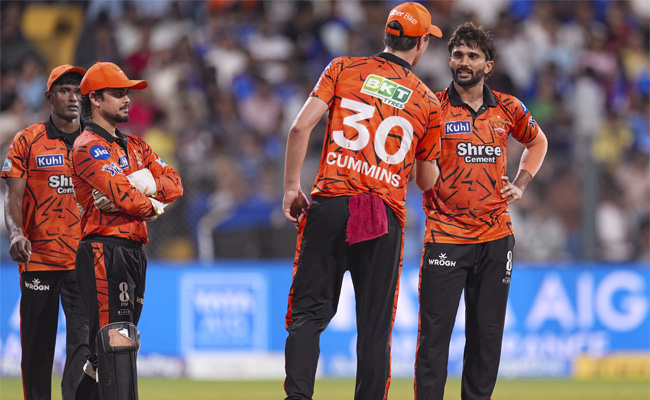
Mumbai (PTI): Ryan Rickelton's whirlwind unbeaten ton was overshadowed by Heinrich Klaasen's unbeaten 65 as Sunrisers Hyderabad defeated Mumbai Indians by six wickets in an IPL match here on Wednesday.
Chasing an imposing 244-run target, Travis Head (76 off 30) and Abhishek Sharma (45 off 24) shared 129 runs for the opening wicket to set the platform for SRH.
Klaasen (65 not out off 30 balls) then displayed his all-round hitting abilities to guide SRH home with the help of Nitish Kumar Reddy (21) and Salil Arora (30 not out off 10) in 18.4 overs.
Earlier, Rickelton's knock powered MI to 243 for five.
MI rode on a 93-run stand between Rickelton (123 not out off 55 balls) and Will Jacks (46 off 22) in 7.1 overs for the opening stand to power the side.
MI skipper Hardik Pandya scored a valuable 31 off 15 balls before being dismissed.
Praful Hinge (2/54), Eshan Malinga (1/29), Sakib Hasan (1/39) and Nitish Kumar Reddy (1/31) were the wicket-takers for SRH.
Brief Scores:
Mumbai Indian: 243 for 5 in 20 overs (Ryan Rickelton 123 not out; Praful Hinge 2/54).
Sunrisers Hyderabad: 249 for 4 in 18.4 overs (Travis Head 76, Heinrich Klaasen 65 not out; AM Ghazanfar 2/51).