Sundar, Shardul guide India to 253/6 at tea after soft dismissals
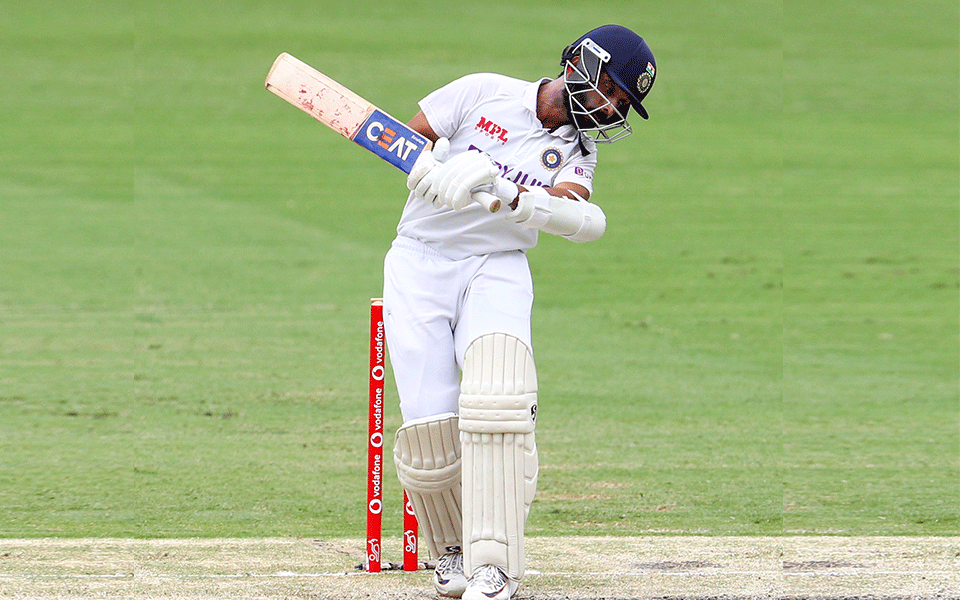
Brisbane: Washington Sundar and Shardul Thakur turned unlikely saviours after three soft dismissals as India reached 253 for six at tea on the third day of the fourth Test against Australia here on Sunday.
With an unbroken partnership of 67, Sundar (38) and Thakur (33) did not let Australia run away with the game after Josh Hazlewood sliced through India's middle-order with the wickets of Mayank Agarwal and Rishabh Pant at the start of second session.
At tea break, India trailed Australia's first-innings total of 369 by 116 runs at the Gabba.
This was largely due to the fight put up by Sundar and Thakur who played their strokes without worrying about the end result, frustrating the high-quality Australian attack with their carefree approach.
However, India were in a spot of bother before their counter-attacking act.
If the visitors lost the big wicket of skipper Ajinkya Rahane to a poor shot at the stroke of lunch, they were dealt another blow right after the break when the persevering Hazlewood lured Agarwal (38) into a loose drive for Steve Smith to complete a catch at second slip on the rebound.
More trouble was in store for India as Pant (23) failed to get past Cameron Green, who pulled off a sharp reflex catch at gully, after the batsman tried to work Hazlewodd through that region.
India were 186 for six at that stage as Australia, still ahead by 183 runs.
This was after Mitchell Starc induced a thick edge off Rahane for Matthew Wade to complete a comfortable catch in the slip cordon after the India captain had got away with similar shots twice in the first hour of play.
It was a shot the seasoned Rahane could have definitely avoided.
The visitors started the day with their overnight pair of Rahane (37) and Cheteshwar Pujara (25) adding 43 runs before the latter fell to a near unplayable delivery by Hazlewood in only his second over of the day.
Until Pujara's dismissal, the experienced duo raised hopes of a big partnership by negotiating the formidable Australian bowling attack in the first one hour of play.
Pujara was his usual solid self while Rahane was a bit more adventurous and lucky as the ball flew past the gap between gully and third slip for boundaries on two occasions.
Before getting out, Pujara square cut Starc for a boundary and also collected four runs with a back-foot square drive through deep point.
Introduced into the attack after 11 overs had been bowled in the day, Nathan Lyon saw Pujara straightaway dancing down the pitch and then running three, which gave Rahane the strike and he rocked on to the back-foot and played the cut shot against the off-spinner for a four through point.
Rahane beautifully punched Cummins for three runs before Australia had their first breakthrough of the day.
Bowling in the channel just outside the off-stump, Hazlewood got one to straighten a bit after angling it in. Pujara had no answer as the ball took an edge through to captain Tim Paine behind the stumps.
Returning to the side after sitting out the third Test, Agarwal showed intent as he looked to keep the scoreboard ticking in the company of his captain.
Batting at number five instead of the opening slot, Agarwal's first boundary was a fortuitous one as a thick edge off Cummins flew between second slip and gully. His second boundary was much better as Agarwal glanced Starc down the leg side.
More convincing was Agarwal's six over long-on off Lyon but the best was the classic straight drive he played against Starc.
Let the Truth be known. If you read VB and like VB, please be a VB Supporter and Help us deliver the Truth to one and all.
Student found dead in hostel room in IIT Kharagpur

Kolkata (PTI): A 22-year-old M Tech student was found dead in his hostel room in the Indian Institute of Technology, Kharagpur, the second such incident reported on the campus within a span of 10 days.
The student, identified as Soham Haldar, was found hanging from the ceiling of his hostel room on Tuesday and he was immediately taken to the institute hospital, where doctors declared him brought dead, an IIT Kharagpur official said.
Haldar, a dual-degree student in Electronics and Electrical Communication Engineering, was a boarder of the Pandit Madan Mohan Malaviya Hall of Residence on the campus.
Police from the Kharagpur Town police station have initiated a probe into the incident as preliminary findings indicated that it could be a case of suicide, though the exact cause of death will be ascertained following the post-mortem examination, the official said.
In a statement, the institute expressed deep grief over the student's death and said a detailed inquiry has been initiated.
The authorities have informed the family and are extending all possible assistance to them, it added.
Director Suman Chakraborty told PTI that the institute will strengthen the mechanism to identify stressed-out and depressed students and take follow-up steps to address their issues.
The grief-stricken parents of the student, who hailed from Barasat in North 24 Parganas district, have come to the campus and the authorities will speak to them, he said.
"Haldar's friends, faculty and staffers also could not gauge any stress or anxiety in him. But we need to enable students suffering from anxiety and extreme stress to open up their minds and do everything needed to prevent such incidents," he said.
Investigators are also scrutinising CCTV footage from the hostel premises to piece together the sequence of events leading to the incident.
The incident comes close on the heels of another student's death reported on April 18, when 21-year-old Jaibir Singh Dodia, a third-year Mechanical Engineering student from Ahmedabad, allegedly died after jumping from the eighth floor of the Atal Bihari Vajpayee Hall of Residence. That case is also under investigation.
The back-to-back incidents have once again brought the issue of mental health and student support systems at the institute into focus, especially in view of several such cases reported last year.