Sunrisers Hyderabad beat Rajasthan Royals by 36 runs, to face KKR in final
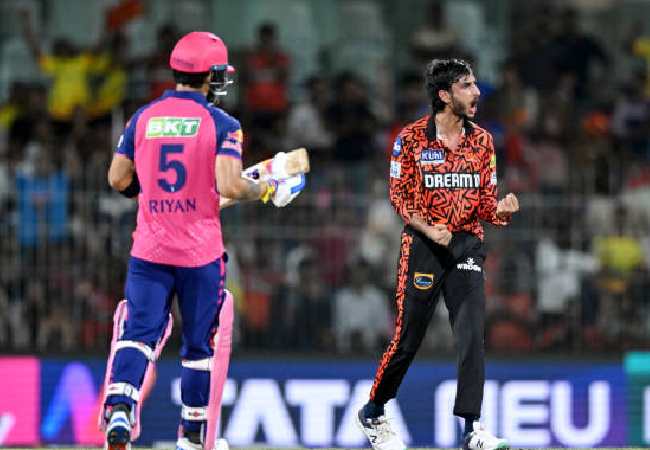
Chennai (PTI): Rajasthan Royals' talented young pretenders miserably failed in a 'Slow Track Test' as Sunrisers Hyderabad's unfancied spin twins Abhishek Sharma and Shahbaz Ahmed spun a web to set-up a 36-run win in the Qualifier 2 and an IPL summit date with Kolkata Knight Riders here on Friday.
The title clash will be played here on Sunday.
Chasing a target of 176, Royals were restricted to 139 for 7 ensuring a third IPL final for SRH after 2016 and 2018.
On a slow track that offered significant turn and grip as the evening progressed and no dew to help batters, Abhishek (2/24 in 4 overs) and Shahbaz (3/23 in 4 overs) forced the Yashasvi Jaiswals, Sanju Samsons and Riyan Parags to press the unwanted 'Harakiri button' in 15 minutes of pure brain fade that ended their hopes of a third final.
Their combined figures of 5 for 47 in 8 overs completely overshadowed the celebrated duo of Ravichandran Ashwin (0/43 in 4 overs) and Yuzvendra Chahal (0/34 in 4 overs), who gave away 77 runs in their quota of overs.
That difference also became the difference between the two sides eventually.
From a comfortable 65 for 1 in 7.4 overs, it suddenly became 79 for 5 by the end of the 12th over.
Abhishek, who had bowled only three overs in 15 games prior this night, suddenly got the ball to dip and turn while Shahbaz's deliveries gripped and one such saw the back of Samson, who waited for an eternity to pull over the cow corner.
Jaiswal and for that matter Parag also couldn't simply get the distance as the ball stopped on them.
The humidity was around 80 percent and hence the absence of dew only made matters worse.
Dhruv Jurel (56 not out off 35 balls) tried his bit but save Jaiswal (42 off 21 balls) all others flattered to deceive.
It must be mentioned that the highly-rated Samson, again failed to score on days when it mattered. Samson's failures on big days have been his biggest undoing and Royals expected a much better effort from their skipper.
It was imperative after Sandeep Sharma, the master operator on tacky surfaces, put his skill-sets to optimum use while restricting Hyderabad to a decent yet manageable 175 for 9.
The Royals bowling could be segregated into three distinct parts despite Heinrich Klaasen's half-century (50, 34b) that had four maximums.
Trent Boult (3/45) started the slide in the Powerplays, Sandeep choked the 'Orange Army' batters in the middle overs while Avesh Khan 2.0 was as
menacing at the death (3/27) as he has been throughout the tournament.
But it was the canny Sandeep (2/25 in 4 overs), who took pace off his deliveries as Sunrisers batters were literally 'Short Third-Manned' with four batters failing to clear the fielder stationed at the edge of the 30-yard circle.
Chahal manning the slot took three catches while Ashwin also got one at the same position.
The problem SRH batters, including the in-form Travis Head (34 off 28 balls), faced was the lack of pace in the surface that became a hindrance while using it for the traditional T20 ramp scoops.
Abhishek (12) at the start became indiscreet when he played one shot too many off Boult and was holed out.
The ploy to use Ashwin (0/43 in 4 overs) with the new ball because of his familiarity with Chepauk didn't work as Rahul Tripathi (37 off 15 balls) hit the senior off-spinner out of the attack.
Just when it seemed that he was taking control on a day when Head wasn't getting his timing right, his poor shot selection while trying to hit Boult over short third became his undoing.
Aiden Markram's re-entry in playing XI didn't pay dividends as he was out slashing at short third-man. However with Klaasen for company, SRH were clawing back at 99 for 3 when Head paid for his profligacy with Sandeep rolling his fingers over.
Klaasen understood that the ball wasn't coming onto the bat and only went for the jugular to the deliveries that were in his arc as he got one of his better half-centuries in difficult conditions before a slower delivery on the blockhole rattled the furniture.
With Klaasen's departure, the chances of getting past 200 also went through the window.
Let the Truth be known. If you read VB and like VB, please be a VB Supporter and Help us deliver the Truth to one and all.
TN seeks duty-free cotton imports to support textile sector: CM Vijay writes to PM
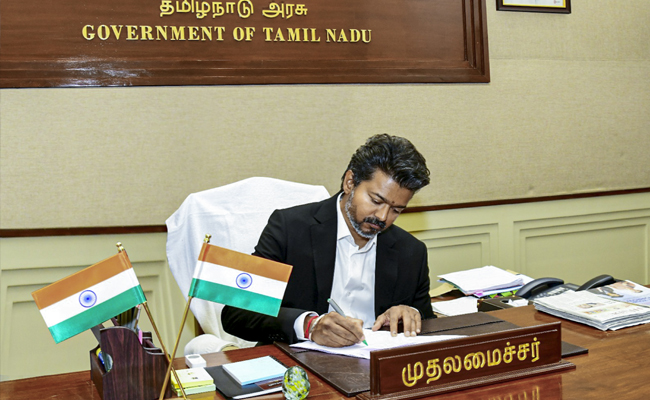
Chennai (PTI): Tamil Nadu Chief Minister C Joseph Vijay on Thursday urged Prime Minister Narendra Modi to remove the import duty on cotton.
In his first letter to Modi after taking over as chief minister of the state, he said Tamil Nadu is the country’s largest textile and apparel exporting state.
Lakhs of people are dependent on this sector for both direct and indirect employment, especially women from rural and semi-urban backgrounds, Vijay pointed out.
Stating that the industry is facing a severe crisis due to an increase in cotton prices and consequently yarn prices, he said, “I understand this is caused primarily due to a shortage in cotton production and increased trading activity in the country.”
Pointing out that the price of cotton has increased from Rs 54,700 to Rs 67,700 per candy—an increase of 25 per cent over the last two months—while yarn prices have increased from Rs 301 to Rs 330 per kg, he said, “In this situation, the continued supply of raw material can be ensured only through imports.”
However, there is an import duty of 11 per cent on cotton, he said, adding that in such a situation, permitting duty-free cotton imports will help the industry meet increasing export commitments and remain globally competitive.
Vijay said that after agriculture, the textile and apparel sector is one of the largest employment-generating sectors.
“There is a significant responsibility on the government to safeguard the employment of lakhs of people and ensure the sustainability of the textile value chain," he said.
“Hence, I request your intervention to remove the import duty on cotton from the existing 11 per cent to 0 per cent to ensure the availability of raw material. This measure will enable the textile and apparel industry to remain globally competitive, enhance exports, and protect jobs,” he added.