Sunrisers Hyderabad beat RR by 1 run in IPL
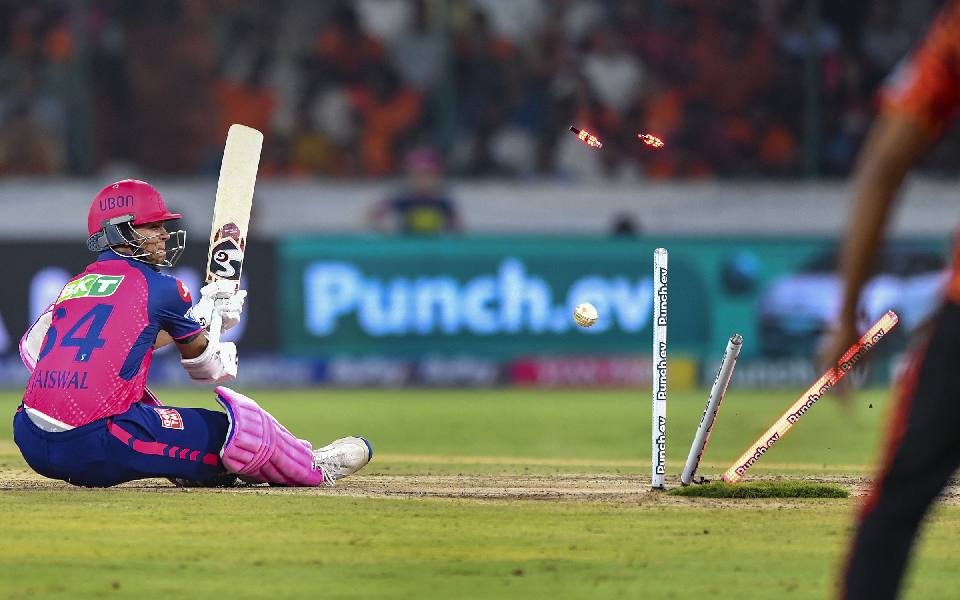
Hyderabad, May 2: Bhuvneshwar Kumar did the star turn with a sensational final over as Sunrisers Hyderabad pulled off a heist, stunning Rajasthan Royals by just one run in a last-ball thriller to keep their IPL playoff hopes alive, here on Thursday.
Needing two to win off the last delivery, Bhuvneshwar (3/41) trapped Rovman Powell (27) with a full toss to leave RR stranded at 200 for seven while chasing a target of 202.
Opting to bat, Nitish Reddy (76 not out) and Travis Head (58) produced explosive fifties, while Heinrich Klassen made an unbeaten 19-ball 42 to power Sunrisers Hyderabad to 201 for three.
Things were looking up when Bhuvneshwar removed Jos Buttler and Sanju Samson for ducks in the opening over to leave RR at 1 for 2.
However, youngsters Yashasvi Jaiswal (67) and Riyan Parag (77) came up with counterattacking fifties on way to a massive 134-run partnership to lay the foundation of the runchase.
But once the duo was back in the hut, Shimron Hetmyar (13) hit a four and a six as it seemed like a regulation chase but T Natarajan got rid off Hetmyar, who perished at long-on and then skipper Pat Cummins removed Dhruv Jurel, who was caught at deep square leg in the 19th over.
The sudden loss of wickets gave SRH hope of a turnaround but Powell produced a six in the last ball of the 19th over to bring the equation down to 13 off six balls.
The West Indian kept a calm head to bring it down to 2 off the last ball but Bhuvneshwar denied him the glory.
Following the win, SRH snapped their two-game losing streak and moved to the fourth spot with 12 points, same as Kolkata Knight Riders, Lucknow Super Giants, while RR stayed at the top with 16 points.
Chasing the total, Jaiswal and Parag were dropped early in their innings and they capitalised on the reprieves to script a quick recovery.
Parag broke the shackles in third over when he carted Bhuvneshwar for two fours and a six. Jaiswal then blasted Marco Jansen for two boundaries after Cummins spilled a straight forward catch.
Parag, who was dropped on 24 by Abhishek Sharma, hammered Cummins for another maximum, before carting Jansen for two more fours.
Cummins finally introduced spin into the attack but Jaiswal smashed Shahbaz Ahmed for a four to complete his fifty. Three balls later, Parag produced a reverse sweep four to reach his milestone in 32 balls.
Jaiwal then played a T Natarajan delivery onto the stumps, while two overs later Parag was holed out at long-on.
Earlier, Head forged a 96-run stand off 57 balls for the third wicket with Nitish, who also added another 70 off 32 balls with Klassen to take SRH across the 200-mark for the fifth time this season.
Head, who was dropped by Parag in the first ball of the innings, hit six fours and three sixes, while Nitish smashed eight maximums and three fours during his brutal assault.
Playing his 300th game, Yuzvendra Chahal, who has been picked for the T20 World Cup, was on the firing line as he conceded 62 in his quota of four overs.
Avesh Khan (2/39) produced the first breakthrough, having Abhishek (12) caught at deep midwicket. Sandeep Sharma (1/31) then claimed a first-ball wicket, removing Anmolpreet Singh (5) as SRH scored 37 for 2 in the powerplay, their lowest this IPL.
The spin duo of Chahal and R Ashwin (0/36), however, disappointed as the batters milked them for runs to set SRH on the road to recovery.
Chahal had a horrible night as Head smashed him for two sixes and a four during an 18-run over after he came on to bowl immediately following the powerplay.
The leg-spinner was then taken apart by Nitish, who plundered him for two sixes and two fours to accumulate 21 runs.
Nitish, who also clobbered Ashwin and Avesh for two maximums, then sent Sandeep sailing over extra cover, while Head pulled Avesh for another six in the 15th over.
The Australian, however, played the pacer onto his middle stump as SRH slipped to 131/3.
New man Klassen then joined the party, sending Chahal into the orbit with back-to-back sixes. When Trent Boult was back, Klassen picked him for two fours, while blasting another six off Sandeep.
Let the Truth be known. If you read VB and like VB, please be a VB Supporter and Help us deliver the Truth to one and all.
Bantwal: SSLC student dies after electrocution

Bantwal: A 15-year-old boy died after coming into contact with an electric wire in Gadiara village on Saturday morning.
The deceased has been identified as Shaheer, son of Sharif, a resident of Neralakatte.
Shaheer, an SSLC student at Mountain View English Medium School, Puttur, had gone to his grandfather’s house in nearby Gadiara village during the school holidays. He came into contact with an electric wire and died at the scene.
He is survived by his parents, a brother, two sisters, and family members.