Surprise maiden India call-up for Ayush Badoni after injury to Washington Sundar
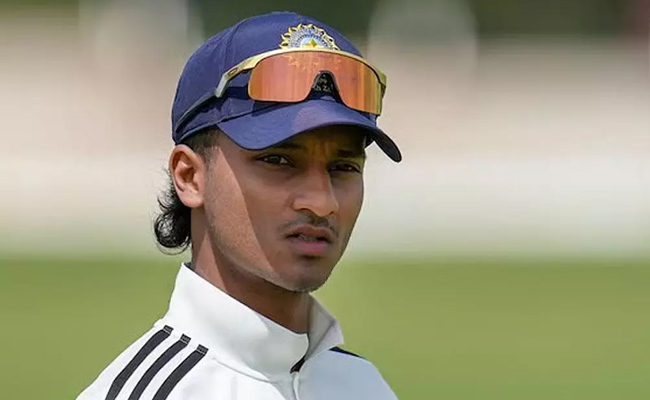
New Delhi (PTI): Uncapped Ayush Badoni on Monday replaced Washington Sundar in India's squad for the remaining two ODIs against New Zealand after the all-rounder was ruled out due to a rib injury.
Washington suffered the injury in the series-opener in Vadodara on Sunday.
The 26-year-old, who bowled five overs for 27 runs, walked off midway through the New Zealand innings and did not return to field. Despite the discomfort, he later came out to bat at No. 8 as India picked up a four-wicket win.
"India all-rounder Washington Sundar reported an acute onset discomfort in his left lower rib area while bowling during the first ODI against New Zealand at the BCA Stadium, Vadodara, on Sunday," said the BCCI in a statement.
"He will undergo further scans, following which the BCCI Medical Team will seek expert opinion. Washington has been ruled out of the remaining two matches.
"The Men's Selection Committee has named Ayush Badoni as his replacement. Badoni will link up with the squad in Rajkot (the game is on Wednesday), the venue for the second ODI," it added.
Badoni being named in the national squad means that he will miss Delhi's quarterfinal against Vidarbha in Bengaluru on Tuesday.
Badoni, primarily a batter who bowls off-spin, has captained Delhi and was deputy to Rishabh Pant in the team's latest Vijay Hazare Trophy campaign.
The 26-year-old rose to prominence with his performances for Lucknow Super Giants in the Indian Premier League where he played under the mentorship of current India head coach Gautam Gambhir.
While Badoni has a batting average of 57.96 in first-class cricket, his List A returns are not that impressive.
He averages 36.47 in 27 games and has done more with the ball than bat in the ongoing Vijay Hazare Trophy.
Delhi head coach Sarandeep Singh spoke about the work Badoni has put on his off-spin over the last year or so.
"He bowls at least 30 balls in every practice session after batting in the nets. He realises that he needs to improve his off-spin to make a strong case as an all-rounder who can fit into the Indian team," Sarandeep said.
"He has improved as a bowler considerably over the last 12 months. He is getting wickets for us regularly, he is a very smart cricketer and learns quickly.
"His off-spin turns sharply and he has a good carrom ball and arm ball as well," the former India spinner told PTI.
Washington is the third Indian player to pick up an injury in the ongoing series.
Earlier, wicketkeeper-batter Rishabh Pant was ruled out after suffering a side strain last week while Tilak Varma is unavailable for the first three T20Is against New Zealand due to a groin injury which required surgery.
Let the Truth be known. If you read VB and like VB, please be a VB Supporter and Help us deliver the Truth to one and all.
Man rapes 13-year-old stepdaughter in Beed; booked
Beed, Apr 13 (PTI): A 13-year-old girl was allegedly sexually assaulted by her stepfather in Maharashtra's Beed district, police said on Monday.
Based on a complaint, the police have registered a case under the Protection of Children from Sexual Offences (POCSO) Act in connection with the incident, which occurred on April 9, an official said.
According to police, the teen's mother divorced her first husband nine years ago and married the accused, with whom she has a son.
On the afternoon of April 9, the accused allegedly sexually assaulted his stepdaughter while his wife was away and threatened her into silence, the official said.
He said that the assault came to light when the mother returned home and noticed a change in her daughter's behaviour and questioned her. The girl narrated the ordeal, following which a complaint was lodged at the Kaij police station.
_vb_65.jpeg)
_vb_90.jpeg)