Suryakumar Yadav, Mohammed Siraj shine in India''s 29-run win over USA in T20 World Cup opener
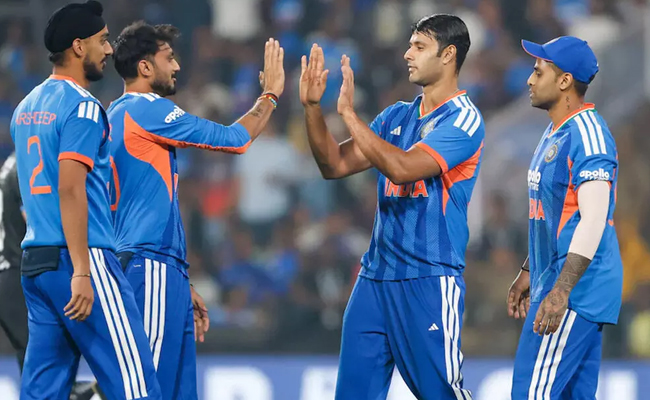
Mumbai (PTI): Skipper Suryakumar Yadav batting just like he does and Mohammed Siraj's incisive first spell headlined defending champions India's scratchy 29-run win against the United States of America despite a stunning top-order collapse in the opening encounter of the T20 World Cup here on Saturday.
A veteran of many-a-battle here at the Wankhede Stadium, Suryakumar's 49-ball unbeaten 84 was a blend of fine rescue act and a defiant counter-attack against a USA attack that proved to be more than mere pushovers.
The Indian captain garnered all his experience of playing at his home ground, reaped rich dividends for being patient but more importantly, disciplined, as plucky USA had India on the mat at 77 for 6 at one stage in the first half.
But Suryakumar's late onslaught which had 10 fours and four sixes after being dropped on 15, took India as far as 161/9 after being precariously placed at 128/7 after 18 overs.
USA, in reply, finished at 132/8 in a meek response with the bat, especially in comparison to their first-innings show in which bowlers kept the high-flying Indians on a tight leash and held on to their catches.
Siraj, who joined the team late Friday evening, came in as a replacement for an indisposed Jasprit Bumrah and bowled a fuller Test match length to take two wickets in his first spell and ended with 3/29 in 4 overs. Once USA were 13 for 3 within fourth over, they didn't have a chance to surpass the middling total.
USA’s fight petered out with Siraj accounting for openers Andries Gous (6) and Saiteja Mukkamalla (2) and Arshdeep Singh (2/18) removing skipper Monank Patel for a duck.
From 13/3 in the fourth over, USA stitched multiple partnerships but never really got back on track of their chase. Milind Kumar (34), Sanjay Krishnamurthi (37) and Shubham Ranjane (37) played useful knocks which only reduced the margin of defeat.
None of them could really dominate and once Varun Chakravarthy (1/24) and Axar Patel (2/24) took charge of the post Powerplay overs giving only 48 runs and taking three wickets in those eight overs.
Earlier, Suryakumar stood tall with a 49-ball innings, single-handedly driving India out of woods after a stunning collapse saw them reeling at 77 for six in the 13th over.
South Africa born Shadley van Schalkwyk returned with figures of 4-0-25-4 as India’s famed batting line-up, barring Suryakumar, endured a horrendous outing with the bat and were in real trouble of being restricted for an under-par total.
The writing was perhaps on the wall when India failed to find a run on the first four balls of the innings with USA not giving any room for the Indian batters to free their arms.
While Ishan Kishan (20) smacked a six off the fifth ball to get rolling, the first blow to India came when Abhishek Sharma fell for a first-ball duck in the second over.
The world No. 1 Abhishek hit Ali Khan’s delivery straight to Sanjay Krishnamurthi at deep cover, and for the first of the several times in the night the Wankhede Stadium fell silent.
The fielding set by US skipper Monank was top notch as he positioned fielders straighter than finer.
Tilak Varma (25) broke the shackles when he danced down to hit a straight off Saurabh Netravalkar (0/65) in the third over and went after van Schalkwyk for three fours in the next and it looked like India were finally up and running.
However, Ishan, having smacked Ali off his pads for a spectacular six, failed to make the most of a dropped catch and hit one straight to mid-on off van Schalkwyk on the first ball of the sixth over.
Van Schalkwyk couldn’t believe his luck when Tilak failed to time a pull off a short ball off one that rose more than he expected, giving catching practice to USA captain Monank Patel.
Shivam Dube (0) is no stranger to the Wankhede wicket but the burly all-rounder was totally outfoxed by an innocuous slow bouncer failing to check his stroke.
Looking completely clueless, Dube was caught in an awkward approach during the time of connection with the ball flying to Netravalkar at short fine leg.
Rinku Singh (6 off 14 balls) couldn’t control his first attacking stroke which went straight to long-on off Mohammad Mohsin (4-0-16-1). Hardik Pandya (5) fell to former Mumbai left-arm spinner Harmeet Singh (4-0-26-2) while trying to clear the sweeper cover, and Axar Patel (14) in his bid to get some late quick runs.
With the onus of getting India out of trouble once again solely on him, Suryakumar dug in deep to farm the strike and rarely missed connecting on the shots that have been his trademark.
Being the only Indian batter to have understood the nature of the wicket completely, Suryakumar opened up finally in the last two overs. He collected 34 runs off those, which included 21 in the last from Netravalkar.
Let the Truth be known. If you read VB and like VB, please be a VB Supporter and Help us deliver the Truth to one and all.
Rickelton's ton in vain as SRH beat MI by 6 wickets
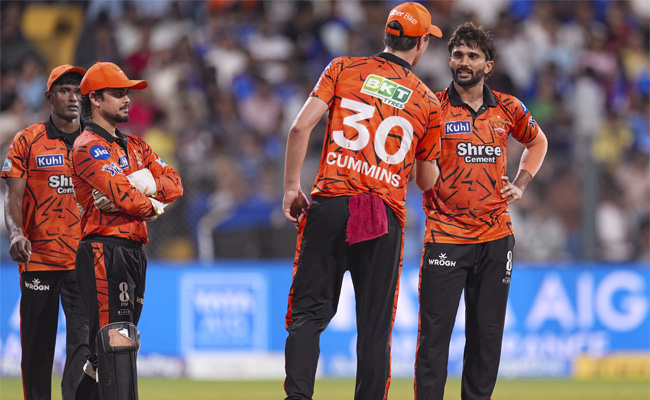
Mumbai (PTI): Ryan Rickelton's whirlwind unbeaten ton was overshadowed by Heinrich Klaasen's unbeaten 65 as Sunrisers Hyderabad defeated Mumbai Indians by six wickets in an IPL match here on Wednesday.
Chasing an imposing 244-run target, Travis Head (76 off 30) and Abhishek Sharma (45 off 24) shared 129 runs for the opening wicket to set the platform for SRH.
Klaasen (65 not out off 30 balls) then displayed his all-round hitting abilities to guide SRH home with the help of Nitish Kumar Reddy (21) and Salil Arora (30 not out off 10) in 18.4 overs.
Earlier, Rickelton's knock powered MI to 243 for five.
MI rode on a 93-run stand between Rickelton (123 not out off 55 balls) and Will Jacks (46 off 22) in 7.1 overs for the opening stand to power the side.
MI skipper Hardik Pandya scored a valuable 31 off 15 balls before being dismissed.
Praful Hinge (2/54), Eshan Malinga (1/29), Sakib Hasan (1/39) and Nitish Kumar Reddy (1/31) were the wicket-takers for SRH.
Brief Scores:
Mumbai Indian: 243 for 5 in 20 overs (Ryan Rickelton 123 not out; Praful Hinge 2/54).
Sunrisers Hyderabad: 249 for 4 in 18.4 overs (Travis Head 76, Heinrich Klaasen 65 not out; AM Ghazanfar 2/51).