T20 World Cup Final: Williamson 85 takes New Zealand to 172/4 against Australia
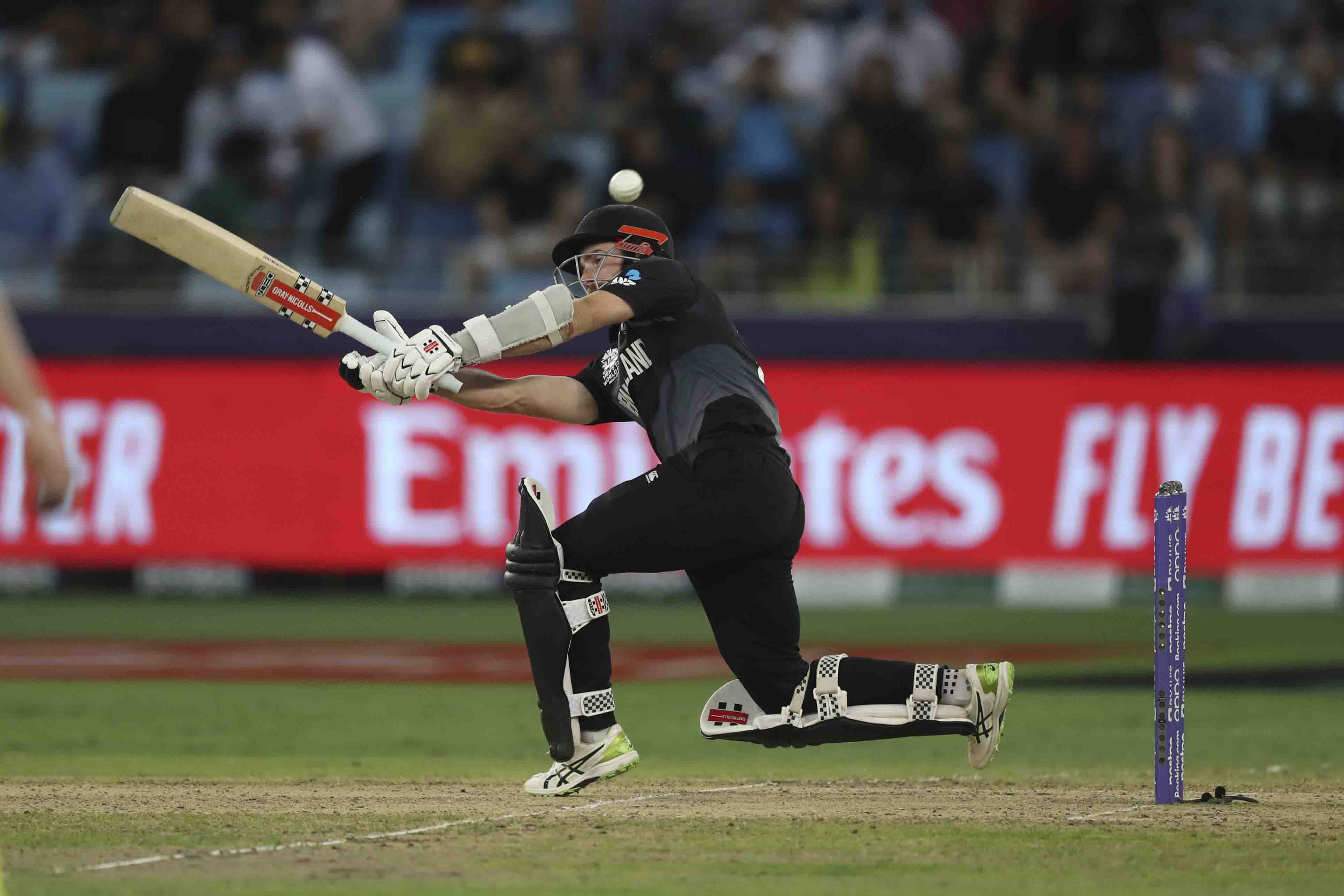
Dubai, Nov 14: Skipper Kane Williamson was brutal and artistic during his beautifully crafted knock of 85, which took New Zealand to a competitive 172 for four against Australia in the T20 World Cup final here on Sunday.
Put into bat, New Zealand literally struggled in the first 10 overs with Martin Guptill's painful 28 off 35 balls slowing the proceedings.
Williamson made the stage his own with a grace of a 'ballet dancer' hitting 10 fours and three sixes in his 47-ball knock.
In the last 10 overs, New Zealand scored an astounding 115 runs to make a match of the 'Grand Finale'.
Williamson shifting gears with such ease that it was a treat to watch him play. The first 16 deliveries that he faced fetched him only 15 runs as Adam Zampa was back then in the midst of a good spell while Guptill's scratchy form also affected the skipper.
But once, he decided that he needed to get a move-on, he hit all those copybook shots at his own free-will scoring 70 off the next 31 deliveries.
The Black Caps skipper showed why he is one of the modern-day greats during the back-10 as he strategically took the attack back to the opposition camp. He became the captain with the highest score in a T20 World Cup final surpassing Kumar Sangakkara.
He first turned the tide in the 11th over when he launched into Mitchell Starc (0/60 in 4 overs) taking 19 off his over including a dropped catch behind square by Josh Hazlewood.
The manner in which he creamed Starc through mid-off by charging down the track, was the most delightful one among the three that he smashed in that over.
When Starc came for his third over and team's 16th, his confidence was already shaken and Williamson made a mockery of him with class of Test match batting mixed with a dash of T20 flair.
One for the ages was a 'pick-up flick' when Starc dragged one into his pads and it soared into the Dubai skyline before landing in the gallery.
If Starc's second over was very bad, the worse came in his third which yielded the Kiwis 24 runs including four fours and a six.
It was a 'half-century' of ignominy that he would like to forget and also forgive Josh Hazlewood for what could possibly be a 'match-turning' bungle.
Hazlewood (3/16 in 4 overs) though was pick of bowlers along with Adam Zampa (1/24 in 4 overs).
The first half of the night certainly belonged to Williamson, who again reiterated the age-old saying -- a technically accomplished Test batter can play any format with authority as he did during an en evening when it mattered the most.
Let the Truth be known. If you read VB and like VB, please be a VB Supporter and Help us deliver the Truth to one and all.
AI, IndiGo, SpiceJet seek ATF price relief; say airline industry on verge of 'stopping operations'
Mumbai (PTI): Air India, IndiGo and SpiceJet have told the government that the country's airline industry is under extreme stress and on the verge of "stopping operations", as they sought revision in ATF pricing and financial support.
The West Asia turmoil has pushed up oil prices, and airspace restrictions have increased airlines' operating costs, especially on long-haul routes. Aviation Turbine Fuel (ATF) accounts for around 40 per cent of a carrier's operational expenses.
Against this backdrop, the Federation of Indian Airlines (FIA) has written to the civil aviation ministry, seeking steps to extend the same fuel pricing mechanism uniformly across both domestic and international operations as was done in the past with the establishment of the crack band.
ALSO READ: Tharoor junks Rijiju's claim that he agreed Cong is 'anti-women'; hails his party
With an unprecedented rise in jet fuel prices and exorbitant crack/differential between crude and ATF, the federation said the operation of airlines is being challenged in totality.
"... any ad hoc pricing (domestic vs international) and/or irrational increase in the price of ATF will result in unsurmountable losses for airlines and will lead to grounding of aircraft, resulting in cancellation of flights," the federation, which represents Air India, IndiGo and SpiceJet, said.
"In order to survive, sustain and continue operation, we request your urgent intervention for immediate and meaningful financial support to tide over the current situation," it said in a letter on April 26.
Also, the airlines have sought temporary deferment of excise duty on ATF, which is at 11 per cent.
"With the abnormal increase in ATF prices from the pre-crisis period, adding rupee depreciation to the increased prices, the 11 per cent excise duty also increases manifold for the airlines and adds to the ATF price as a big impact on airlines," they said.
Last month, the government limited the hike in ATF price to Rs 15 per litre for domestic operations, but for international operations, the price rose by Rs 73 per litre.
The airlines said the situation has practically made international operations, along with domestic operations, completely unviable and resulted in significant losses for the aviation sector in April.
Seeking urgent intervention on the current ATF ad hoc pricing, FIA said the current situation is creating a severe imbalance in domestic and international operations and rendering airline networks unviable and unsustainable.
"The airline industry in India is under extreme stress and is on the verge of closing down or of stopping its operations."
The federation has pitched for a transparent pricing framework under the crack band mechanism (USD 12–22/BBL) that was implemented in October 2022, saying there was a fair and reasonable margin for Oil Marketing Companies (OMCs).
According to FIA, the country's largest aviation hub Delhi has the second-highest value-added tax (VAT) of 25 per cent on jet fuel, while the highest rate is 29 per cent levied in Tamil Nadu.
"The other major aviation cities, viz. Mumbai, Bangalore, Hyderabad, and Kolkata range between 16 per cent and 20 per cent. These 6 cities cover more than 50 per cent of airlines' operations within India," the federation said.