There are better fast bowlers in Indian T20 cricket than Shami: Ricky Ponting
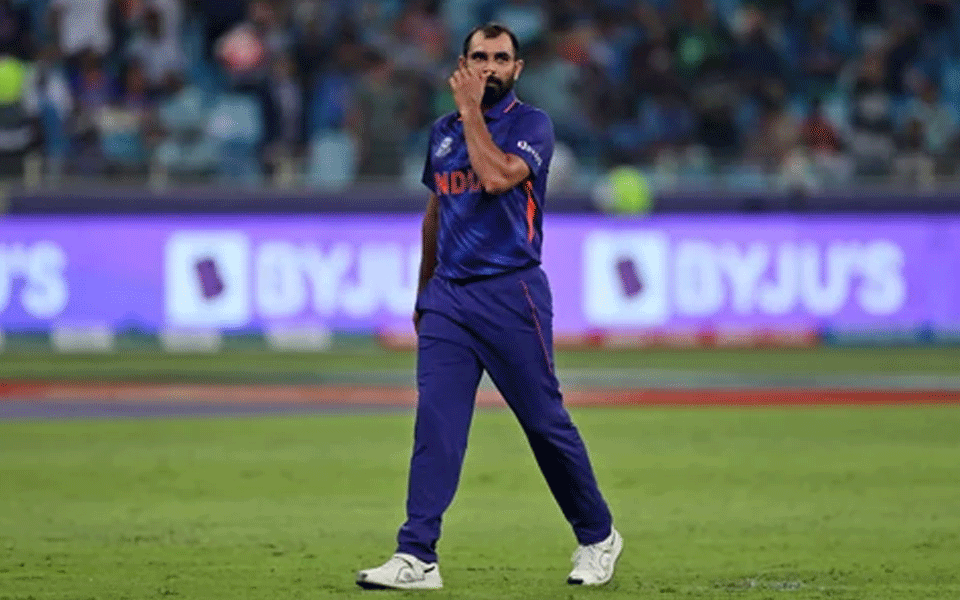
Dubai (PTI): Australian legend Ricky Ponting feels Mohammed Shami's strength lies in the longest format and there are better quick bowlers in India's T20 set up, weighing in on his absence from the Asia Cup squad.
India have picked Bhuvneshwar Kumar, Avesh Khan and Arshdeep Singh as the three specialist fast bowlers with all-rounder Hardik Pandya being the fourth pacer in the 15-member squad.
"He's (Shami) been a very, very good bowler for India for a long time now. If you look at his strengths, his Test cricket is probably where he thrives the most," Ponting, a two-time World Cup-winning captain, said in the latest episode of The ICC Review.
"I think there are better fast bowlers in Indian T20 cricket than Shami and they've only named three (for the Asia Cup). So if there's potentially four named in the squad he might be the fourth man in."
With Jasprit Bumrah and Harshal Patel nursing injuries, many felt Shami might be included to share the new-ball duties during the Asia Cup.
"I would think they'll probably only have the four quicks coming to Australia. They'll still want to bring a lot of spin here even though the wickets are probably not that conducive," Ponting said.
The Asia Cup will be held in Dubai and Sharjah from August 27 to September 11 and Ponting picked India as the favourites to win the tournament.
"It's always hard to go past India in any tournament, not just an Asia Cup, but I think every time we talk about the T20 World Cup which is coming up, I think that India will be right in the thick of it there," the 47-year-old said.
"Their depth is definitely better than the other teams and I think India will win the Asia Cup."
Arch-rivals India and Pakistan haven't competed in a bilateral series for nearly a decade now.
"To be totally honest it's one that we've been starved of, haven't we looking back the last 15 or 20 years," Ponting said.
"As a cricket lover like I am and a cricket observer, any time those sorts of battles come up it's almost always nice to sit back and watch because everything just goes up a notch, doesn't it?
"When I think about rivalries, Australia and England and Ashes cricket is the pinnacle I've always thought of for our Test match game. I'm sure India and Pakistanis will say the same about that and the actual rivalry would be the pinnacle of Test match cricket for those two countries as well."
Ponting believes India have the depth to prevail over Pakistan.
"I'll stick with India to win that clash against Pakistan. That's taking nothing away from Pakistan because they are an incredible cricket nation that continue to present out-and-out superstar players." PTI ATK
Let the Truth be known. If you read VB and like VB, please be a VB Supporter and Help us deliver the Truth to one and all.
Rupee falls 11 paise to 94.27 against US dollar in early trade

Mumbai (PTI): The rupee depreciated 11 paise to 94.27 against US dollar in early trade on Monday driven by persistent dollar demand and a broader shift toward safe-haven assets.
Forex traders said the Indian rupee has hit a rough patch, falling for five consecutive sessions, weighed down by a combination of factors such as the RBI loosening its grip on currency rules and rising oil prices caused by global tensions.
Moreover, investors are becoming cautious again, with foreign institutions pulling money out of the market after a brief period of buying amid rising geopolitical uncertainty.
At the interbank foreign exchange market the rupee opened at 94.25 against the US dollar, then lost some ground and touched 94.27 against the US dollar in initial trade, registering a fall of 11 paise over its previous close. On Friday, the rupee had settled at 94.16 against the American currency.
ALSO READ: Death toll in Mundathikode fireworks explosion rises to 16
Meanwhile, the dollar index, which gauges the greenback's strength against a basket of six currencies, was down 0.09 per cent at 98.44.
Brent crude, the global oil benchmark, was trading higher by 1.16 per cent at USD 106.55 per barrel in futures trade.
A mix of softer economic signals and renewed, even if fragile, hopes of diplomacy pulled the dollar lower again, CR Forex Advisors MD Amit Pabari said, adding that for Rupee, on one hand, a softer dollar offers relief. On the other, uncertainty remains the dominant force.
Meanwhile, India’s forex reserves have crossed USD 703 billion as of April 17, reflecting a consistent build-up of buffers.
"For now, the rupee continues to lean toward gradual weakness. Uncertainty remains the dominant force, shaping both global flows and local reactions," Pabari said.
He further noted that any dips are likely to be bought into, with the 92.80–93.20 zone acting as a strong support. On the upside, 93.50 to 94.50 is expected to define the near-term range.
On the domestic equity market front, the 30-share benchmark index Sensex was trading 518.96 points or 0.68 per cent higher at 77,183.17, while the broader Nifty was trading up 131.30 points or 0.55 per cent at 24,029.25.
Foreign Institutional Investors offloaded equities worth Rs 8,827.87 crore on Friday, according to exchange data.