Tokyo Paralympics: Harvinder Singh wins bronze, India's first archery medal in Paralympics
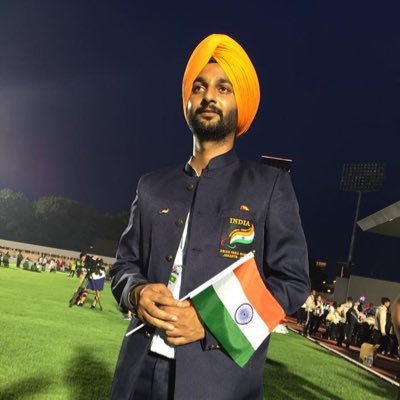
Tokyo, Sep 3: Harvinder Singh on Friday notched up India's first ever archery medal in the Paralympics, holding his nerves to down Kim Min Su of Korea in a thrilling shoot-off for the men's individual recurve bronze in the ongoing Games here.
World No.23 Singh was the first athlete from India to win a gold medal at a major para competition in the 2018 Asian Games.
An economics scholar from the Punjabi University, Patiala, Singh collected three shoot-off wins on the day starting with his triumphs in the opening rounds.
In the bronze playoff, the 31-year-old was leading 5-3 before the Kroean clinched the fifth set shooting a perfect 10 to force a shoot-off where the Indian responded in style shooting a perfect 10 against Kim's 8 for a 6-5 (26-24, 27-29, 28-25, 25-25, 26-27) (10-8) win.
In the semifinals, Singh lost to world number 10 Kevin Mather of the USA 6-4 in an intense five-setter (25-28, 24-24, 25-25, 25-24, 24-26).
Singh, who hails from a small village Guhla Cheeka near Kaithal in Haryana, was stretched to the fullest in the first two rounds, but he showed tremendous resilience to overcome his fancied opponents via shoot-offs.
In the first round of 32, Singh squandered a 4-0 lead against Stefano Travisani after shooting a 7 in the third set as his Italian rival made it 5-5 (27-24, 26-22, 26-27, 25-25, 25-27) to force a shoot-off.
Singh clinched the issue -- 6-5 (10-7) -- in style, shooting a perfect 10 in the tie-breaker as his rival managed just a 7.
In the last-16, Singh pipped former world number one Bato Tsydendorzhiev of Russia, once again by the thinnest of margins 6-5 (8-7).
Singh effected a spectacular turnaround from 0-4 down to bring the match on an even keel 5-5 (26-28, 23-26, 29-26, 23-21, 28-28) and force a shoot-off where he edged out his Russian opponent 8-7.
In the quarters, Singh swept aside 49-year-old three-time Paralympian Maik Szarszewski of Germany 6-2 (25-21, 28-23, 25-28, 26-23) dropping just one set.
Hailing from a middle-class farming family, Singh had dengue when he was just one-and-half years old and a local doctor administered him an injection that had an adverse effect and his legs stopped working properly.
Let the Truth be known. If you read VB and like VB, please be a VB Supporter and Help us deliver the Truth to one and all.
MediaOne TV Facebook page restored after block linked to ‘government request’

Kochi: The official Facebook page of Malayalam news channel MediaOne TV has been restored after being blocked without prior notice, the broadcaster said on Wednesday.
The channel was quoted by Maktoob as saying that the restriction was lifted automatically, with Meta Platforms informing it that the action had been taken following a “government request” which has now expired or been reversed.
The development came shortly after the channel approached the Kerala High Court challenging the blocking of its page, terming it arbitrary and in violation of legal provisions and judicial precedents. The High Court had issued notice to Meta via email hours before the restriction was withdrawn.
In its petition, the channel said access to its Facebook page had been restricted for users in India without citing any specific content or alleged violation. It contended that while individual posts may be taken down under applicable a rule, blocking an entire page goes beyond the scope of such measures.
The incident followed an earlier action taken against the channel in 2022, when the Ministry of Information and transmitting prohibited it from transmitting. It cited national security concerns regarding the Ministry of Home Affairs' refusal of security clearance.
The Supreme Court of India in April 2023 set aside the ban, observing that national security claims cannot be made without substantive basis and that criticism of government policies does not render a media outlet anti-national.