Ton-up Rohit Sharma takes India to a commanding 202/0 at tea against SA
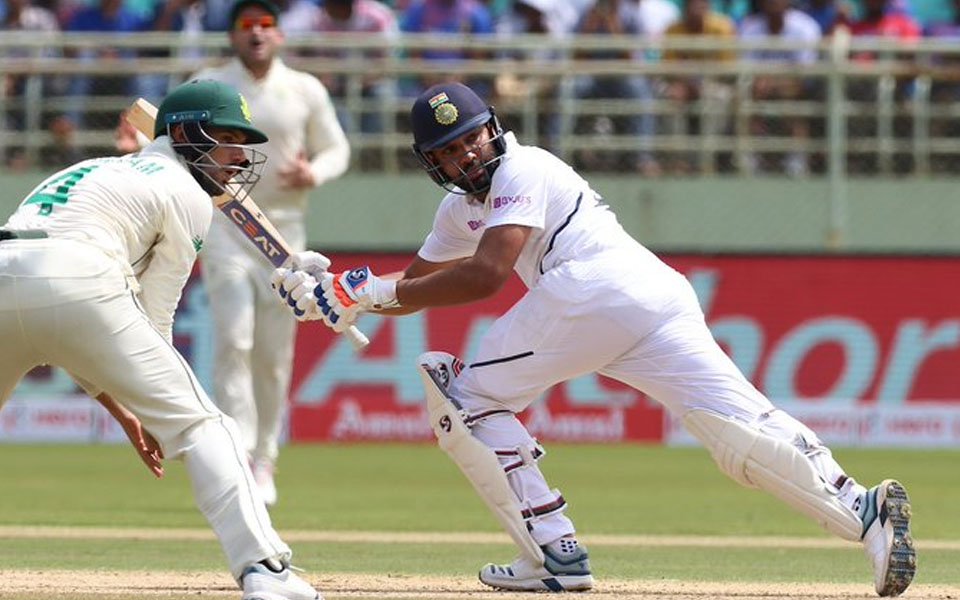
Visakhapatnam, Oct 2: Rohit Sharma made a dream start as a Test opener, scoring an unbeaten 115 off 174 balls to take India to a commanding 202 for no loss at tea on day one of the series opener against South Africa here on Wednesday.
While South African bowlers did trouble the Indian batsmen on a few occasions in the first session, they seemed toothless in the afternoon session where Rohit and Mayank Agarwal (84 not out off 183) scored at a brisk rate.
Rohit, who got to his fifty before lunch, shifted gears and was particularly harsh on the spinners.
He hammered offie Danie Piedt for successive sixes over deep midwicket to get into the nineties before completing his fourth Test ton with a single off debutant spinner Senuran Muthusamy.
The entire dressing room including skipper Virat Kohli stood up to laud Rohit's feat. His unconquered innings comprised 12 fours and five sixes.
At the other end, Agarwal was cruising towards his maiden Test ton. He too looked assured at the crease and played his shots.
Early into the afternoon session, he brought up his half century with a spectacular six over extra cover off Keshav Maharaj.
Clouds gathered over the stadium towards the end of the session and thunderstorms forced the umpires to take the tea break eight minutes before scheduled time.
Earlier, Rohit and Agarwal played out 30 overs in the morning session after safely negotiating the South African pacers Kagiso Rabada and Vernon Philander, taking India to 91 for no loss.
India, who had named their playing on the eve of the first Test, opted to bat on a dry surface with skipper Kohli calling his decision a "no brainer."
Expecting the pitch to turn, South Africa picked three spinners in Maharaj, Piedt and Muthusamy, who is more of a batting all-rounder.
All eyes were expectedly on Rohit whose stop-start Test career has taken a new direction with the management accommodating him at the top of the order.
He left the first ball he faced before driving Rabada past backward point with minimal feet movement for a four.
His second scoring shot was also a boundary as he punched Philander towards backward point. The pitch offered very little to the pacers and spinners in the first two hours of play.
What worked for Rohit was standing outside the crease when Philander was bowling to negate any little swing that was available.
Rabada has the express pace but he did not test the Indian openers as much as Philander.
Rohit and Philander's battle in the first hour was absorbing. Philander, who got the better of Rohit in the warm-up game, challenged Rohit by moving the ball both ways in his opening spell of four overs.
After a few play and misses, Rohit chose to walk down the pitch before South Africa skipper Faf du Plessis asked wicketkeeper Quinton de Kock to stand up to the stumps.
India reached 37 for 0 in 15 overs with Rohit and Agawal looking solid in the middle.
After getting the measure of the surface, Rohit went for his strokes like he does in white-ball cricket.
His first big hit was a typical one as he gently stepped out of the crease to smash Maharaj over long-on. A little later, he played a similar short off Piedt, only this time the ball flew well above the long-on fielder.
Rohit completed his 11th Test half-century towards the end of the session but in a not so convincing fashion. He mistimed a sweep but fortunately it was not in the reach of the fielder and went for four.
Let the Truth be known. If you read VB and like VB, please be a VB Supporter and Help us deliver the Truth to one and all.
Rickelton's ton in vain as SRH beat MI by 6 wickets
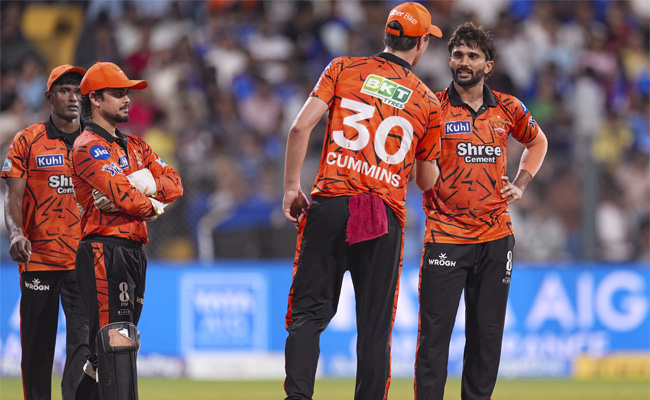
Mumbai (PTI): Ryan Rickelton's whirlwind unbeaten ton was overshadowed by Heinrich Klaasen's unbeaten 65 as Sunrisers Hyderabad defeated Mumbai Indians by six wickets in an IPL match here on Wednesday.
Chasing an imposing 244-run target, Travis Head (76 off 30) and Abhishek Sharma (45 off 24) shared 129 runs for the opening wicket to set the platform for SRH.
Klaasen (65 not out off 30 balls) then displayed his all-round hitting abilities to guide SRH home with the help of Nitish Kumar Reddy (21) and Salil Arora (30 not out off 10) in 18.4 overs.
Earlier, Rickelton's knock powered MI to 243 for five.
MI rode on a 93-run stand between Rickelton (123 not out off 55 balls) and Will Jacks (46 off 22) in 7.1 overs for the opening stand to power the side.
MI skipper Hardik Pandya scored a valuable 31 off 15 balls before being dismissed.
Praful Hinge (2/54), Eshan Malinga (1/29), Sakib Hasan (1/39) and Nitish Kumar Reddy (1/31) were the wicket-takers for SRH.
Brief Scores:
Mumbai Indian: 243 for 5 in 20 overs (Ryan Rickelton 123 not out; Praful Hinge 2/54).
Sunrisers Hyderabad: 249 for 4 in 18.4 overs (Travis Head 76, Heinrich Klaasen 65 not out; AM Ghazanfar 2/51).