
Top-seeded Aryna Sabalenka powers her way into the quarterfinals at the Australian Open
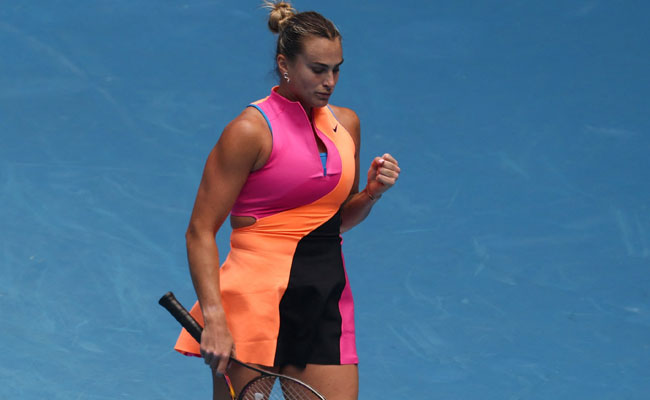
Melbourne (AP): First-seeded Aryna Sabalenka, attempting to win her third Australian Open title in four years, reached the quarterfinals on Sunday with a victory over No. 17 Victoria Mboko of Canada 6-1, 7-6 (1).
Sabalenka, using a high-powered serve that produced three aces in the first set, rolled over the 19-year-old Canadian in just 31 minutes.
Sabalenka was not quite as dominant in the second set — producing a few more unforced errors — against Mboko, who played well enough to beat many players but not the two-time Australian Open champion.
“What an incredible player for such a young age,” the 27-year-old Sabalenka said of the young Canadian. “It's incredible to see these kids coming up on Tour. I can't believe I say that. I feel like I'm a kid.”
“She pushed me so much, and I'm happy to be through,” Sabalenka added in her on-court interview.
Sabalenka led the second set 4-1, and then failed to convert three match points while leading 5-4. Mboko slowly took back the momentum and forced a tiebreaker only for Sabalenka to dominate.
It was the 20th straight tiebreak victory for Sabalenka.
“I try to — not to think this is a tiebreak and play point by point, and I guess that's the key to consistency,” she said.
Sabalenka won this Grand Slam in 2023 and 2024 and was the runner-up last year against Madison Keys. The Belarussian has also won two U.S. Open titles.
In a later match Sunday at Rod Laver Arena, the top-seeded man Carlos Alcaraz of Spain faced American No. 19 Tommy Paul for a spot in the quarterfinals.
Alexander Zverev and Coco Gauff, the third seeds on the men and women's side, also played later for spots in the quarterfinals.
Let the Truth be known. If you read VB and like VB, please be a VB Supporter and Help us deliver the Truth to one and all.
KMC Mangaluru team led by Dr. Haroon files patent for absorbent pads for elderly women
Aims to address urinary incontinence in elderly women
_vb_78.jpeg)
Mangaluru: Kasturba Medical College (KMC) has filed a patent application for “Absorbent Pads” designed to address urinary incontinence among elderly women, a condition that remains largely underreported despite its widespread impact.
Urinary incontinence does not command urgency like a heart attack, nor does it evoke the same collective response as more visible illnesses. However, for those living with it, the burden is constant, intimate, and often isolating.
There is a gradual and often unspoken impact on daily life. It begins with hesitation, declining invitations, avoiding travel, and choosing silence over conversation. Over time, this can lead to withdrawal, where fear of embarrassment starts shaping everyday decisions. For many elderly women, dignity becomes tied to small, often invisible compromises, including limiting outings or adjusting routines.
What makes this condition particularly poignant is not just its prevalence, but its invisibility. It is endured, not expressed. Accepted, not addressed.
It is in this context that the recent innovation assumes importance. The team at KMC, which includes clinicians such as Dr Haroon Hussain, has approached the issue not merely from a technical standpoint but from the perspective of lived experience.
The proposed solution, biodegradable, antimicrobial absorbent pads with improved fluid control and reduced irritation, aims to go beyond basic functionality, addressing comfort, safety, and dignity.
The development also reflects the role of academic institutions in addressing everyday health challenges. When research focuses not only on major diseases but also on conditions that affect quality of life, it reinforces the broader purpose of healthcare.
However, experts note that innovation alone cannot fully address the issue. Urinary incontinence continues to be underreported, often dismissed as an inevitable consequence of ageing. Many women do not seek medical help, not due to a lack of solutions, but because of stigma and discomfort associated with discussing the condition.
This creates a paradox, a widespread issue that is often experienced in isolation.
Medical professionals emphasise that greater awareness and open conversations are essential. Families must learn to speak about such issues without embarrassment. Healthcare providers must create spaces where patients feel heard without judgment.
The significance of this innovation lies not only in its technical aspects but also in what it brings into focus, that even the most private discomforts deserve public attention.
The patent application was filed by a team comprising Dr. Haroon Hussain, Dr. Sameena, Dr. Ritu Raval of Manipal Institute of Technology, Syed Ayaan Hussain Rizvi, and Suzanne Riya Dsouza.
_vb_49.jpeg)

_vb_90.jpeg)