TT star Manika Batra alleges national coach Roy asked her to fix match in Olympic qualifiers
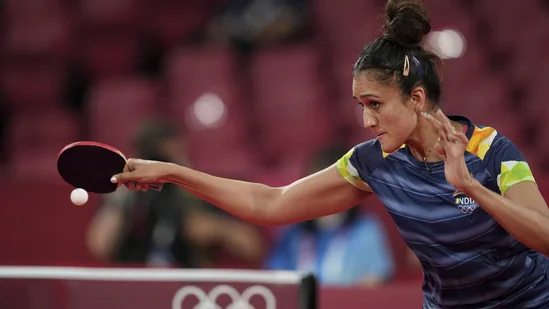
New Delhi, Sep 3: Table tennis star Manika Batra has alleged that national coach Soumyadeep Roy asked her to throw a match during the Olympic qualifiers in March and that was the main reason she refused his help in the singles competition of the Tokyo Games.
Responding to Table Tennis Federation of India's show cause notice, Manika strongly denied that she brought disrepute to the game by refusing Roy's help.
According to TTFI sources, the world number 56 stated she would not have been able to focus on her match if someone who asked to her indulge in match-fixing months earlier was sitting by her side.
"Besides the need to avoid disturbance due to his last minute intervention, there was an additional and much more serious reason behind my preference to play without the national coach," the Khel Ratna awardee alleged in her response to TTFI secretary Arun Banerjee.
"The national coach had pressurised me during the qualification tournament in Doha in March 2021 to concede my match to his student to enable her to qualify for Olympics - in short- to indulge in match-fixing," she said.
Despite repeated attempts, Roy was not available for a response to the allegations. The player-turned coach has also not been asked to join the ongoing national camp and has been told by TTFI to present his side of the story.
"The allegations are against Roy. Let him respond and then we will decide future course of action," said Banerjee when asked about Manika's response to the show cause notice.
Roy is a former Commonwealth Games gold-medallist in the team event and also an Arjuna awardee.
Both Manika and Sutirtha Mukherjee, who train in Roy's academy, ended up qualifying for the Tokyo Olympics. Manika qualified on her higher world ranking after losing to Sutirtha, who secured the Olympic quota from the event held in Doha.
"I have evidence of this incident and I am ready to present it to the competent authorities at the appropriate time. For asking me to concede the match, the national coach personally met me in my hotel room and talked to me for nearly 20 minutes," said Manika.
"He tried to promote his own student using unethical means under the pretext of national interest. He was accompanied by his student who trains in the private academy not only run by, but also named after him.
"From my side, I did not promise to oblige him and promptly reported this matter to a TTFI official. I decided not to obey the unethical command of the national coach. But his intimidation and pressure had its effect on my mental frame and consequently my performance.
"During the Olympics, I wanted to keep away from the demoralising effect of such a coach. Because, as a player representing India, it was my duty to serve my country in the best possible way."
Manika made history by reaching the third round while Sutirtha also did well to reach the second round.
TTFI had called Manika's refusal to take Roy's advice as an act of indiscipline and showcaused her.
"I strongly deny the charge therein that I brought disrepute to TTFI, Government of India and the country and undermined the appointment of the national coach by playing my singles matches in the Tokyo Olympics without the presence of the national coach in the field of play.
"In fact and on the contrary, I have served my country and TTFI in the best possible way by playing my matches alone," she wrote.
Manika also questioned TTFI for not taking action against Roy.
"I have been falsely charged with 'bringing disrepute to the country by the sight of an empty chair of the coach'. But the truth is that the 'empty chair' was the result of the national coach's pressure tactics for match fixing and TTFI's inaction to act on my prompt reporting of that incident and not the result of my so-called 'indiscipline'.
"Unfortunately, when I raised the issue of the match fixing pressure tactics by the national coach again in my e-mail dated 14'th August 2021, TTFI refuted this issue outright without even a preliminary, impartial and transparent inquiry.
"Finally, to reiterate and summarise, I have done nothing wrong in playing my matches alone," she asserted.
Let the Truth be known. If you read VB and like VB, please be a VB Supporter and Help us deliver the Truth to one and all.
4 held for sexually assaulting woman, girl on moving bus after social media alert in UP's Agra

Agra (UP) (PTI): Four people were arrested, after a prompt response by police following a social media alert, for allegedly sexually assaulting a woman and a girl inside a moving bus here, officials said on Tuesday.
According to an official police statement, at 12:27 am on April 27, information was received on the social media platform X about an incident of sexual assault on a bus travelling from Kanpur to Ahmedabad, which was approaching Namner crossing in Agra.
Acting under the direction of Police Commissioner Deepak Kumar, the Agra Police social media team immediately alerted the Rakabganj police station within minutes and coordinated with the victims to confirm the incident and obtain the exact location, it stated.
Police teams launched intensive checking at Namner crossing and intercepted the bus as it reached the spot. The four accused involved in the incident were apprehended on the spot, and legal action was initiated against them, the statement said.
The police said the swift response and coordination between the social media team and field units ensured timely action, bringing relief to the victims and other passengers, who expressed gratitude towards the police, it added.