Viacom 18 bags media rights for Women's IPL for 951 crore
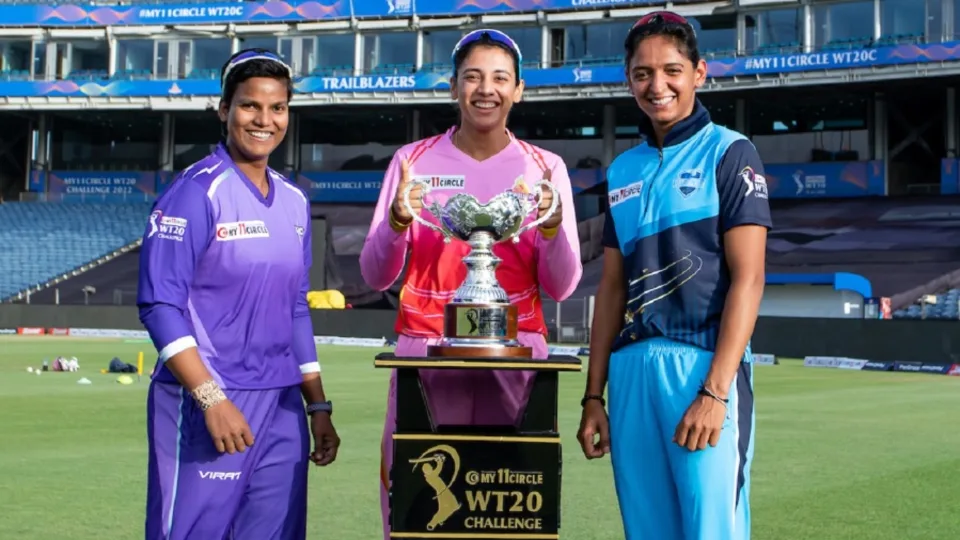
New Delhi, Jan 16: The BCCI on Monday announced that Viacom 18 have grabbed the media rights for the upcoming Women's IPL for a whopping Rs 951 crore for five years after pipping other bidders, including Disney Star and Sony, in a closed-bid auction.
The auction for the T20 league was conducted by the cricket board in Mumbai on Monday. The inaugural Women's IPL is likely to begin in the first week of March. Five teams will compete and all the matches will be held in Mumbai.
The global rights comprise three categories -- linear (TV), digital and combined (TV and digital) and Viacom 18 successfully bid for the combined rights.
In the men's IPL, separate rights are sold across regions.
"Women's cricket has been on the up since a few years and the recently concluded bilateral series against Australia is a great testament to how popular women's cricket has become in India," BCCI president Roger Binny said in a release issued by the board.
"It was only apt to get our own women's T20 league and give the fans more of women's cricket."
According to BCCI secretary Jay Shah, the fee per match will come to Rs 7.09 crore for the next five years.
"The broadcasters play a key role in taking the game to a wider audience and their active interest in the league is a clear indication that the Women's Indian Premier League is headed in the right direction. The per-match valuation of Rs INR 7.09 crore is something that has never previously been registered for a women's game," Shah said.
"I congratulate Viacom18 for securing both the TV and digital rights with a combined bid of INR 951 crores and welcome them on Board. The journey has well and truly started and we will take another major step this month when the five franchises are announced."
Viacom18 had won the IPL digital rights for Rs 23,758 crore while Disney Star had retained the TV rights for Rs 23,575 crore for a five-year period starting 2023 during a three-day auction held in June, 2022.
IPL governing council chairman Arun Singh Dhumal said: "The faith of all our bidders for this process also testifies that they see value in investing in this property which will only be growing with each passing year.
"Women's cricket has shown immense growth in the past few years and our own T20 league, it only solidifies our approach towards women's cricket and the potential it has for growth in India."
Some of the country's biggest stars in the women's game, such as national team skipper Harmanpreet Kaur and senior opener Smriti Mandhana, lauded the BCCI after the big announcement.
"Huge congratulations to Viacom18 and @BCCI, @JayShah for a historic day in women's cricket. Today marks a new era where our women cricketers will get the platform they deserve to thrive, excel and develop on the global stage. I'm sure you'll be mesmerized by the talent we have!" Harmanpreet tweeted.
Mandhana said, "Today's a day that every Indian women cricketer will remember. The #WIPL is finally taking shape. @BCCI, @JayShah and all those involved deserve huge praise. Women's cricket will go to the next level with this global stage provided. Come on girls, it's all yours for the taking!"
Let the Truth be known. If you read VB and like VB, please be a VB Supporter and Help us deliver the Truth to one and all.
Trump rushed out of dinner event after shots fired; one arrested
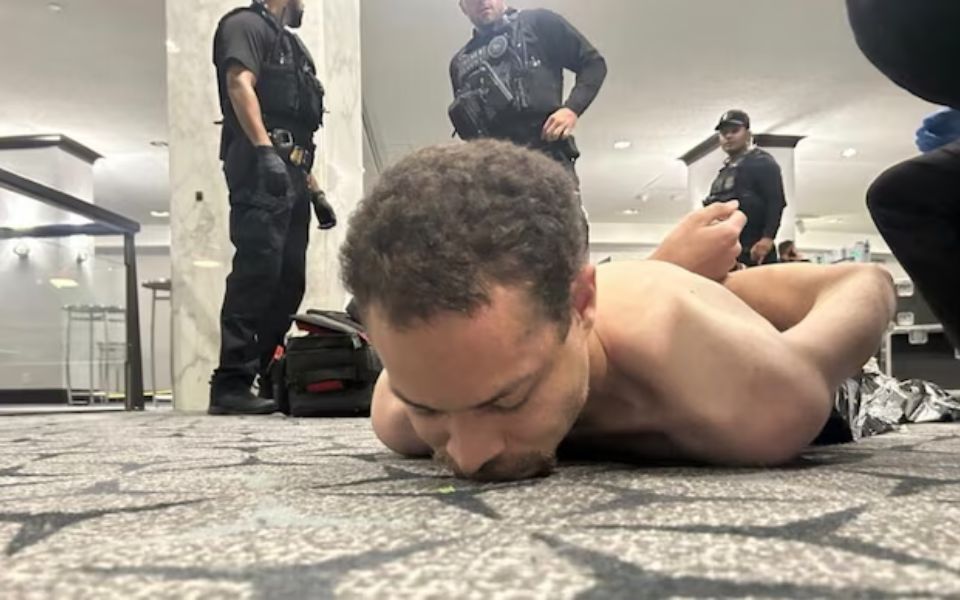
Washington (PTI): US President Donald Trump and other top White House officials were evacuated unharmed from the annual dinner of White House correspondents after a man armed with multiple weapons fired shots outside the ballroom of the hotel.
The incident took place at around 8:34 PM local time when dinner was served. At that time, Trump was seen having a conversation with Weijia Jiang, the President of the White House Correspondents' Association, and mentalist Oz Pearlman, who was scheduled to present a show at the marquee event at the Washington Hilton here.
Secret Service officials and other security personnel covered the President, First Lady Melania Trump, Vice President J D Vance, and the Second Lady Usha Vance, who were seated at the head table, and escorted them out of the ballroom.
Several guests at the dinner, including leaders across the political spectrum, journalists and other invitees, ducked under the table, apparently as a reflex reaction.
Putting up a brave face, President Trump later announced on Truth Social that the dinner would be rescheduled within 30 days.
“Boom, boom, boom, boom is all that I heard, and many guests ducked under the table,” a C-SPAN reporter at the dinner said.
Hours later, Trump addressed a press conference at the White House and announced that the security personnel had captured one person who hails from California.
“I heard a noise and sort of thought it was a tray going down. I've heard that many times. It was a pretty loud noise, and it was from quite far away. He (the attacker) hadn't reached the area at all. They really got him,” Trump told reporters, recalling the incident.
Trump said one security officer was shot at but saved as he was wearing a bulletproof vest.
Several protestors had lined up on the road outside the hotel, raising slogans against the Trump administration and Defence Secretary Pete Hegseth.
A CNN reporter who was outside the ballroom at the Washington Hilton said he saw a gunman opening fire just a few feet away. He was among the dozens of attendees who took cover as law enforcement swarmed the venue.
The suspect has been identified as 31-year-old Cole Tomas Allen from California.
Asked how Saturday’s incident impacts him as the US president, Trump told reporters he is in a dangerous job but that he is no “basket case.”
“I like not to think about it. I lead a pretty normal life, considering, you know, it’s a dangerous life. I think I handle it as well as it can be handled,” Trump said.
Trump has survived two assassination attempts over the past two years – first at a presidential election campaign rally in Butler, Pennsylvania, on July 13, 2024, and later in Palm Beach, Florida, on September 15, 2024.
“I will say you had Republicans, Democrats, independents, conservatives, liberals, and progressives...everybody in that room, big crowd, record-setting crowd,” he said.
“We had some great work done by law enforcement, but in light of this evening's events, I ask that all Americans recommit with their hearts in resolving our differences peacefully,” Trump said.