Virat Kohli might give up captaincy in other formats to focus on his batting: Ravi Shastri
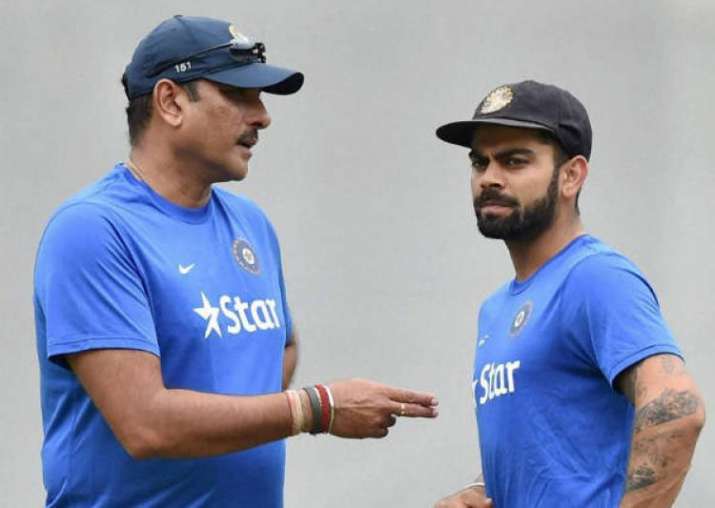
New Delhi, Nov 12: Former India head coach Ravi Shastri says Virat Kohli might give up captaincy in other formats after doing so in the T20 version to deal with the intense pressure associated with the job, especially in COVID times.
Shastri's tenure with the Indian team ended with an early exit from T20 World Cup.
Kohli, who has taken rest for the T20 series and one Test against New Zealand to recover bubble fatigue in COVID times, has relinquished captaincy in the shortest format after the showpiece event.
Speaking to India Today, Shastri was asked about Kohli giving up captaincy in other formats to manage his workload better.
"In red ball cricket, India have been number one for the last five years under his captaincy. Unless, he wants to give it up or he is mentally fatigued where he says he wants to focus on my batting which can happen in the near future.
"It won't happen immediately but it can happen. The same might happen with white ball cricket, he might say he had enough and he focuses on Test captaincy. It is his mind and body that will make that decision. He won't be the first.
"A lot of successful players have given up captaincy to focus on their batting for their side."
Shastri said Kohli remains the fittest cricketer in the team by far.
"He is hungry for sure, fitter than anybody in the team. No doubt about that. When you are physically that fit, your longevity only increases. On the captaincy part of it, it will be his decision but I see if anything he might say no to white ball cricket but red ball, he should carry on because he has been the best ambassador for the test cricket. That will make him carry on," said Shastri.
Shastri also foresees many players in the team, including Kohli taking long breaks to recover from bubble fatigue.
He also spoke on the relevance of split captaincy in COVID times.
"Especially, in these times it will reduce the pressure on the individual. A lot of players will take breaks. I foresee lot of plays wanting breaks and rightly so. You need to switch off from the game from time to time."
Shastri reiterated that playing World Cup right after IPL was not ideal for the team but didn't want to blame BCCI as the re-scheduling happened because of COVID-19.
"I won't say that but because IPL was cancelled in April, they had no choice. But I don't think that will happen in the future. Kapil is right about the scheduling part because it will take its toll," he said when asked to comment on Kapil Dev's statement on players prioritising IPL over country.
"It is not just the BCCI, every board has to be careful on scheduling. Don't forget, we play more cricket than any other team in the world, if you add the IPL."
New Zealand and Australia face in the final on Sunday.
"The teams that are playing in the final on Sunday, they have hardly played in the last 6 months and you can see the difference. They have played enough to keep themselves sharp but they have got enough round of rest, at times forced as well," Shastri said.
Let the Truth be known. If you read VB and like VB, please be a VB Supporter and Help us deliver the Truth to one and all.
AI, IndiGo, SpiceJet seek ATF price relief; say airline industry on verge of 'stopping operations'
Mumbai (PTI): Air India, IndiGo and SpiceJet have told the government that the country's airline industry is under extreme stress and on the verge of "stopping operations", as they sought revision in ATF pricing and financial support.
The West Asia turmoil has pushed up oil prices, and airspace restrictions have increased airlines' operating costs, especially on long-haul routes. Aviation Turbine Fuel (ATF) accounts for around 40 per cent of a carrier's operational expenses.
Against this backdrop, the Federation of Indian Airlines (FIA) has written to the civil aviation ministry, seeking steps to extend the same fuel pricing mechanism uniformly across both domestic and international operations as was done in the past with the establishment of the crack band.
ALSO READ: Tharoor junks Rijiju's claim that he agreed Cong is 'anti-women'; hails his party
With an unprecedented rise in jet fuel prices and exorbitant crack/differential between crude and ATF, the federation said the operation of airlines is being challenged in totality.
"... any ad hoc pricing (domestic vs international) and/or irrational increase in the price of ATF will result in unsurmountable losses for airlines and will lead to grounding of aircraft, resulting in cancellation of flights," the federation, which represents Air India, IndiGo and SpiceJet, said.
"In order to survive, sustain and continue operation, we request your urgent intervention for immediate and meaningful financial support to tide over the current situation," it said in a letter on April 26.
Also, the airlines have sought temporary deferment of excise duty on ATF, which is at 11 per cent.
"With the abnormal increase in ATF prices from the pre-crisis period, adding rupee depreciation to the increased prices, the 11 per cent excise duty also increases manifold for the airlines and adds to the ATF price as a big impact on airlines," they said.
Last month, the government limited the hike in ATF price to Rs 15 per litre for domestic operations, but for international operations, the price rose by Rs 73 per litre.
The airlines said the situation has practically made international operations, along with domestic operations, completely unviable and resulted in significant losses for the aviation sector in April.
Seeking urgent intervention on the current ATF ad hoc pricing, FIA said the current situation is creating a severe imbalance in domestic and international operations and rendering airline networks unviable and unsustainable.
"The airline industry in India is under extreme stress and is on the verge of closing down or of stopping its operations."
The federation has pitched for a transparent pricing framework under the crack band mechanism (USD 12–22/BBL) that was implemented in October 2022, saying there was a fair and reasonable margin for Oil Marketing Companies (OMCs).
According to FIA, the country's largest aviation hub Delhi has the second-highest value-added tax (VAT) of 25 per cent on jet fuel, while the highest rate is 29 per cent levied in Tamil Nadu.
"The other major aviation cities, viz. Mumbai, Bangalore, Hyderabad, and Kolkata range between 16 per cent and 20 per cent. These 6 cities cover more than 50 per cent of airlines' operations within India," the federation said.