Virat Kohli returns to Vijay Hazare Trophy: King’s tryst with silence and chaos
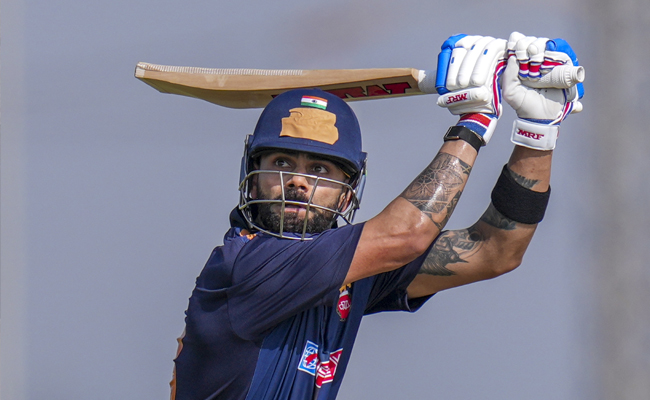
Bengaluru (PTI): Virat Kohli’s 58th List A hundred resembled a grand opera played inside an empty Royal Albert Hall.
Kohli’s 83-ball knock for Delhi against Andhra in the Vijay Hazare Trophy was magnificent as usual in its execution, but there were no screaming spectators to garnish the occasion here at the BCCI Centre of Excellence.
The Karnataka government’s reticence to grant permission to host matches at the M Chinnaswamy Stadium citing security reasons forced the KSCA to shift matches to CoE, and the venue was out of bounds for fans.
ALSO READ: Kohli goes past Tendulkar to become fastest to 16000 List A runs
So, instead of a roaring house, a tranche of snail-paced cargo trucks, a large posse of police personnel and few fans gawking over the barbed concrete walls provided an austere setting for Kohli’s return to Vijay Hazare Trophy after 15 years.
Kohli himself might have found it a tad bizarre. For a better part of the last decade and half, the 37-year-old has always walked onto a cricket field to an uproarious welcome.
Even his return to Ranji Trophy earlier this year after a hiatus of 12 years at Ferozeshah Kotla had drawn huge crowds.
But on a sunny Wednesday, Kohli made a rather unfamiliar, lonely walk to the middle — no cheers, no chants of "Kohli... Kohli!" and not even that ubiquitous RCB cries that reverberate around stadiums irrespective of the formats he plays.
The thick veil of silence was breached only when the fielding side players chatted among themselves or when occasional applause emanated from the respective dressing rooms.
But the entire sight had its own charm. A champion cricketer who has always been flanked on either side by fame and fans, was now doing it all alone.
There were short chats and high-fives with teammates, a diving stop to deny Ricky Bhui another boundary, and a quick word of advice to Delhi pacer Navdeep Saini when Andhra batters carted him around.
Kohli even jived to some imaginary tune. Perhaps, an effort to recreate an air of exuberance and theatre around him, something he loves to do so dearly on a cricket field.
He was trying to flame the dramatist inside him, which often drove him to some dizzying peaks.
Kohli the master batter
But that situational solitude did not affect his batting. Barring a couple of drops, Kohli slipped into his familiar ‘Chase Master’ garb with ease.
His money shots were on full view on Wednesday — pulls, charge to spinners, flicks, cuts and those beautiful perpendicular bat straight drives.
Fifty came in 39 balls and 100 in 83 balls, but none of those moments were celebrated with usual gusto. But a simple wave to the dressing room marked the occasion.
In fact, silence shrouded those moments so deep that a blink could have made one miss them.
But there was another side to it. Perhaps, Kohli too might have enjoyed that slice of loneliness which he often craves for.
That search for privacy has made him set an alternate base in London apart from his uber posh Mumbai dwelling. Here, he had all the desired isolation.
But the day ended in familiar chaos. Andhra cricketers and officials mobbed him for photographs and autographs, and he obliged with a smile.
“It was a dream to play in the same match as Kohli. I always wanted to play with or in the opposition (of Kohli), and the all the Andhra cricketers were elated at the opportunity,” said fellow centurion Ricky Bhui after the match.
As boxing legend Frank Bruno once said: ‘Boy! That’s cricket.”
Let the Truth be known. If you read VB and like VB, please be a VB Supporter and Help us deliver the Truth to one and all.
Injured Phil Salt returns home for scans
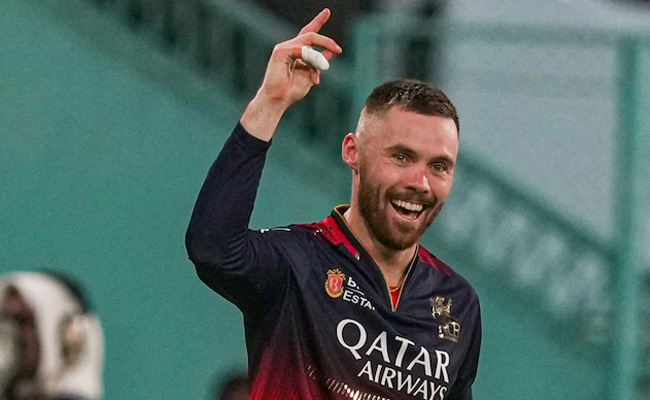
New Delhi (PTI): Royal Challengers Bengaluru opener Phil Salt has returned to England for scans on a finger injury sustained last month.
The injury has kept Salt out of RCB's last three matches, with compatriot Jacob Bethell stepping in at the top of the order.
The 29-year-old is reported to have "damaged a finger on his left hand" while diving to save a boundary at deep backward square leg during RCB's defeat to Delhi Capitals at the M. Chinnaswamy Stadium on April 18.
"Salt, who is centrally contracted by the ECB, has since returned home at the request of England's management and has undergone scans on his finger," ESPNCricinfo reported.
According to the report, both RCB and Salt are hopeful of a speedy recovery and the opener can return to India later this month.
Salt had enjoyed a strong start to the season, amassing 202 runs in six innings at an impressive strike rate of 168.33.
RCB are currently second on the points table behind Punjab Kings. They take on Lucknow Super Giants (LSG) on Thursday next.