Virat Kohli ton powers RCB to 183/3 against RR in IPL
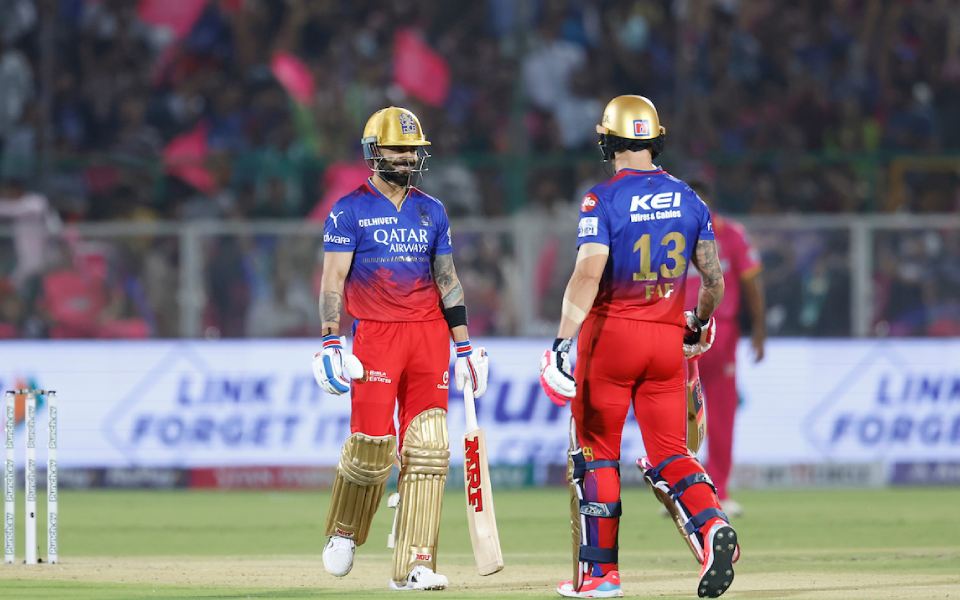
Jaipur, Apr 6: Virat Kohli enhanced his status as a lone ranger by notching up a record-extending eighth IPL century but Royal Challengers could only manage just about par-score of 183 for 3 against Rajasthan Royals here on Saturday.
Kohli showed superb improvisation, from his wrist-rolled pulls, powerful swat flicks to steer through third man as he remained unbeaten on 113 off 72 balls and has now scored 38 percent of RCB's total runs so far.
Kohli smashed 12 fours and four sixes and barring the assistance received from his skipper Faf Du Plessis (44 from 33 balls; 2x4, 2x6), he did not get any support from the other batters.
After reaching his fifty in 39 balls, Kohli stepped up well and took just 28 balls for his next fifty as he reached the milestone with a single off Nandre Burger in the penultimate over.
Glenn Maxwell (1) and debutant left-hander Saurav Chauhan (9), who failed to replicate his Syed Mushtaq Ali T20 form, fell cheaply.
Credit should go to RR spin duo of Ravichandran Ashwin (0/28) and Yuzvendra Chahal (2/34) who stifled the proceedings in the middle overs.
Chahal was exceptional as he cleverly deceived the batters with his pace and variations by bowling googlies and sliders to fox the RCB batters.
Put in, RCB had their best ever start in this IPL when Kohli and Du Plessis saw through the power play for the first time this season in a 125-run opening partnership.
The duo put on a steady 53-run inside the power play, thanks to a brilliant over by Ashwin who conceded just three runs in the fifth over to pull them back.
Their pace spearhead Trent Boult bowled short and Kohli pulled them to get into the zone, while Nandre Burger was wayward and leaked 26 runs from his two overs inside the power play.
Thanks to Ashwin's over, RR had RCB in check even as the visitors had all their wickets intact.
Chahal further tightened the noose by brilliantly stifling Kohli in the eight over where he conceded just four runs.
But Du Plessis broke the shackles smashing Boult for two sixes in the ninth over, while Kohli also got it going against his former RCB teammate, smashing Chahal for six.
Sanju Samson took a gamble to bring in Riyan Parag against the set opening duo in the 11th over.
The part-time spinner, who bowls with a sling action even troubled the duo before being smashed by Kohli into the stands to bring up his third fifty this season. It came off 39 balls.
Riyan had a chance to break the partnership but he dropped a tough return catch from Du Plessis on 36.
Chahal finally broke the opening stand in an eventful 14th over, dismissing Du Plessis.
In the same over, Kohli was dropped on 66, a tough chance by Burger at point, and then Boult grassed a sitter from the South African at extra cover.
However in the next ball, Buttler made no mistake when Du Plessis went in for charge once again to be holed out at long-on.
He may have failed to impress with the new ball, but Burger came back strongly in the middle overs and beat Maxwell by angle and pace to clean up the Aussie dangerman for a three-ball one.
Let the Truth be known. If you read VB and like VB, please be a VB Supporter and Help us deliver the Truth to one and all.
Delhi sizzles at 42.8 deg C, logs hottest day of year so far

New Delhi (PTI): The national capital sweltered on Saturday, recording its highest maximum temperature of the year so far. Several weather stations reported heatwave conditions across the city, even as the IMD has forecast rain from Monday to Wednesday, bringing some hope of respite to Delhiites.
While a yellow alert had been issued for Saturday, a similar alert remains in place for Sunday as well, warning people of isolated heatwave conditions.
On Saturday, Safdarjung, representative of the city's weather, recorded a maximum temperature of 42.8 degrees Celsius, 5.1 degrees above normal and a 0.9-degree rise from the day before, thus fulfilling the criteria for a heatwave.
According to the India Meteorological Department, a heatwave is classified when the maximum temperature is 40 degrees Celsius or above, and it is 4.5 degrees to 6.4 degrees above normal.
This was also the highest maximum recorded in Delhi in the last four years since 2022, when the maximum had reached 43.5 degrees Celsius on April 28, 2022.
Safdarjung recorded a minimum temperature of 25.2 degrees Celsius, 2.5 degrees above normal and a mere 0.7-degree rise from the day before.
Other weather stations also recorded isolated heatwave conditions. Lodhi Road recorded a maximum temperature of 42.6 degrees Celsius, 5.6 degrees above the normal; Ridge recorded a minimum of 44.5 degrees, 6.1 degrees above the normal; and Ayanagar logged a minimum temperature of 43.2 degrees Celsius, 4.8 degrees above the normal.
While the IMD had initially classified Friday as the season's first isolated heat wave, the MeT department later clarified on Saturday that it had been the third consecutive day of a heatwave.
IMD classifies a heatwave when at least two stations have met the required criteria. An IMD official clarified that while Delhi had fulfilled the heatwave condition only in one station on Thursday, the two-step criteria are actually for the entire subdivision of Haryana-Chandigarh-Delhi.
"On Thursday, one station, Rohtak to be specific, of Haryana and Ridge of Delhi, had satisfied heatwave criteria, thus making it the first day. Saturday was the third consecutive day of heat waves," an IMD official said.
Meanwhile, the weather department has issued a yellow alert for Sunday as well. The official added, "These conditions are likely to continue till Sunday.
Under the influence of the setting in of lower tropospheric level easterly winds, the maximum temperature might drop on Tuesday, as forecasts suggest very light rain possible from Monday.
According to forecasts by the MeT department, a spell of very light rain, along with thunderstorms and gusty winds, might bring some respite from Monday to at least Wednesday. The maximum temperature is forecast to fall to 38-40 degrees Celsius by the end of next week.
The minimum temperature is likely to be around 25-27 degrees Celsius for the next couple of days.
The 24-hour average air quality index (AQI) of Delhi stood at 243 (poor) at 4 pm, compared to an AQI of 226 (poor) recorded at the same time on Friday, according to the Central Pollution Control Board (CPCB).
According to CPCB standards, an AQI of 0-50 is considered 'good', 51-100 'satisfactory', 101-200 'moderate', 201-300 'poor', 301-400 'very poor', and 401-500 'severe'.
The Air Quality Early Warning System (AQEWS) for Delhi has forecast the AQI to remain in the poor category over the weekend and then improve to the moderate category in the subsequent days.