Wanindu Hasaranga suspended by ICC, to miss Test series against Bangladesh
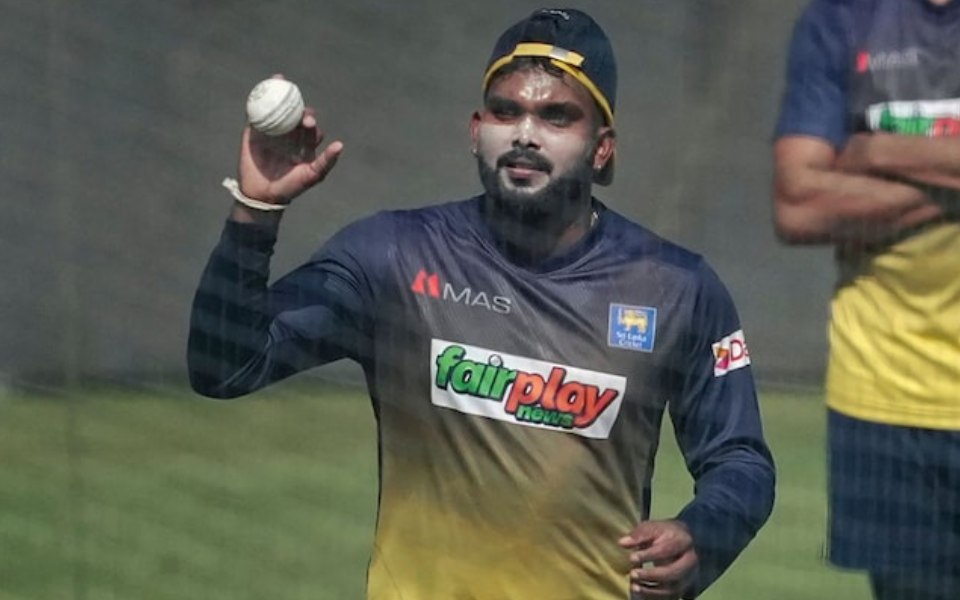
Dubai, Mar 19: All-rounder Wanindu Hasaranga could be unavailable for initial few games for Sunrisers Hyderabad in the Indian Premier League after he was suspended from the upcoming two-Test series against Bangladesh by the ICC, despite coming out of retirement on Tuesday.
Hasaranga, who had retired from Tests in August last year, was named in Sri Lanka's 17-man squad for the two-Test series against Bangladesh starting on Friday.
But the ICC informed that the 26-year-old has 'breached the threshold of eight demerit points, which, pursuant to article 7.6 of the Code, have been converted into four suspension points' in his latest offence during the third ODI.
"Hasaranga was found guilty of breaching article 2.8 of the ICC Code of Conduct for Players and Player Support Personnel, which relates to 'showing dissent at an Umpire's decision during an International Match'," the ICC said on its website.
The incident happened in the 37th over when the right-arm spinner "snatched his cap" from one of the on-field umpires and also "ridiculed" the umpiring in the contest, the ICC said.
"He received a 50 per cent fine and accumulated three demerit points for his offense. This brought his total demerit points to eight in a 24-month period," the ICC said.
Hasaranga already had five demerit points three of which were docked in the third T20I against Afghanistan in Dambulla last month. He was also suspended for two T20Is against Bangladesh.
"Now, with the addition of the latest demerit points, he has breached the threshold of eight demerit points, which, pursuant to article 7.6 of the Code, have been converted into four suspension points," the ICC said.
"The four suspension points equate to a ban from two Tests or four ODIs or T20Is, whatever comes first Hasaranga will therefore miss the two ICC World Test Championship Tests against Bangladesh," the governing body added.
Meanwhile, ICC also handed a 50 per cent match fee fine and three demerit points on Sri Lanka captain Kusal Mendis for "abusing the umpires while shaking hands with them".
"This breached article 2.13 of the Code, which relates to 'Personal abuse of a Player, Player Support Personnel, Umpire or Match Referee during an International Match'."
This was a first offence for Mendis in a 24-month period," the ICC said.
Both the players admitted their offences and accepted the sanctions which were imposed by Andy Pycroft.
The first Test will be played in Sylhet from March 22-26, while the second tie is slated from March 30 to April 3 at Chattogram.
Hasaranga was roped in by SRH at his base price of Rs 1.5 crore.
As per the IPL schedule announced for the first two weeks, SRH will take on Kolkata Knight Riders on March 23 in Kolkata. They will travel to Hyderabad for the tie against Mumbai Indians on March 27 and then proceed to Ahmedabad for the game against Gujarat Titans on March 31.
A big loss for Sri Lanka as star all-rounder is suspended for the #BANvSL Test series 👀
— ICC (@ICC) March 19, 2024
Details ⬇#WTC25https://t.co/CMmQZj3616
Let the Truth be known. If you read VB and like VB, please be a VB Supporter and Help us deliver the Truth to one and all.
Chadha, others wouldn't have left AAP had it followed 'right' path: Anna Hazare
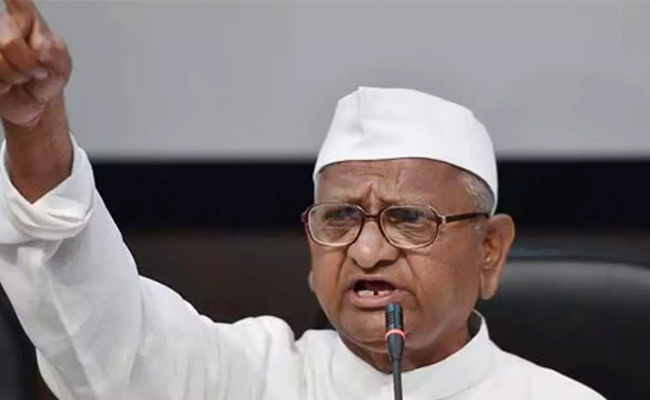
Mumbai (PTI): Social activist Anna Hazare has said Raghav Chadha and six other Aam Aadmi Party (AAP) Rajya Sabha members would not have quit the party had it followed the "right" path.
"Everyone has the right to hold an opinion in a democracy. They (Chadha and others) must have faced some trouble, which is why they left," Hazare told reporters on Friday in Ahilyanagar district of Maharashtra.
AAP Rajya Sabha members Raghav Chadha and Sandeep Pathak addressed a joint press conference in Delhi on Friday, announcing their exit from the Arvind Kejriwal-led party to join the BJP.
Chadha claimed that nearly two-thirds of AAP's Rajya Sabha members had quit the party and would function as a separate faction.
"It is their (AAP leadership’s) fault. Had that party followed the right way, they would not have left," Hazare said.
Hazare reiterated that Chadha and others must have faced difficulties within AAP, and that is why they left. "Had the party gone in the right direction, they would not have quit the party," he added.
"There must be some or the other reason (for their leaving AAP). In a democracy, every person has a view about where to stay and leave," Hazare said.
The Chadha-led exodus marks a significant setback for the Kejriwal-led party since its formation in 2012, which followed the momentum of Anna Hazare’s anti-corruption movement.