Warner makes low-key exit from international cricket after Afghans beat Bangladesh in T20 WC
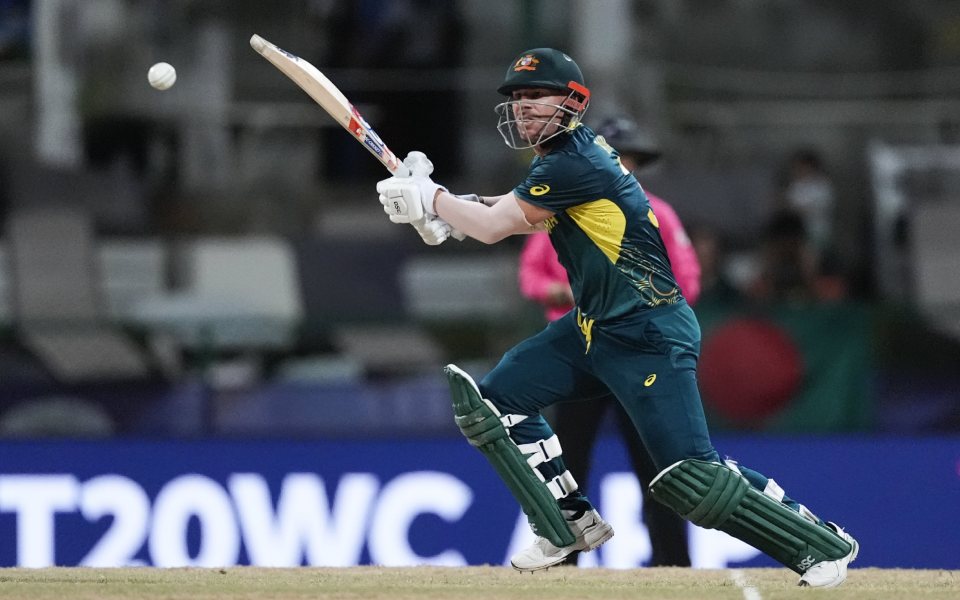
Kingstown, Jun 25: Australia batting great David Warner's 15-year-long international career, dotted with glorious achievements and controversies in equal measure, has come to an anti-climactic end after Afghanistan beat Bangladesh, eliminating the former champions from the T20 World Cup at the Super Eight phase.
Australia, the 2021 champions, finished at third place in the Super 8s Group 1 table with just two points -- from the win against Bangladesh. They had suffered a shocking loss to Afghanistan and a humbling defeat to India.
The 37-year-old Warner, who made his international debut in January 2009 in a T20I match, thus made a low-key exit from international cricket with Australia's 24-run loss to India on June 24 at Gros Islet being his last match.
There was no guard of honour or standing ovation, befitting one of Australia's all-time great batters. He made six runs off six balls in the match, edging Arshdeep Singh as Suryakumar Yadav took a low catch. He walked off the pitch with his head down, not knowing whether that was his last game.
Warner's retirement has been gradual. He played his final ODI match in the World Cup final win over India in November 2023 and his last Test against Pakistan in January. He has long signalled that this T20 World Cup would be his final tournament.
He retires as Australia's highest scorer and seventh-most prolific batter in the world in T20 format with 3,277 runs from 110 matches, at an average of 33.43 and strike rate of 142.47. He scored one hundred and 28 fifties in the shortest format.
From 112 Tests, he has scored 8,786 runs at an average of 44.59 with 26 hundreds and 37 fifties between 2011 and 2024.
He also scored 6,932 runs from 161 ODI matches at an average of 45.30 with the help of 22 centuries and 33 half centuries.
Warner, who has 49 centuries across formats and close to 19,000 runs in international cricket, had acknowledged that his name will forever be linked to the sandpaper gate scandal that took place at Newlands, Cape Town during a Test match against South Africa in 2018.
Warner's involvement in the scandal in the Newlands Test, when Cameron Bancroft used sandpaper to scuff the ball earned him a one-year ban, the same punishment as that of the-then skipper Steven Smith.
Warner was also banned for life from taking any leadership role in the Australian cricket setup.
"I think it's going to be inevitable that when people talk about me in 20 or 30 years' time, there will always be that sandpaper scandal," he said last week at North Sound ahead of Australia's Super 8 clash against Bangladesh.
"But for me, if they're real cricket tragics and they love cricket, (as well as) my closest supporters, they will always see me as that cricketer - someone who tried to change the game.
"Someone who tried to follow in the footsteps of the openers before me and try and score runs at a great tempo and change Test cricket in a way."
Warner was also a part of the IPL side Sunrisers Hyderabad from 2014 till 2021, and led the franchise to its only title in 2016.
Let the Truth be known. If you read VB and like VB, please be a VB Supporter and Help us deliver the Truth to one and all.
NEET student hangs self in Rajasthan's Sikar

Jaipur (PTI): A student preparing for the NEET examination allegedly committed suicide by hanging himself in a rented room in Rajasthan's Sikar on Friday, police said.
According to the police, the student allegedly hanged himself from a ceiling fan using his sister's scarf while one sister was attending coaching classes and the other was in the bathroom.
He had appeared in the NEET UG exam 2026, which was cancelled due to paper leak, they said.
Udyog Nagar SHO Rajesh Kumar said that the deceased, identified as Pradeep Meghwal, was a resident of Kanika ki Dhani village in Jhunjhunu's Gudha Gaudji area.
He had been living in a rented room in Sikar's Jaldhari Nagar area with his two sisters while preparing for NEET over the last three years.
His elder sister later found him hanging and informed the landlord and police after bringing him down, officials said.
The SHO said the body was kept at SK Hospital mortuary, and a postmortem had not been conducted.
The student's father, Rajesh Kumar Meghwal, told police that Pradeep's NEET examination had gone well and the family was expecting him to score around 650 marks.
Former Rajasthan deputy chief minister Sachin Pilot expressed grief over the incident and linked it to anxiety among students after reports of irregularities and paper leaks in NEET 2026.
Pilot said repeated paper leak incidents and cancellation of examinations were affecting students' mental health and demanded a time-bound investigation and strict action against those responsible.