Wasn't asked not to quit T20 captaincy, was updated on ODI captaincy before SA selection: Kohli
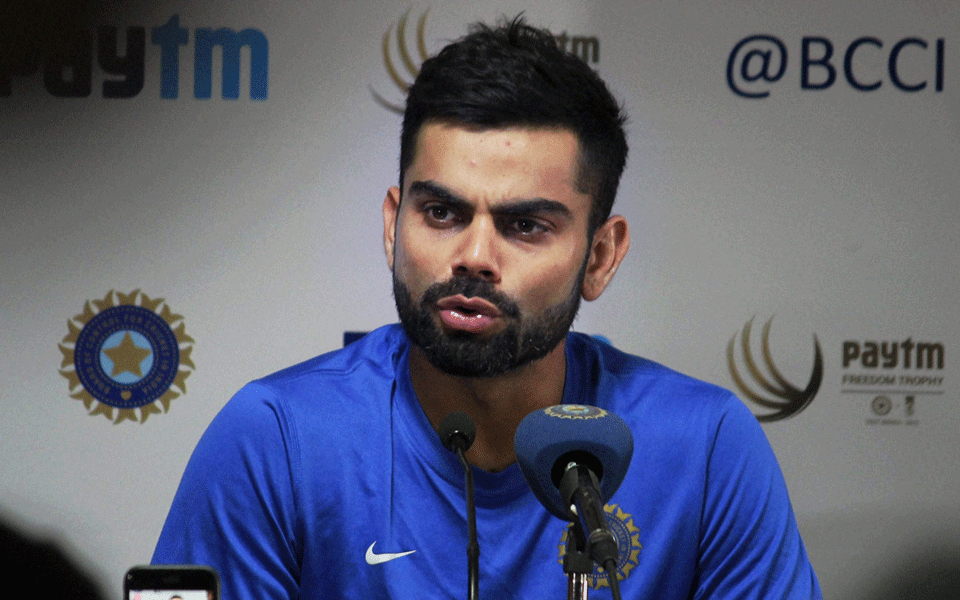
Mumbai(PTI): India Test skipper Virat Kohli on Wednesday said his removal from ODI captaincy happened 90 minutes before the team's selection for the South Africa tour and the BCCI never asked him to reconsider quitting T20 leadership as claimed by the Board.
At the pre-departure press meet before the South Africa tour, the Indian skipper took all the tough questions head on and said that he would put his full support behind new white-ball skipper Rohit Sharma and head coach Rahul Dravid's "vision". He said he understands that not winning an ICC white ball trophy led to his removal.
"Whatever was said about the communication that happened about the decision that was made was inaccurate," Kohli said with obvious reference to BCCI president Sourav Ganguly's statement about the Board requesting him not to quit as split captaincy might not work in the white-ball format.
"I was contacted one and half hours before selection meeting on 8th for Test series and there was no prior communication to me at all since I announced my decision on T20 captaincy.
"...the chief selector discussed the Test team to which we both agreed.
Before ending the call, I was told that the five selectors have decided that I will not be the ODI captain to which I replied 'okay fine'.
"In the selection call afterwards we chatted about it briefly and that's what happened
The discord between Kohli and the BCCI mandarins came out in the open when he was asked the next question. But you had only stated that you wanted to remain captain till 2023 ODI World Cup?
"Was it a question?" Kohli smiled.
"Yes, it is a question because you had only said you wanted to remain India's ODI captain?," the reporter again asked.
"When I left the T20 captaincy, I had first approached BCCI and intimated them of my decision and laid down my point of view in front of them (office bearers).
"I gave the reasons why I wanted to quit T20 captaincy and my view point was received very nicely. There was no offence, no hesitation and not for once was I told that 'you should not leave T20 captaincy'," Kohli said, in complete contradiction to what Ganguly had stated a few days earlier.
Kohli said the BCCI brass called his decision a progressive one.
"On the contrary, the BCCI called it a progressive step and in the right direction. At that time I had communicated that, yes I would like to continue in Tests and ODIs unless office-bearers and selectors think that I shouldn't carry on with this responsibility.
"I had clarified on my call and communication to BCCI was clear. I had given that option if office bearers and selectors think otherwise, then it's in their hands (their call)."
Let the Truth be known. If you read VB and like VB, please be a VB Supporter and Help us deliver the Truth to one and all.
CCTVs in police stations: SC asks amicus to convene meeting on utilisation of funds
New Delhi (PTI): The Supreme Court on Tuesday said that a meeting be convened on May 6 to deliberate on the aspect of utilisation of funds by the states on installation of CCTVs in police stations across the country.
A bench of Justices Vikram Nath and Sandeep Mehta asked senior advocate Siddhartha Dave, who is assisting it as an amicus curiae in a suo motu matter concerning lack of functional CCTVs in police stations, to hold a meeting on May 6 with the Centre, all states and Union Territories.
"We are of the view that a meeting be convened by the amicus, as done earlier, in which the home secretary of the central government or his nominee not below the rank of joint or additional secretary and the home secretary of states/Union Territories will participate," the bench said.
The issue cropped up after the amicus flagged the aspect of utilisation of funds by the states.
Dave told the bench that in UTs, the Centre gives 100 percent funds while in hilly states, the central government gives 90 percent funding.
He said in remaining states, the Centre gives 60 percent while the rest 40 percent funding is by the respective state.
"Why don't we get responses of the states only on utilisation of funds?" the bench said.
The top court suggested that the amicus can convene a meeting with the Centre, states and UTs on the issue.
It posted the matter for hearing on May 13 and said that a report be submitted before it.
On April 7, the Centre told the top court that all issues concerning installation of CCTVs in police stations would be sorted out within two weeks.
Attorney General R Venkataramani had told the bench that he was taking stock of the issue and a lot of things were happening.
On February 26, the apex court directed the Centre and others to participate in a meeting to deliberate upon the feasibility, modalities and implementation framework of the issues, including creation of a centralised dashboard and standardisation of CCTV infrastructure in police stations.
The top court had earlier directed registration of a suo motu case over the lack of functional CCTVs in police stations after taking cognisance of a media report.
The apex court had in 2018 ordered the installation of CCTV cameras across police stations to check human rights abuses.
In December 2020, the top court directed the Centre to install CCTV cameras and recording equipment at the offices of investigating agencies, including the Central Bureau of Investigation (CBI), the Enforcement Directorate (ED) and the National Investigation Agency (NIA).
It said that states and UTs should ensure that CCTV cameras were installed at every police station, at all entry and exit points, main gate, lock-ups, corridors, lobby and reception, as well as in areas outside the lock-up rooms so that no part was left uncovered.
The top court said that CCTV systems must be equipped with night vision and have audio as well as video footage.
The court made it mandatory for the Centre, states and the UTs to purchase such systems which allow storage of data for at least one year.