WFI withdraws India from World Ch'ship, writes to UWW about govt interference
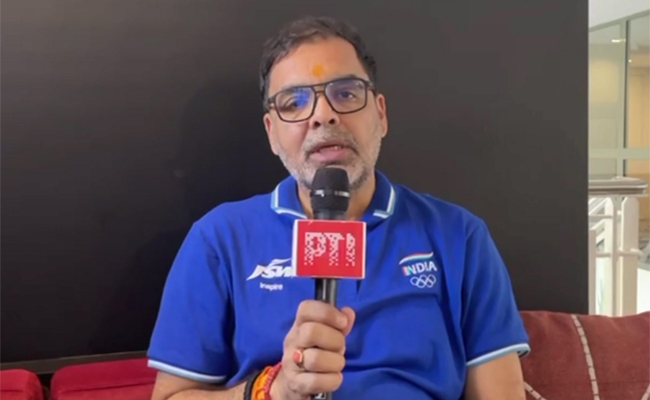
New Delhi (PTI): The Wrestling Federation of India (WFI) on Wednesday withdrew the Indian team from the World Championship, conveying to world governing body, UWW, that the sports ministry is interfering with its autonomy.
The senior World Championship in 12 non-Olympic categories is scheduled to be held in Tirana, Albania from October 28.
The WFI had recently announced selection trials for the U23 and World Championship, which was challenged as contempt of court by the protesting wrestlers who questioned the legality of the selection by the suspended federation.
WFI withdrew the selection trials notice and the court, on October 4, decided not to proceed with the contempt petition.
"Satyawart Kadian, the husband of Sakshi Malik, approached the court recently saying that the WFI should be charged with contempt of court. We won't be able to send the Indian team for the World Championship now, we have conveyed this to the UWW," a WFI source told PTI.
"This is all happening because of the ministry's suspension. There are no grounds to keep the suspension. If the ministry lifts the suspension, all these issues won't crop up. It's just pathetic that wrestlers have to suffer because of a few wrestlers and the ministry is not lifting the suspension," the source added.
The WFI was suspended by the Sports Ministry on December 24 soon after the polls were conducted to elect the new office-bearers.
"Unfortunately, the MYAS (ministry) continues to interfere in the autonomy of the WFI. The MYAS has ordered on 24th December 2023 to the WFI to cease and desist from discharging the day to day administration of WFI and had directed the Indian Olympic Association (NOC of India) to make an Ad-Hoc Committee for governance of WFI," WFI President Sanjay Singh wrote in his letter to UWW President Nenad Lalovic.
The Indian Olympic Association (IOA), though, had disbanded the ad-hoc panel managing the Federation in March this year after UWW lifted the ban on WFI in February.
WFI put on record support from the PT Usha-led Indian Olympic Association (IOA).
"Though the IOA through its President Ms. PT Usha had supported the WFI in the case, it is the MYAS that is the problem creator because of their letter of 24th December 2023 which is being used as a tool to interfere in the administration of the WFI by the wrestlers."
The WFI began to function but wrestlers Bajrang Punia, Vinesh Phogat, Sakshi Malik, and her husband Satyawart filed a plea before the court for appointing an administrator to manage the sports body.
In an interim order, the court said that the IOA's decision to dissolve the ad-hoc committee was incompatible with the sports ministry's suspension order.
It said that until the suspension order was recalled, it was necessary for the ad-hoc committee to manage the federation's affairs. The IOA, though, told the court that it cannot re-constitute the panel.
The WFI has now asked UWW to invoke article 6.3 of UWW Regulations
and take appropriate action and also use Thursday's communication as a complaint to the International Olympic Committee (IOC).
Article 6.3 of the UWW Constitution states that, "Affiliated and Associated Members shall govern and administer their activities independently. They
shall preserve their autonomy without influence by any political, religious or economic pressures."
"Governments and other public authorities shall only be entitled to verify the use of their financial grants by the National Federations."
In the Olympic year, World Championships are held in four categories in each of the three styles -- men's freestyle, women and greco-roman -- instead of all 10.
Indian teams:
Men's freestyle: Udit (61kg), Manish Goswami (70kg), Parvinder Singh (79kg), Sandeep Mann (92kg).
Greco-Roman: Sanjeev (55kg), Chetan (63kg), Ankit Gulia (72kg), Rohit Dahiya (82kg).
Women: Kirti (55kg), Mansi (59kg), Manisha (65kg), Bipasha (72kg).
Let the Truth be known. If you read VB and like VB, please be a VB Supporter and Help us deliver the Truth to one and all.
Allahabad HC orders FIR against Rahul Gandhi in dual citizenship case
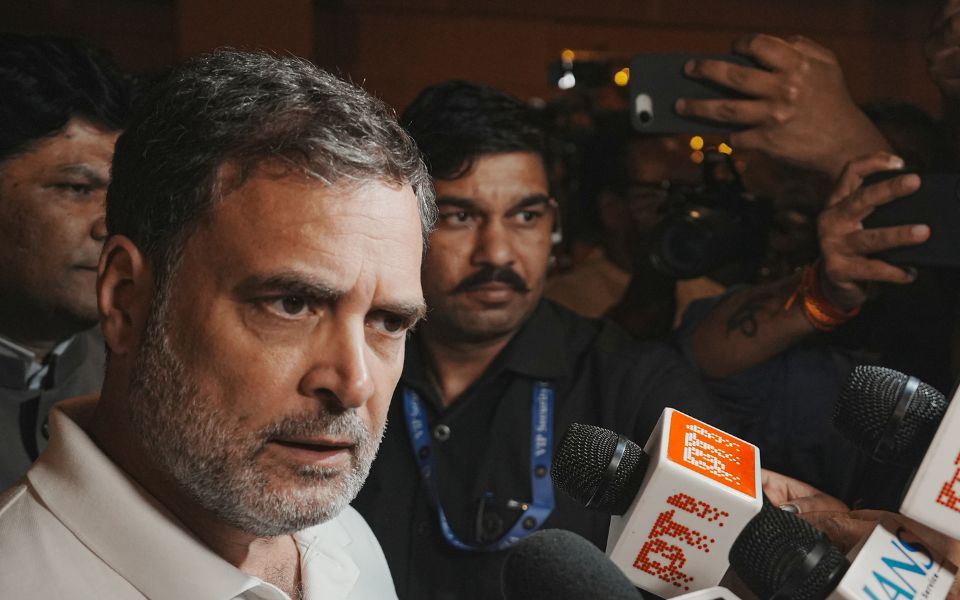
Lucknow (PTI): The Lucknow bench of the Allahabad High Court on Friday ordered an FIR be filed against Congress MP Rahul Gandhi in connection with an alleged dual citizenship controversy.
The bench permitted the state government to hand over the probe to any central probe agency after registration of the FIR.
The order was passed by a bench of Justice Subhash Vidyarthi on a petition filed by S Vignesh Shishir, who had challenged a January 28 order of a special MP/MLA court rejecting his plea for an FIR against Gandhi, the leader of the Opposition in the Lok Sabha.
The special court had earlier held that it was not competent to adjudicate on issues related to citizenship.
The petitioner, a BJP worker from Karnataka, had sought registration of an FIR and a detailed probe into the matter, levelling allegations against Gandhi under provisions of the Bharatiya Nyaya Sanhita (BNS), the Official Secrets Act, the Foreigners Act and the Passport Act.
The complaint was initially filed before the special MP/MLA court in Rae Bareli. However, on the petitioner's request, the high court transferred the case to Lucknow on December 17, 2025.
The MP/MLA court in Lucknow subsequently dismissed the plea on January 28, 2026, prompting the petitioner to approach the high court, which has now ordered registration of an FIR.
In its order, the bench said that from a bare perusal of the allegations, prima facie cognizable offences were made out against Gandhi and hence the allegations required to be investigated.
The bench said that the special court should have looked into whether the allegations prima facie made out any cognizable offences or not, but it failed to consider it.
Earlier, Deputy Solicitor General of India SB Pandey produced the central government's records in the court relating to the citizenship controversy surrounding Gandhi.
Government counsel VK Singh also consented on behalf of the UP government that the allegations prima facie made out cognizable offences.
After having a detailed hearing, the bench found that the material on records showed that Gandhi had committed "cognizable offences" in having dual citizenship, and these allegations required to be probed.
The petitioner has alleged that Rahul is a UK Citizen and incorporated a company named M/S Backops Ltd in August 2003.
It was further submitted that Gandhi categorically admitted and voluntarily declared his nationality as British, having a Director Identification ID and London and Hampshire addresses.
In his petition, Shishir claimed that Rahul submitted the company's annual returns in October 2005 and October 2006, listing his nationality as British.
Thereafter, the company was dissolved through a dissolution application in February 2009.
According to the petitioner, the material placed before the court includes records suggesting that Rahul Gandhi may have been listed as a voter in the United Kingdom and participated in electoral processes there.
During the course of the hearing, the high court earlier directed the Ministry of Home Affairs to place all relevant records, including classified documents, before the court.