Women’s WC: Richa Ghosh’s impeccable knock carries India to 251 against SA
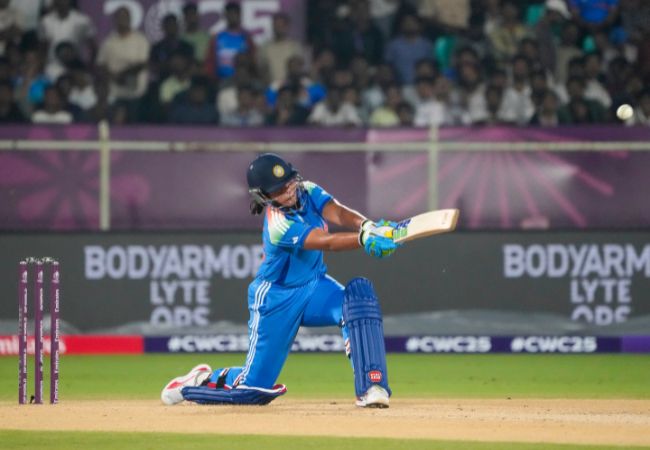
Visakhapatnam (PTI): Richa Ghosh made a vibrant 94 after another top-order malfunction as India recovered to post a competitive 251 against South Africa in the Women’s World Cup match here on Thursday.
Ghosh’s 77-ball innings (11x4, 4x6) showed her teammates how to make use of a rather easy-paced pitch with her seventh ODI fifty.
The ACA-VDCA Stadium pitch, perhaps, was the best among the three decks — including Guwahati and Colombo — India have batted on yet but they failed to exploit it fully after being asked to bat.
But the beginning was bright as openers Pratika Rawal (37) and Smriti Mandhana (23) added 55 runs in 10.2 overs.
Rawal engaged in some smooth strokeplay, and a flowing cover drive off pacer Marizanne Kapp was the standout shot in her innings.
But Mandhana never looked comfortable out there. She tried to break the shackles with a towering straight six off pacer Ayabonga Khaka but perished soon to left-arm spinner Noku Mlaba.
Rawal and Harleen Deol (13) took India to 83 for one, and the latter's dismissal sparked a collapse, as the hosts lost five wickets for just 19 runs.
South African bowlers’ nagging line, and a hint of turn might have played a part in it, but the Indian batters too were guilty for trying to force the pace before settling in.
Deol fell to a peach by Mlaba as the ball squared her up with its outward turn, but Rawal tried to push pacer Tumi Sekhkhune to leg-side but resulted only a leading edge catch to Tazmin Brits.
Skipper Harmanpreet Kaur looked to drive spinner Chloe Tryon but another leading edge ended in the hands of Kapp inside the circle.
Jemimah Rodrigues missed the sweep against Tryon and fell leg before and Deepti Sharma was caught down the leg side as India slipped to 102 for six, and were in need of a steadying alliance.
It came in the form of a 51-run stand between Ghosh and Amanjot Kaur (13) as India inched past the 150-run mark.
Ghosh was impressive in pacing the innings, using her power judiciously as a couple of slog-swept sixes gave her the desired momentum.
Ghosh, who was dropped on 76 and 84, fetched her fifty in 53 balls, and thereafter she opened up to put the SA bowlers to the sword as 44 runs came in 24 balls.
Kaur fell trying to accelerate the pace, but Ghosh found another able and stable ally in Sneh Rana (33) as they realised 88 runs off 53 balls for the eighth wicket. Ghosh fell in the last over but she had done her job by then.
Let the Truth be known. If you read VB and like VB, please be a VB Supporter and Help us deliver the Truth to one and all.
Rajnath to top commanders: Outmaneuver adversaries with strategic surprise
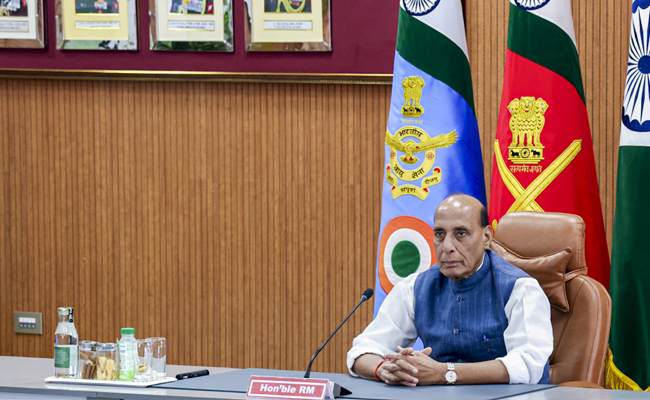
Jaipur/New Delhi (PTI): Defence Minister Rajnath Singh on Friday directed the top military commanders of the three services to integrate an "element of surprise" into modern warfare to outmaneuver India's adversaries and bolster strategic posture.
In his address at the joint commanders conference in Jaipur, Singh also described the Operation Sindoor as a testament to the "swift, precise, and joint response" of the Indian armed forces to safeguard national interests and called upon the military to remain ready to deal with any security challenges.
In their two-day deliberations, the commanders carried out a comprehensive review of the combat preparedness of the military in the wake of the evolving regional security situation.
Operation Sindoor was a demonstration of India's growing capabilities and a symbol of the nation's collective resolve and new military ethos, Singh said, a day after the first anniversary of Operation Sindoor.
He also unveiled a 'Joint Doctrine for Integrated Communication Architecture' that is aimed at strengthening doctrinal clarity, interoperability and integrated communications across the armed forces in future multidomain operations.
The joint commanders' conference, themed 'Military Capability in New Domains', brought together the top leadership of the defence ministry and the three services to deliberate on emerging security challenges and future readiness.
Comprehensive deliberations were held on future warfare, multidomain operations, technological transformation and joint capability development.
The conference witnessed extensive discussions on cognitive warfare, cyber resilience against evolving quantum and AI-enabled threats, military capability development in emerging domains, indigenous innovation and AI-enabled warfighting concepts.
It was attended by Chief of Defence Staff Gen Anil Chauhan, Chief of the Naval Staff Admiral Dinesh Kumar Tripathi, Chief of the Army Staff Gen Upendra Dwivedi, Chief of the Air Staff Air Chief Marshal AP Singh and Defence Secretary Rajesh Kumar Singh among others.
In his remarks, Singh asked the commanders to remain "future-ready" by learning from the operation as well as the current global security landscape.
He underscored the need to strengthen capabilities in artificial intelligence, autonomous systems, data analytics and secure communication networks to stay prepared in the rapidly evolving geopolitical security scenario. He emphasised that future conflicts will increasingly be shaped by hybrid threats, information dominance and operations conducted simultaneously across cyber, space, electromagnetic and cognitive domains, according to an official readout.
Highlighting the transformative impact of emerging technologies, Singh stressed on the importance of ensuring integrated national preparedness across all spectrums of conflict, it said.
Singh's remarks at the conference came a day after the first anniversary of Operation Sindoor.
The defence minister appreciated the progress achieved in enhancing jointness, integration and technological adoption across the three services, the readout noted.
Singh said that jointness constitutes a pivotal dimension within the transformative changes sweeping across the global defence sector.
"Future wars will not be won solely through weaponry, but through innovative thinking and enhanced synergy," he said.
The defence minister exhorted the commanders to cultivate the "element of surprise" to remain unpredictable to the nation's adversaries and secure a strategic edge in any given situation.
He, however, urged them to remain vigilant of the element of surprise of the enemy and always stay two steps ahead.
Singh also reiterated the Narendra Modi government's commitment to enhancing the capabilities of the defence forces through state-of-the-art weapons and platforms. He added that special focus is being laid on research in niche domains.
During the conference, he released a documentary film on Operation Sindoor.
The film reaffirms the nation's and defence forces' commitment to operational preparedness and decisive national response capabilities.
Demonstrations of advanced systems and platforms developed for intelligence fusion, operational planning and information management were also showcased during the conference reflecting growing integration of cutting-edge technologies into joint operational structures, according to the defence ministry.
The discussions will contribute significantly towards shaping India's future military transformation and integrated operational preparedness, it said.