World Cup 2019 Warm-Up Match: Batsmen get a shake up as India lose to NZ by 6 wkts

London, May 25: Indian batting line-up's soft underbelly lay exposed in slightly favourable bowling conditions as New Zealand gave a rude wake-up call, winning the first warm-up game ahead of the ICC World Cup by six wickets here Saturday.
Under overcast conditions, Trent Boult's (4/33 in 6.2 overs) incisive swing bowling was a test of technique for the Indian top-order batsmen and the Men In Blue never recovered from an early collapse, being bowled out for 179 in 39.2 overs.
It was a walk in the park for the 'Black Caps' as they reached the target in only 37.1 overs with Kane Williamson (67) and Ross Taylor (71) helping themselves to half-centuries.
While it was a warm-up game and the outcome of the result isn't something that India would be bothered too much but what certainly would keep them worried is the failure to find a solution to their problems.
KL Rahul failed at No 4, Dinesh Karthik's poor IPL form continued while Vijay Shankar and Kedar Jadhav's respective injuries in all likelihood would prevent the team management from checking them out against Bangladesh in the second warm-up game at Cardiff.
The two wrist spinners Kuldeep Yadav (0/44 in 8.1 overs) and Yuzvendra Chahal (1/37 in 6 overs), who have gone off the boil in the past few months also didn't make much of an impact.
A sub-200 total meant that Williamson and Taylor, during their 114-run stand, hardly took risks against the duo, getting run-a-ball with minimum fuss.
For India, Ravindra Jadeja's decent show (54 off 50 balls and 1/27 in 7 overs) was the only silver lining.
There was a possibility that after IPL, played on pitches devoid of any lateral movement and conditions that didn't aid swing bowling, the footwork would remain a touch iffy for Indian batsmen.
It was Boult's first spell which saw openers Rohit Sharma (2) and Shikhar Dhawan (2) along with No. 4 KL Rahul (6) being dismissed that proved to be decisive in overcast conditions.
The lack of footwork was evident as Boult trapped Rohit with a delivery that darted in while Dhawan had an inside edge to a delivery that had a shade more bounce. Rahul was played on when Boult got one to rear up. On all three occasions, there was distinct lack of footwork.
Skipper Virat Kohli (18 off 24 balls) found his defence breached by Colin de Grandhomme's off-cutter trying to play across the line.
Jadeja's half-century ensured a 175-plus score for the 'Men In Blue' after being reduced to 115 for 8 at one stage. His 62-run ninth-wicket stand with Kuldeep Yadav (19) was the only saving grace for India in an otherwise disappointing batting performance.
Before Jadeja, it was Hardik Pandya (30 off 37 balls), who added 38 runs with Mahendra Singh Dhoni (17 off 42 balls) for the fifth wicket.
Dhoni's painful stay at the crease was cut short by Tim Southee when he was caught at short mid-wicket while trying to give the bowler charge.
Dhoni, who takes time to settle down, not for once looked comfortable and failed to rotate the strike during the partnership, consuming a lot of deliveries.
It was Jimmy Neesham (3/26 in 3 overs), who dismissed Hardik with a cross-seam delivery that moved a shade, inducing an outside edge.
Hardik was promoted ahead of Dhoni in adverse conditions and he showed positive intent with six boundaries.
Dinesh Karthik was gone in the same over, flicking a half-volley straight to fine leg and it was Jadeja, who resurrected the innings with Kuldeep for company.
When New Zealand batted, Jasprit Bumrah (4-2-2-1) bowled a testing first spell and Mohammed Shami (4-0-16-0) also found the right length, which will be a positive that Kohli and Co. can take from this game.
Let the Truth be known. If you read VB and like VB, please be a VB Supporter and Help us deliver the Truth to one and all.
Siddaramaiah stresses need to establish Supreme Court bench in South India
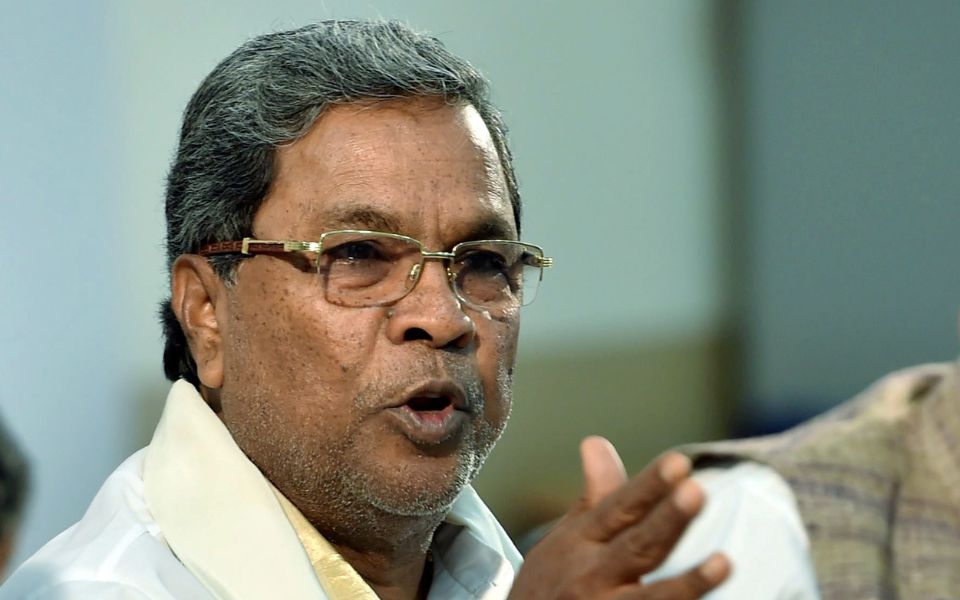
Bengaluru (PTI): Karnataka Chief Minister Siddaramaiah on Saturday stressed the need to improve accessibility to the highest court of the land, asserting that establishing a Supreme Court bench in South India would go a long way in ensuring justice.
Speaking at the 22nd Biennial State Level Conference of Judicial Officers with a theme 'Reimagining the Judiciary in the era of Artificial Intelligence', he said, the authority of a judge must never be overshadowed by the authority of an algorithm.
"Even as we explore these new frontiers, we must remain mindful of the enduring challenges facing our judiciary," the chief minister said.
"Pendency of cases continues to be a serious concern that affects the timely delivery of justice. While technology can provide tools to address this, it must be complemented by systemic reforms through strengthening infrastructure, increasing judicial capacity, and modernising court processes," Siddaramaiah said.
"There is also a strong and compelling need to improve accessibility to the highest court of the land. The establishment of a Supreme Court bench in South India would go a long way in ensuring justice," he said.
Chief Justice of India, Surya Kant, Supreme Court Judges B V Nagarathna and Aravind Kumar and Chief Justice of High Court of Karnataka Vibhu Bakhru were among those present.
The CM said, "We stand today at a defining juncture where law and technology are no longer separate domains, but interconnected forces shaping governance, rights, and the very nature of justice itself."
"Artificial Intelligence is emerging as a transformative force that challenges how we interpret evidence, how we understand facts, and how decisions are arrived at. It offers immense promise, aiding faster legal research, improved case management, and the possibility of reducing pendency through intelligent systems," he said.
"Yet, it also raises profound concerns. Algorithmic bias can undermine the guarantee of equality before law. Opaque systems may weaken the doctrine of reasoned decisions, which lies at the heart of our judicial process," he added.
Siddaramaiah said, Judicial independence, which is the cornerstone of our democracy, must be preserved not only from external pressures but also from subtle technological dependence.
"The authority of a judge must never be overshadowed by the authority of an algorithm," he said.
Pointing out that the emergence of AI-generated evidence presents new challenges for our legal system, the CM said, Deepfakes, synthetic data, and machine-generated content compel us to revisit established doctrines relating to admissibility, burden of proof, and authenticity.
"The courts will increasingly be called upon to determine what constitutes reliable evidence in a digital age. In doing so, we must ensure that truth remains grounded in verifiability and integrity, not merely in technological sophistication," he said.
Hoping that the judiciary will play a defining role in shaping the regulatory framework for artificial intelligence in India, he further said, "through well-established constitutional doctrines such as due process, proportionality, and the right to privacy, our courts will determine the contours within which AI must operate."
"The judiciary, therefore, is not only a user of technology but also the ethical compass that will guide its deployment in society," he added.
Noting that technology also offers meaningful opportunities to strengthen judicial processes, Siddaramaiah said, AI-assisted legal research may democratise access to precedents and reduce disparities in legal knowledge.
Siddaramaiah also said that blockchain technology holds promise in ensuring secure, tamper-proof judicial records. Stating that the intelligent case management systems can streamline court functioning and reduce delays, he said, "However, these innovations must be adopted with care, ensuring that efficiency does not come at the cost of fairness."
"In this transformation, the capacity of our judicial institutions becomes critical. Judges of the future must be equipped not only with legal acumen but also with a clear understanding of technological systems," he added.
Stating that the question is how artificial intelligence intersects with the fundamental principles of equality and social justice, the CM said, if not carefully designed and regulated, AI systems can replicate and even amplify existing social inequalities.
No algorithm can replace the human capacity for empathy, the wisdom that comes from lived experience, or the moral reasoning that defines judicial decision-making, he said, "Technology can assist, but it cannot replace the human conscience that lies at the heart of justice."
Siddaramaiah said, the Government of Karnataka remains committed to building robust judicial infrastructure, facilitating digital transformation, and creating an ecosystem where innovation and justice can progress together.