Wrestler Antim Panghal and team set to be deported from Paris for disciplinary breach

Paris (PTI): In a major embarrassment for the country, Antim Panghal and her entire entourage is being deported from Paris for a major disciplinary breach where the young wrestler handed her official accreditation card to her sister who was caught by security while leaving the Games Village.
Panghal had crashed out of the Paris Olympics after losing her opening bout in the women's 53kg during the day.
"The Indian Olympic Association has decided to fly wrestler Antim and her support staff back after a disciplinary breach was brought to IOA’s notice by the French authorities," an IOA statement said.
While IOA did not share what the disciplinary breach was, a source shared the details with PTI.
"Instead of heading to the Games Village, she reached the hotel where her coach Bhagat Singh and sparring partner Vikas, who is actually her coach, were staying. Antim asked her sister to go to the Games Village and come back with her belongings. Her sister was caught for impersonation and was taken to a police station to record her statement," said the source.
The 19-year-old U20 world champion Antim was also called by police to record her statement.
If that was not enough, Antim's personal support staff -- Vikas and Bhagat -- travelled in an inebriated state in a taxi and refused to pay the driver, who then called police.
"We have left to fight fire," fumed an IOA official.
When contacted, Vikas flatly refused their involvement in such an incident.
"Who told you this? Antim and her sister are sitting right before me," said Vikas.
Let the Truth be known. If you read VB and like VB, please be a VB Supporter and Help us deliver the Truth to one and all.
Ordinance issued to increase number of Supreme Court judges from 34 to 38
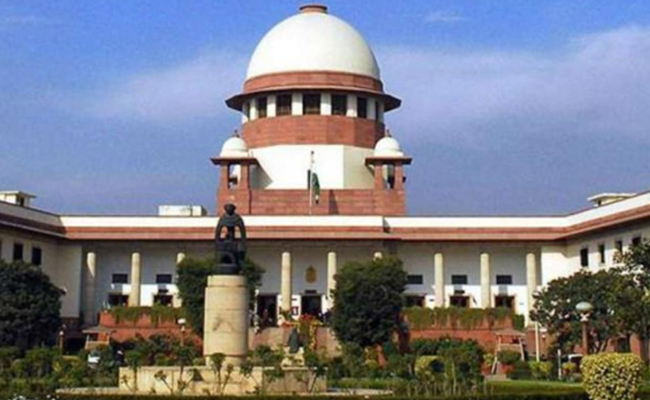
New Delhi (PTI): The government has promulgated an ordinance to increase the strength of the Supreme Court from the present 34 judges to 38, including the Chief Justice of India.
The law ministry notified the ordinance on Saturday, which amended the Supreme Court (Number of Judges) Act, 1956, to increase the sanctioned strength of the top court.
So far, the sanctioned strength of the top court was 34, including the Chief Justice of India (CJI). Now, the number of judges has been increased by four, taking the sanctioned strength to 38.
The top court will now have 37 judges, other than the CJI.
With the apex court having two vacancies at present, and the ordinance coming into force immediately, the Supreme Court Collegium will now have to recommend six names for appointment as judges in the top court.
A bill will be brought in the Monsoon Session of Parliament to convert the ordinance – an executive order – into a law passed by Parliament.
The Union Cabinet had cleared a draft bill on May 5 to increase the number of apex court judges.
The strength of the Supreme Court was last increased from 30 to 33 (excluding the CJI) in 2019.
The Supreme Court (Number of Judges) Act, as originally enacted in 1956, put the maximum number of judges (excluding the CJI) at 10.
This number was increased to 13 by the Supreme Court (Number of Judges), Amendment Act, 1960, and to 17 by another amendment to the law.
The Supreme Court (Number of Judges) Amendment Act, 1986, augmented the strength of judges from 17 to 25, excluding the CJI.
A fresh amendment in 2009 further increased the strength from 25 to 30.
Article 124(3) of the Constitution lists the qualifications required to become a Supreme Court judge.
An Indian citizen who has either served as a high court judge for at least five years, or as an advocate for 10 years, or is a distinguished jurist, can be appointed to the top court.
The strength of the Supreme Court is increased based on the recommendations of the CJI, who writes to the Union law minister. After consulting the finance ministry, the Department of Justice under the law ministry moves the Cabinet with a draft bill.