WTC: Team India players lose 100% match fees, Gill penalised additional 15% for questioning umpire

Dubai: Indian players have been fined their entire match fees for maintaining a slow over rate while opener Shubman Gill was docked an additional 15 per cent for criticising the umpire's decision to rule him out in a debatable call during the World Test Championship final.
The Australian players were also fined 80 per cent of their fees for maintaining a slow over rate during the marquee-clash, which they won by 209 run in London on Sunday.
"It was confirmed shortly after the conclusion of the match on Sunday's final day that India will lose all of their match fees for their slow over rate, with Australia also docked 80 percent of their match fees.
"In accordance with Article 2.22 of the ICC Code of Conduct for Players and Player Support Personnel, players are fined 20 per cent of their match fee for every over their side fails to bowl in the allotted time," the ICC said in a statement on Monday.
The fines were imposed after India were ruled to be five overs short of the target after time allowances were taken into consideration, while Australia were found to be four overs short.
Indian players, who are part of the playing XI earn Rs 15 lakh per Test while the reserve players get Rs 7.5 lakhs each.
Gill was found guilty of "breaching article 2.7 which relates to public criticism or inappropriate comment in relation to an incident occurring in an international match." During India's second innings, television umpire Richard Kettleborough had adjudged a catch by Cameron Green to remove Gill had been taken cleanly.
However after the day's play, the youngster had posted a TV screen grab of the replay in which the ball seemed to be touching the ground.
Chasing a mammoth 444 in the second innings, a lacklustre India lost seven wickets before lunch on the fifth and final day on Sunday to suffer the crushing defeat.
Let the Truth be known. If you read VB and like VB, please be a VB Supporter and Help us deliver the Truth to one and all.
Chadha, others wouldn't have left AAP had it followed 'right' path: Anna Hazare
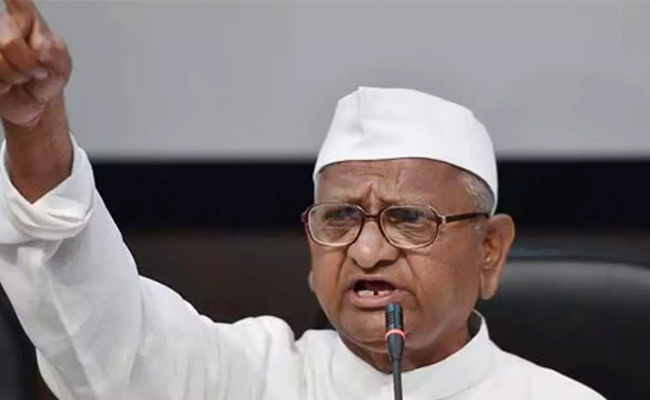
Mumbai (PTI): Social activist Anna Hazare has said Raghav Chadha and six other Aam Aadmi Party (AAP) Rajya Sabha members would not have quit the party had it followed the "right" path.
"Everyone has the right to hold an opinion in a democracy. They (Chadha and others) must have faced some trouble, which is why they left," Hazare told reporters on Friday in Ahilyanagar district of Maharashtra.
AAP Rajya Sabha members Raghav Chadha and Sandeep Pathak addressed a joint press conference in Delhi on Friday, announcing their exit from the Arvind Kejriwal-led party to join the BJP.
Chadha claimed that nearly two-thirds of AAP's Rajya Sabha members had quit the party and would function as a separate faction.
"It is their (AAP leadership’s) fault. Had that party followed the right way, they would not have left," Hazare said.
Hazare reiterated that Chadha and others must have faced difficulties within AAP, and that is why they left. "Had the party gone in the right direction, they would not have quit the party," he added.
"There must be some or the other reason (for their leaving AAP). In a democracy, every person has a view about where to stay and leave," Hazare said.
The Chadha-led exodus marks a significant setback for the Kejriwal-led party since its formation in 2012, which followed the momentum of Anna Hazare’s anti-corruption movement.