Yusuf Pathan takes a breathtaking catch during Syed Mushtaq Ali trophy game against Karnataka
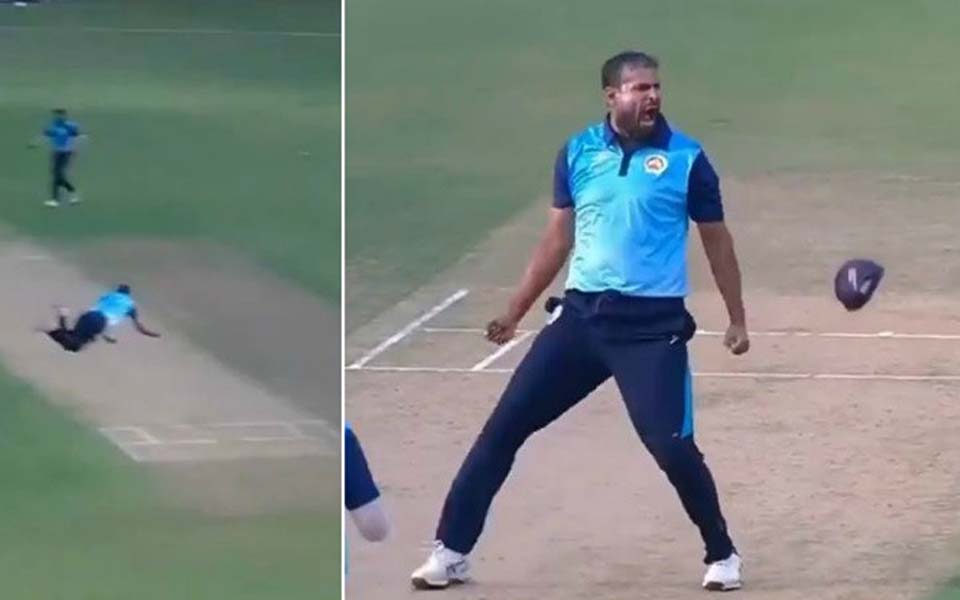
New Delhi: India cricketer Yusuf Pathan pulled off a breathtaking catch during a Syed Mushtaq Ali game between Baroda and Karnataka on Saturday in Visakhapatnam. Baroda all-rounder Yusuf took the catch to send Karnataka batsman Devdutt Padikkal packing. The incident took place of the first ball of the seventh over when Padikkal decided to take on Deepak Hooda.
It was the big slog towards the deep mid-wicket region, Yusuf, who was stationed at long-on had to make ground to reach the ball. Then, with a big dive, he caught the ball. What was important was he did not ket the ball pop-out after he landed.
Here is the video shared by Irfan with caption, “Kon bola kon bola ??? Another day another brilliance from Lala @iamyusufpathan.”
Kon bola kon bola ??? Another day another brilliance from Lala @iamyusufpathan ?? pic.twitter.com/SVeMSDz61x
— Irfan Pathan (@IrfanPathan) November 9, 2019
Not long back, Yusuf had taken another brilliant catch against Goa in the ongoing Syed Mushtaq Ali Trophy. It was the all-important catch of Goa skipper Darshan Misal.
Known for his six-hitting prowess, Yusuf is certainly proving a lot of critics wrong by showing athleticism and super fitness on-the-field.
After the completion of Vijay Hazare and Deodhar Trophy, Syed Mushtaq Ali tournament is another important domestic competition which provides everyone with a chance to showcase their skill and strength in the shorter format.
It also serves as a perfect platform for the young and talented cricketers to hone their skills and grab eyeballs ahead of the Indian Premier League (IPL) 2020 auction in December in Kolkata.
Is it a bird ? No this is @yusuf_pathan Great catch today lala.All ur hard work in pre season is paying off #hardwork @BCCI @StarSportsIndia pic.twitter.com/bcpO5pvuZI
— Irfan Pathan (@IrfanPathan) November 8, 2019
Haha sahi kaha pathano ke hath or wrist mein jaadu hay...
— Irfan Pathan (@IrfanPathan) November 8, 2019
Courtesy: www.india.com
Let the Truth be known. If you read VB and like VB, please be a VB Supporter and Help us deliver the Truth to one and all.
Online fraud: Hotel chef from Udupi cheated of over Rs 1 lakh by WhatsApp contact

Udupi: Udupi City Police have registered a case of online fraud after a 62-year-old hotel chef was allegedly cheated of Rs 1.13 lakh by a woman who befriended him on WhatsApp, claiming to be based in London.
The victim, identified as Pandu Kariappa Poojary, a resident of Kuthpadi in Udupi, was working at a hotel in Mangaluru.
He reportedly came into contact with a woman identifying herself as Emilda William on WhatsApp. During their interactions, she told Poojary that she planned to start a cosmetics and hotel business in India and would meet him during a visit to Mangaluru.
On April 7, Emilda sent Poojary a flight ticket from London to Delhi via WhatsApp. The following day, Poojary received a phone call from a woman who informed him that Emilda had arrived at Delhi airport carrying a demand draft worth Rs 5 crore along with other items. The caller allegedly asked him to pay Rs 70,000.
Subsequently, Poojary also received a call from Emilda, who was reportedly crying and spoke about the situation. Believing the claims, he transferred a total of Rs 1,13,300 in phases using a scanner. He later realised that he had been cheated.