11 reported killed in Lebanon as Israeli forces remain after withdrawal deadline
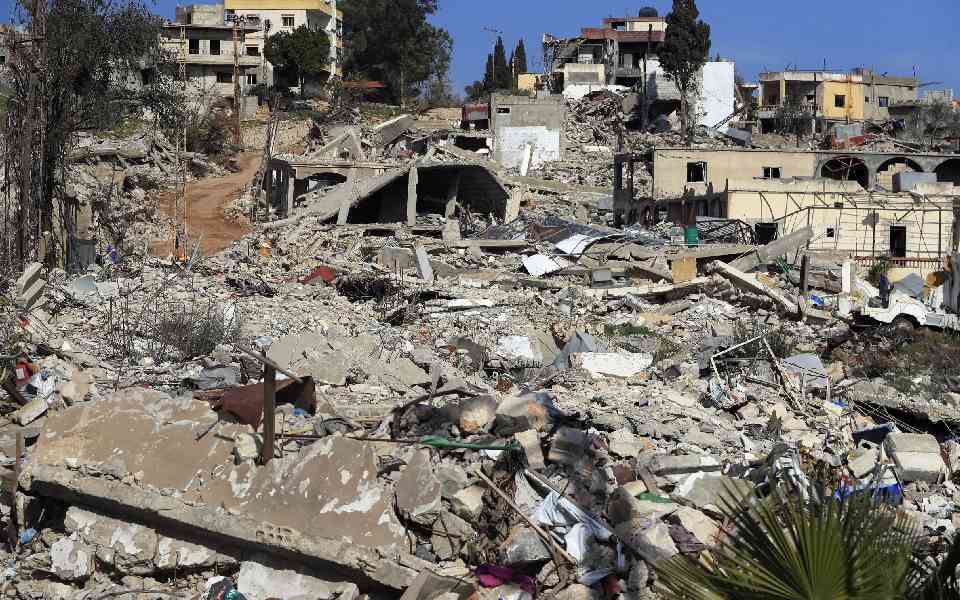
Mays Al-Jabal (Lebanon), Jan 26 (AP): Israeli forces in southern Lebanon on Sunday opened fire on protesters demanding their withdrawal in line with a ceasefire agreement, killing at least 11 and injuring more than 80, Lebanese health officials reported.
The dead included two women and a Lebanese army soldier, the Health Ministry said in a statement. People were reported wounded in more than a dozen villages in the border area.
Demonstrators, some of them carrying Hezbollah flags, attempted to enter several villages to protest Israel's failure to withdraw from southern Lebanon by the 60-day deadline stipulated in a ceasefire agreement that halted the Israel-Hezbollah war in late November.
Israel has said that it needs to stay longer because the Lebanese army has not deployed to all areas of southern Lebanon to ensure that Hezbollah does not reestablish its presence in the area. The Lebanese army has said it cannot deploy until Israeli forces withdraw.
The Israeli army blamed Hezbollah for stirring up Sunday's protests.
It said in a statement that its troops fired warning shots to “remove threats in a number of areas where suspects were identified approaching”.
It added that a number of suspects in proximity to Israeli troops were apprehended and were being questioned.
Lebanese President Joseph Aoun said in a statement addressing the people of southern Lebanon on Sunday that “Lebanon's sovereignty and territorial integrity are non-negotiable, and I am following up on this issue at the highest levels to ensure your rights and dignity”.
He urged them to “exercise self-restraint and trust in the Lebanese Armed Forces.” The Lebanese army, in a separate statement, said it was escorting civilians into some towns in the border area and called on residents to follow military instructions to ensure their safety.
Parliament Speaker Nabih Berri, whose Amal Movement party is allied with Hezbollah and who served as an interlocutor between the Hezbollah group and the US during ceasefire negotiations, said that Sunday's bloodshed “is a clear and urgent call for the international community to act immediately and compel Israel to withdraw from occupied Lebanese territories”.
An Arabic-language spokesperson for the Israeli military, Avichay Adraee, posted on X that Hezbollah had sent “rioters” and is "trying to heat up the situation to cover up its situation and status in Lebanon and the Arab world”.
He called Sunday morning for residents of the border area not to attempt to return to their villages.
UN Special Coordinator for Lebanon Jeanine Hennis-Plasschaert and the head of mission of the UN peacekeeping force known as UNIFIL, Lt. Gen. Aroldo Lázaro, called in a joint statement for both Israel and Lebanon to comply with their obligations under the ceasefire agreement.
“The fact is that the timelines envisaged in the November Understanding have not been met,” the statement said. “As seen tragically this morning, conditions are not yet in place for the safe return of citizens to their villages along the Blue Line.”
UNIFIL said that further violence risks undermining the fragile security situation in the area and "prospects for stability ushered in by the cessation of hostilities and the formation of a government in Lebanon”.
It called for the complete withdrawal of Israeli troops, the removal of unauthorised weapons and assets south of the Litani River, the redeployment of the Lebanese army in all of south Lebanon and ensuring the safe and dignified return of displaced civilians on both sides of the Blue Line.
An AP team was stranded overnight at a UNIFIL base near Mays al-Jabal after the Israeli army erected roadblocks Saturday while they were joining a patrol by peacekeepers. The journalists reported hearing gunshots and booming sounds Sunday morning from the base, and peacekeepers said that dozens of protesters had gathered nearby.
In the village of Aita al Shaab, families wandered over flattened concrete structures looking for remnants of the homes they left behind. No Israeli forces were present.
“These are our houses,” said Hussein Bajouk, one of the returning residents. “However much they destroy, we will rebuild.”
Bajouk added that he is convinced that former Hezbollah leader Hassan Nasrallah, who was killed in an Israeli strike in Beirut's southern suburbs in September, is really still alive.
“I don't know how much we're going to wait, another month or two months... but the Sayyed will come out and speak,” he said using an honorific for Nasrallah.
Some 112,000 Lebanese remain displaced, out of over 1 million displaced during the war.
Let the Truth be known. If you read VB and like VB, please be a VB Supporter and Help us deliver the Truth to one and all.
India describes attack on Fujairah 'unacceptable'
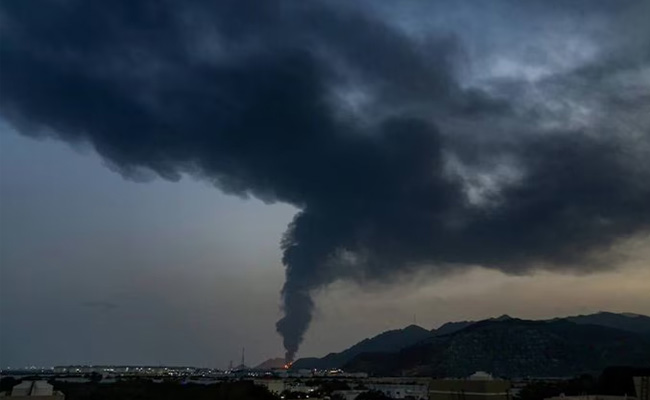
New Delhi (PTI): India on Tuesday described the wounding of three Indians in an attack on the United Arab Emirates' port city of Fujairah as "unacceptable" and pressed for an immediate cessation of hostilities targeting innocent civilians.
New Delhi's reaction came a day after the Indians were injured after a drone attack caused a fire at a major oil industry zone in Fujairah. The UAE had accused Iran of carrying out the strike.
"The attack on Fujairah that resulted in injury to three Indian nationals is unacceptable," External Affairs Ministry spokesperson Randhir Jaiswal said.
"We call for immediate cessation of these hostilities and the targeting of civilian infrastructure and innocent civilians," the spokesperson said.
Jaiswal said India continued to stand for dialogue and diplomacy to deal with the situation so that peace and stability could be restored across West Asia.
"We also call for free and unimpeded navigation and commerce through the Strait of Hormuz in keeping with international law. India stands ready to support all efforts for a peaceful resolution of issues," he said.
The attack on Fujairah city came as the ceasefire between the US and Iran came under strain in the Strait of Hormuz.
The Strait of Hormuz, through which roughly one-fifth of the world's oil and gas pass, remains a major sticking point in the talks. Shipping through the narrow Gulf waterway has been severely disrupted by the conflict, triggering a sharp increase in oil prices and energy shortages in several countries.
The UAE's defence ministry on Monday said its air defence systems engaged 12 ballistic missiles, three cruise missiles and four drones launched from Iran.
The ministry affirmed that it "remains fully prepared and ready to deal with any threats and will firmly confront anything that aims to undermine the security of the country."