164 people killed in one week in Kazakhstan Protests against fuel hikes: Reports
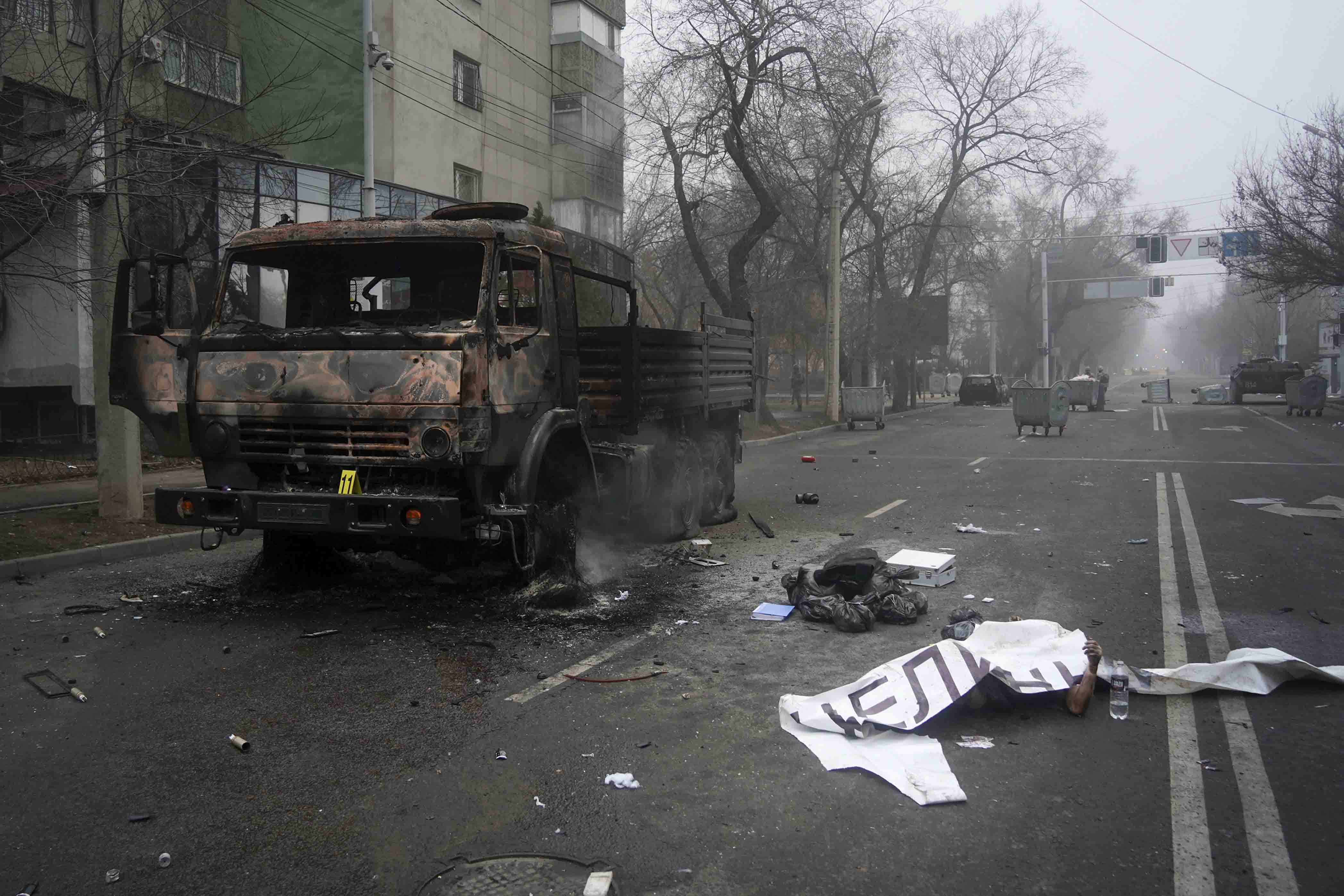
Moscow, Jan 9: Kazakhstan's health ministry said Sunday that 164 people have been killed in protests that have rocked the country over the past week.
The figures reported on the state news channel Khabar-24 are a significant rise from previous tallies. It is not clear if the deaths refer only to civilians or if law-enforcement deaths are included. Kazakh authorities said earlier Sunday that 16 police or national guard had been killed. Authorities previously gave the civilian death toll as 26.
Most of the deaths 103 were in Almaty, the country's largest city, where demonstrators seized government buildings and set some afire, according to the ministry. the country's ombudswoman for children's rights said that three of those killed were minors, including a 4-year-old girl.
The ministry earlier reported more than 2,200 people sought treatment for injuries from the protests, and the Interior Ministry said about 1,300 security officers were injured.
The office of Kazakhstan's president said that about 5,800 people were detained by police during the protests that developed into violence last week and prompted a Russia-led military alliance to send troops to the country.
President Kassym-Jomart Tokayev's office said Sunday that order has stabilized in the country and that authorities have regained control of administrative buildings that were occupied by protesters, some of which were set on fire.
The Russian TV station Mir-24 said sporadic gunfire was heard in Almaty on Sunday but it was unclear whether they were warning shots by law enforcement. Tokayev on Friday said he had authorized police and the military to shoot to kill to restore order.
Almaty's airport, which had been taken by protesters last week, remained closed but was expected to resume operating on Monday.
Protests over a sharp rise in prices of LPG fuel began in the country's west on Jan. 2 and spread throughout the country, apparently reflecting discontent extending beyond the fuel prices.
The same party has ruled Kazakhstan since independence from the Soviet Union in 1991. Any figures aspiring to oppose the government have either been repressed, sidelined, or co-opted and financial hardship is widespread despite Kazakhstan's enormous reserves of oil, natural gas, uranium and minerals.
Tokayev contends the demonstrations were ignited by terrorists with foreign backing, although the protests have shown no obvious leaders or organization. The statement from his office on Sunday said the detentions included a sizable number of foreign nationals, but gave no details.
It was unclear how many of those detained remained in custody on Sunday.
The former head of Kazakhstan's counterintelligence and anti-terror agency has been arrested on charges of attempted government overthrow. The arrest of Karim Masimov, which was announced Saturday, came just days after he was removed as head of the National Security Committee by Tokayev.
No details were given about what Masimov was alleged to have done that would constitute an attempted government overthrow. The National Security Committee, a successor to the Soviet-era KGB, is responsible for counterintelligence, the border guards service and anti-terror activities.
Authorities say security forces killed 26 demonstrators in this week's unrest and that 16 law-enforcement officers died.
At Tokayev's request, the Collective Security Treaty Organization, a Russia-led military alliance of six former Soviet states, authorized sending about 2,500 mostly Russian troops to Kazakhstan as peacekeepers.
Some of the force is guarding government facilities in the capital, Nur-Sultan, which made it possible to release part of the forces of Kazakhstani law enforcement agencies and redeploy them to Almaty to participate in the counter-terrorist operation, according to a statement from Tokayev's office.
In a sign that the demonstrations were more deeply rooted than just the fuel price rise, many demonstrators shouted Old man out, a reference to Nursultan Nazarbayev, who was president from Kazakhstan's independence until he resigned in 2019 and anointed Tokayev as his successor.
Nazarbayev retained substantial power as head of the National Security Council. But Tokayev replaced him as council head amid this week's unrest. possibly aiming at a concession to mollify protesters. However, Nazarbayev's adviser Aido Ukibay said Sunday that it was done at Nazarbayev's initiative, according to the Kazakh news agency KazTag.
Let the Truth be known. If you read VB and like VB, please be a VB Supporter and Help us deliver the Truth to one and all.
Vartha Bharati–Sankalp predictions align closely with Karnataka bypoll results
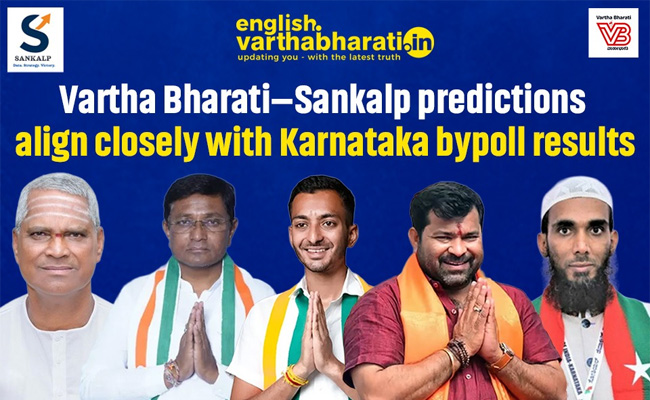
Bengaluru: The Vartha Bharati–Sankalp election analysis has shown a high level of accuracy in predicting the outcome of the recent Karnataka Assembly by-elections held in May 2026, correctly calling winners in both constituencies and closely estimating vote share trends.
The by-elections were held in Bagalkot and Davanagere South, drawing significant political attention as both seats were seen as key tests for the ruling Congress and opposition BJP.
According to the analysis, Vartha Bharati–Sankalp had made three major projections ahead of the results the winning party, vote share percentages, and margin of victory.
In both constituencies, the platform accurately predicted that the Congress would emerge victorious. The outcome matched the projections, with Congress candidates winning in Bagalkot and Davanagere South.
In terms of vote share, the predictions were largely in line with the final results. In Bagalkot, the BJP’s vote share was forecast in the range of 40 to 46 per cent, while the actual figure stood at 42.9 per cent. The Congress vote share, however, exceeded expectations, with the party securing 55.4 per cent against a projected range of 43 to 48 per cent.
The margin of victory in Bagalkot turned out to be significantly higher than anticipated. While the projection had placed the margin between 2,000 and 3,500 votes, the final margin was around 22,332 votes.
In Davanagere South, the predictions also remained largely accurate. The Congress vote share was projected between 43 and 51 per cent, and the final figure stood at 43.9 per cent. The BJP was expected to secure between 42 and 50 per cent but ended with 40.3 per cent.
The analysis had also identified the role of SDPI as a potential spoiler in the constituency. While its vote share was estimated around 6 per cent, the party eventually secured around 12 per cent of the vote.
The margin of victory in Davanagere South was predicted to be between 1,500 and 2,600 votes. The actual margin was higher at around 5,708 votes, though the contest remained relatively close as anticipated.
Overall, the performance of Vartha Bharati–Sankalp stood out for correctly identifying the winning parties in both seats and maintaining close accuracy in vote share estimates, with only limited deviations in specific cases.